
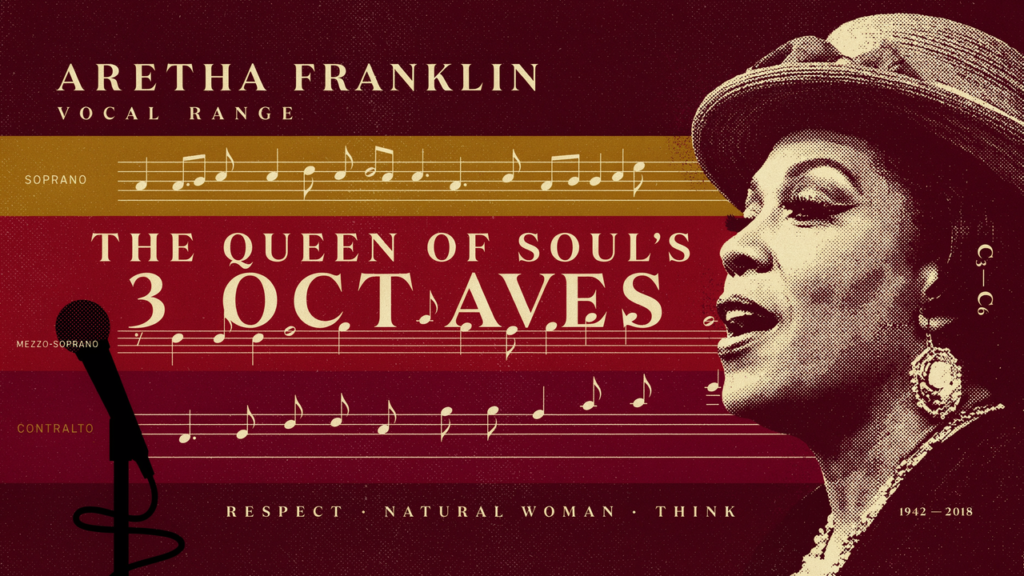
Aretha Franklin’s vocal range is widely estimated at around three octaves, anchored by a mezzo-soprano tessitura with remarkable command of chest voice, mix, head voice, and expressive register shifts. There is no officially verified clinical measurement of her exact highest and lowest notes. What is beyond dispute—across decades of studio recordings and live performances—is her extraordinary functional range, dynamic power, agility, and emotional authority, forged in the gospel tradition and refined across soul, jazz, pop, and R&B.
For artists rooted in gospel and soul, vocal ability is demonstrated in performance, not in lab-style assessments. In Aretha Franklin’s case:
- Improvisation expands perceived pitch limits
- Live performances reveal abilities beyond studio takes
- Classical fach labels only partially apply
- Gospel technique emphasizes expression over linear scale display
Because of this, any precise note lists you see online should be treated as informed estimates, not facts.
You can test your voice by clicking here.
Vocal range vs tessitura: the distinction that explains everything
Two terms are often confused:
- Vocal range: the total span of notes a singer can produce
- Tessitura: where the voice sits comfortably and repeatedly
For great singers, tessitura matters more than extremes. Aretha Franklin’s tessitura sits mid-to-upper female, which explains why she could sing high with power and return instantly to a grounded, resonant middle.
Aretha Franklin’s tessitura and voice type
Across gospel recordings, soul hits, and live improvisations, Aretha Franklin consistently sang:
- In a mid-to-upper female tessitura
- With tremendous strength in the middle register
- With free, confident access to higher notes when emotionally driven
This supports classifying her as a mezzo-soprano—often described as mezzo with contralto depth. True contraltos are rare; Aretha’s ability to soar and ring in the upper register places her squarely in mezzo territory.
Why her voice sounded both deep and soaring
Her combination of:
- A strong, grounded chest voice
- Seamless mix
- Ringing head voice
created the illusion of multiple voice types in one instrument.
How Aretha Franklin used vocal registers
What made Aretha extraordinary wasn’t just how high or low she could sing—it was how fluidly she moved between registers.
Chest voice
- Exceptionally powerful and resonant
- Agile rather than heavy
- Central to her authority and emotional weight
Few singers have ever had such a flexible, commanding chest register.
Mixed voice
- Seamless and explosive when needed
- Allowed her to drive climaxes without strain
- Central to gospel shouts and soul peaks
Her mix is one reason her voice cut through full bands and choirs.
Head voice
- Clear, ringing, and controlled
- Used musically, not theatrically
- Integrated smoothly with mix
She could lift phrases into head voice without losing intensity.
Falsetto and stylistic shifts
- Used sparingly
- Often as a color in gospel improvisation
- Never relied on as a crutch
Her register choices always served expression.
Gospel roots: the foundation of her range
Aretha Franklin grew up in the church, and gospel singing shaped her voice in critical ways:
- Call-and-response phrasing
- Improvisation across registers
- Dynamic swells and releases
- Emotional authenticity over perfection
Gospel singers often display greater functional range than studio recordings suggest because the style demands constant register movement.
Estimated vocal range (with necessary caveats)
Commonly cited estimates suggest:
- Lower notes: approximately G2–A2
- Upper notes: approximately C6–D6 (often in head voice during live improvisation)
This indicates a span of around three octaves, possibly more depending on classification and context.
Why estimates vary:
- Live improvisation extends perceived range
- Studio recordings don’t capture extremes
- Analysts differ on counting brief high notes
What matters most is that Aretha used this range consistently and musically, not as isolated stunts.
Why Aretha Franklin’s range mattered musically
Range alone does not make a singer legendary. Aretha Franklin’s range mattered because it was:
- Usable across styles
- Expressive rather than decorative
- Powerful without losing control
- Flexible in dynamics and tone
Her voice could whisper intimacy, then erupt into commanding climaxes—sometimes within a single phrase.
Common myths about Aretha Franklin’s voice
Myth: “Aretha Franklin was a contralto.”
Reality: Contralto is rare; mezzo-soprano with depth is more accurate.
Myth: “She was powerful but not agile.”
Reality: Her agility is evident in gospel runs and improvisation.
Myth: “She just sang loudly.”
Reality: Her dynamic control was extraordinary.
Myth: “Range alone made her great.”
Reality: Musical intelligence and emotional truth were equally vital.
Aretha Franklin compared to other legendary singers
Compared to artists like:
- Whitney Houston: lighter timbre, more pop-oriented phrasing
- Nina Simone: darker timbre, narrower tessitura, different emotional palette
- Beyoncé: broader stylistic versatility with modern production
Aretha Franklin stands apart for raw emotional authority combined with technical command.
What singers can learn from Aretha Franklin
From a vocal pedagogy and artistry standpoint, Aretha Franklin demonstrates that:
- Mastery of the middle register builds real power
- Seamless register transitions protect longevity
- Emotion and technique must work together
- Functional range beats theoretical extremes
For singers studying vocal range, her career offers a clear lesson:
range matters most when it serves expression.
Why “Aretha Franklin vocal range” remains a popular search
People continue to search this because:
- Her voice feels unmatched even decades later
- Singers want a technical explanation for her power
- Her sound defies simple classification
The answer isn’t just a number—it’s gospel roots, register mastery, and emotional truth.
Final verdict
- Aretha Franklin’s vocal range is commonly estimated at around three octaves
- There is no officially verified measurement
- She is best described as a mezzo-soprano with exceptional depth and flexibility
- Her greatness lies in functional range, dynamics, and expression
- Her legacy proves that usable range plus emotional honesty creates timeless impact
If you’re studying vocal ranges to improve your own singing, Aretha Franklin sets the gold standard:
build power in your core voice, and let range emerge naturally.
Related Articles:
- To understand her dramatic highs and lows, this artist range profile gives a clear snapshot of Aretha’s vocal span.
- Her mezzo-soprano weight makes more sense when viewed through this useful voice comparison between closely related female types.
- The way her comfortable notes sat in songs is clarified by this tessitura overview.
- Her classification fits neatly into this fach system guide that explains how voices are categorized.
- The power behind her sustained notes reflects what’s shown in this three-octave reference.
- Singers inspired by her belts can explore similar control through this vibrato technique article.
- Anyone hoping to follow a legendary path will find perspective in this singing career roadmap.

John Mayer is a vocal analysis and music education writer specializing in vocal range testing, voice type analysis, pitch recognition, and singing improvement tools for singers, musicians, performers, and beginners. He creates practical content focused on vocal training, singing techniques, and voice analysis tools to help users better understand and improve their vocal abilities.