
Testing your vocal range is not about chasing extreme notes or labeling your voice.
It’s about accurately identifying the lowest and highest notes you can sing comfortably and consistently, without strain.
Test your vocal range the right way. Learn how to find your lowest and highest notes safely, avoid strain, and get accurate results.
To test your vocal range, use a piano or try this online tool and sing from your lowest comfortable note to your highest clear note without strain. Write down both notes to determine your range in octaves and help identify your voice type.
This guide explains exactly how to test your vocal range, what counts (and what doesn’t), and how to avoid the most common mistakes that lead to inaccurate results or vocal damage.
What Is Vocal Range?
Vocal range is the span of musical notes from the lowest comfortable note to the highest comfortable note a person can sing reliably and without tension.
A note does not count if it:
- Hurts
- Feels forced
- Only works once
- Requires shouting or squeezing
For foundational context, see what is vocal range.
Why Testing Your Vocal Range Matters
Testing your vocal range correctly helps you:
- Choose songs that fit your voice
- Avoid vocal strain and overuse
- Track progress objectively
- Prevent misclassification of your voice
- Train more efficiently
Importantly, vocal range is not the same as voice type, and confusing the two leads to poor training decisions.
How to Test Your Vocal Range Step by Step
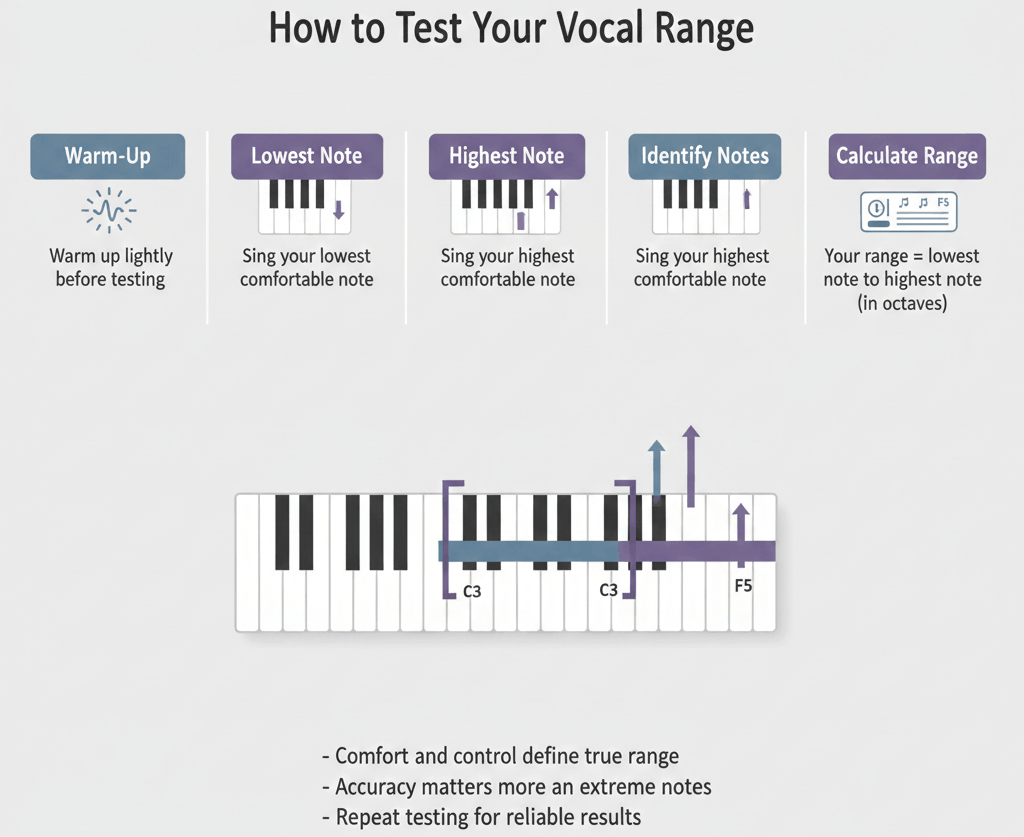
Step 1: Warm Up First (Non-Negotiable)
A cold voice gives smaller, inaccurate results and increases injury risk.
Before testing:
- Do gentle humming
- Lip trills
- Easy scales in a comfortable pitch
Use a short routine from vocal warm-up exercises.
Step 2: Find Your Lowest Comfortable Note
- Start on a relaxed mid-range note
- Move down one note at a time
- Stop when the sound becomes:
- Breathy
- Unstable
- Uncomfortable
Your lowest note is the last pitch that feels easy and repeatable.
Step 3: Find Your Highest Comfortable Note
- Return to a comfortable pitch
- Move up gradually, one note at a time
- Stop before you feel throat tension or the urge to push
High notes should feel lighter, not harder.
Understanding why this matters is explained in how vocal cords work.
Step 4: Confirm Consistency (Most People Skip This)
- Repeat both notes 2–3 times
- If a note only works once, exclude it
- Re-test on a different day for accuracy
Consistency matters more than extremes.
Three Accurate Ways to Test Your Vocal Range
1) Using a Piano or Keyboard (Most Precise)
- Match pitch one note at a time
- Write down note names (example: A2–E4)
- Move slowly
2) Without Instruments
- Use a tuner app for reference pitches
- Avoid jumping intervals
- Retest to confirm consistency
3) Using an Online Vocal Range Tool
- Useful for beginners
- Helps track progress visually
- Best used after warming up
You can try a simple online tool via the homepage.
Common Mistakes That Invalidate Vocal Range Tests
| Mistake | Why It’s Incorrect |
|---|---|
| Counting strained notes | Overestimates real range |
| Skipping warm-ups | Shrinks usable range |
| Testing while tired | Produces false lows/highs |
| Shouting for high notes | Measures force, not range |
| Confusing range with voice type | Leads to misclassification |
For reference ranges, see vocal range chart.
Vocal Range vs Voice Type
Your vocal range does not automatically determine whether you are a soprano, alto, tenor, or bass.
Voice type depends on:
- Comfortable tessitura
- Tone quality
- Register balance
- Long-term vocal behavior
Learn proper classification at voice types.
What to Do After You Find Your Vocal Range
Once you know your range:
- Choose songs that stay mostly within it
- Train control before expanding range
- Retest every 4–8 weeks, not daily
If your goal is expansion, follow how to increase vocal range safely and protect your voice using vocal health tips.
How to test your vocal range accurately:
- Warm up gently
- Find lowest comfortable note
- Find highest comfortable note
- Confirm consistency
- Retest on another day
Frequently Asked Questions
1. Do I need a piano to test my vocal range?
No. A piano is helpful, but tuner apps and online tools work well if used carefully.
2. What notes should I count?
Only notes that are comfortable, repeatable, and pain-free.
3. How often should I test my vocal range?
Every 4–8 weeks. Vocal range fluctuates daily.
4. Can my vocal range change over time?
Yes. Training, health, rest, and age all influence range.
5. Is vocal range the same as tessitura?
No. Tessitura is where your voice feels best most of the time.
6. What is a normal vocal range?
Most untrained singers have about 1.5–2 octaves of comfortable range.
7. Should testing my range ever hurt?
Never. Pain means stop immediately.
Related Articles:
- To avoid mislabeling your voice, it helps to validate results with a voice type classifier after testing.
- Preparing your voice properly is easier when you follow a guided warm-up routine before checking extremes.
- If lower notes feel unclear, confirming them with a deep voice test can improve accuracy.
- Putting your results in context becomes simpler when you explore a common three-octave range as a reference point.
- Some beginners overestimate their span, which is why reviewing a four-octave comparison helps set realistic expectations.
- For perspective beyond solo testing, many singers use a singer comparison tool to benchmark their range safely.