
Chester Bennington’s voice is one of the most recognizable in modern rock because it combined high, emotional clean singing with aggressive distortion and screaming — often in the same phrase. People love debating his vocal range, but the most useful question isn’t “what’s the highest note?” It’s: what could he do consistently, and how did he do it?
A singer’s vocal range is the span from their lowest usable note to their highest usable note, usually written in scientific pitch notation (like A2–C5). For Chester Bennington, range discussions should be separated into clean singing range and distorted/screamed range, because vocal effects can change the perceived pitch without reflecting true tessitura.
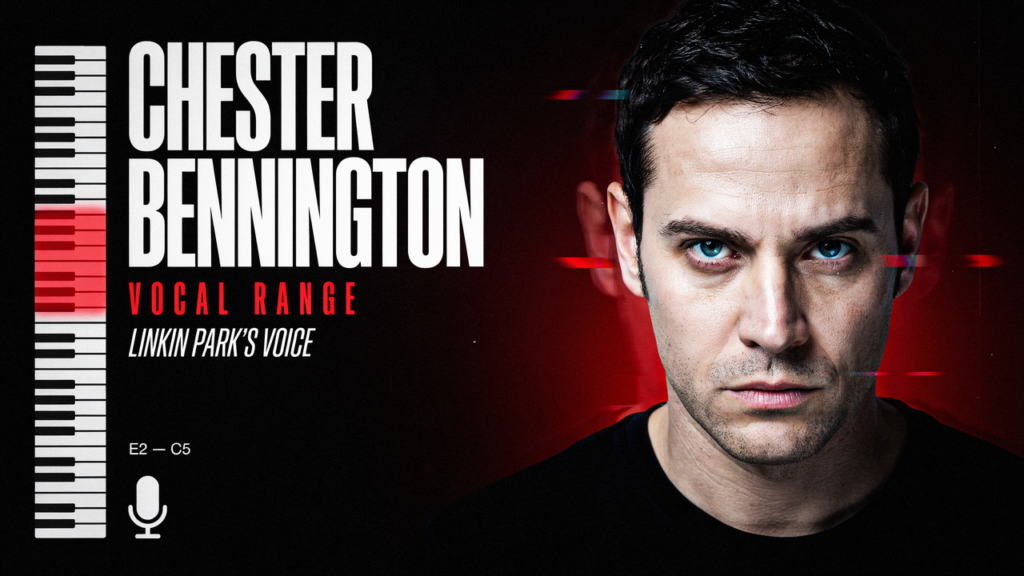
Chester Bennington’s Vocal Range: The Coach’s View
Chester’s voice is often described as a high male voice, usually classified as a tenor in a practical, contemporary sense. He regularly sang in keys that sit high for many male singers, and he had strong coordination in his upper range.
That said, most online range numbers vary because people measure different things:
- studio vs live
- clean notes vs distorted notes
- falsetto vs full voice
- one-time extremes vs repeatable notes
If you want a clean baseline for how range works, read what vocal range means first, because it’ll prevent most of the common misunderstandings.
Clean Range vs Distortion Range (This Is the Big One)
This is where almost all arguments come from.
Clean range
This is the range Chester could sing with:
- stable pitch
- clear tone
- repeatability
Even when intense, the voice still sounds like a voice.
Distortion/screamed range
This is where Chester used:
- grit
- rasp
- scream textures
These effects can make notes feel higher or more extreme, but they don’t always reflect a bigger “true singing range.”
A good way to think about it:
- Clean range is like a clean guitar tone.
- Distortion range is like adding an amp effect.
It’s powerful, but it’s not the same measurement.
The vibrato analysis tool helps you see whether your vibrato is steady.
Was Chester Bennington a Tenor or Baritone?
In real-world coaching terms, Chester is best described as a rock tenor.
That doesn’t mean he sang like an opera tenor. It means:
- his comfortable working area sat higher than average
- he could sustain intensity above the first passaggio
- his voice stayed bright and focused in the upper mix
If you want a reference point, compare his likely profile to the typical tenor singing range rather than trying to force a strict classical label.
Why some people call him a baritone
Because he could sound thick and aggressive.
But tone weight isn’t the same as voice type. In rock, singers often create heaviness through:
- compression
- resonance choices
- distortion layers
A tenor can sound “heavy” if they’re using the right coordination.
The practical truth
Chester’s voice lived high. That’s the part that matters for singers trying to learn from him.
What Made Chester’s High Notes So Effective?
Chester didn’t just “sing high.” He sang high with:
- urgency
- clarity
- pitch center
- emotional intensity
Here are the main traits that made his high singing work:
- Strong upper mix (not just falsetto)
- Bright resonance (forward placement)
- Compression (efficient closure, not breathy)
- Twang/edge (helps notes cut without yelling)
- Smart vowel shaping (subtle, but huge)
If you’re working on this skill set, you’ll progress faster if you build your pitch control first using how to improve pitch accuracy as a foundation.
The Most Useful Way to Think About Chester’s Range
Instead of obsessing over the highest note, focus on three ranges:
1) Comfort range
Where you can sing any day without warming up much.
2) Performance range
Where you can sing reliably under stress (recording, stage, long sessions).
3) Absolute range
The extreme notes you can hit once in a while.
A lot of celebrity range claims are based on absolute range. Chester’s real magic was his performance range — he could do intense high singing repeatedly.
If you want a reality check, compare to average male vocal range so you understand why his voice felt so exceptional.
A Simple Range Framework (With One Helpful Table)
This isn’t meant to “prove” an exact number. It’s meant to help you understand what you’re hearing.
| Category | What it means | What it sounds like |
|---|---|---|
| Low usable notes | Repeatable lows with tone | steady, not gravelly |
| Midrange work zone | Where most songs live | full, stable, clear |
| High clean notes | Upper mix/head coordination | ringing, intense, pitched |
| High distorted notes | Effects layered over pitch | rasp/grit/scream texture |
This framework keeps your thinking accurate: range is more than “highest scream.”
Step-by-Step: How to Test Your Range Like a Singer (Not a Fan)
If you want to compare yourself to Chester, you need a consistent method. Here’s a safe one.
Step 1: Warm up first
Do not test range cold. A cold range test encourages strain.
Use a short warmup or a tool-based routine like the vocal warm-up generator for 3–5 minutes.
Step 2: Find your lowest usable note
Your low note counts if it’s:
- steady
- not whispered
- not forced down
If you feel your throat pushing downward, stop.
Step 3: Move upward with a gentle slide
Use lip trills or “ng.” Your goal is smooth coordination, not volume.
Step 4: Mark your first strain point
This is the note where you notice:
- neck tightening
- jaw clenching
- breath pressure spiking
That’s your current limit.
Step 5: Find your highest clean note
A note only counts if you can:
- hit it 2–3 times
- keep pitch stable
- avoid pain
If it’s a one-time “survival squeak,” don’t log it.
Step 6: Write it down as notes
If you don’t know your note names, use a pitch tool like the pitch detector to label them.
How Chester Sang Intense High Notes Without “Just Yelling”
This is the part singers actually want.
Chester’s intensity came from efficient coordination, not brute force. The sound is loud, but the mechanism is not necessarily heavy.
The “laser beam” mix
A good mixed voice feels like a focused beam. Not wide. Not shoved.
If you imagine:
- a flashlight = breathy singing
- a floodlight = yelling
Then Chester’s mix is closer to a laser pointer: concentrated energy.
Twang for cut (without strain)
Twang is a resonance strategy. It helps you be heard without pushing.
A simple test:
- Say “HEY!” like calling a friend across the street.
- That brightness is closer to twang than nasal squeezing.
Compression without choking
Compression means the vocal folds come together efficiently.
You want:
- clean closure
Not: - throat squeeze
If you’re unsure, start by improving pitch stability using a tool like the pitch accuracy test because unstable pitch often causes singers to over-press.
The Truth About Chester’s Screaming (And Safety)
Chester’s scream textures are part of why his voice sounded huge. But here’s the coaching truth:
Screaming is not required to sing high.
And screaming is not a shortcut to range.
Distortion should never feel like:
- sharp pain
- burning
- loss of voice afterward
- persistent scratchiness the next day
If you’re trying to learn this style, start with clean coordination first. Your clean high notes are your “skeleton.” Distortion is a costume you add later.
If you want a clean range baseline before experimenting with effects, measure yourself using the vocal range calculator.
Common Mistakes When Trying to Copy Chester Bennington
1) Pushing volume to reach notes
High notes do not require more air. They require better coordination.
If you push, your throat tightens and the pitch often goes flat.
2) Trying to “scream high” instead of sing high
Distortion can hide pitch problems. That’s why it feels easier.
But if the clean note isn’t there, the scream will eventually become unstable and risky.
3) Locking the jaw
Chester’s diction was intense, but his jaw wasn’t locked.
A tight jaw = tight tongue = tight larynx.
4) Over-darkening the voice
Some singers try to sound “heavier” by lowering the larynx.
That often kills the upper mix and makes the voice fatigue faster.
5) Skipping the midrange
Most high-note problems are actually midrange problems.
If your middle notes aren’t stable, your high notes will feel like a cliff.
Quick Self-Check (60 Seconds)
Use this to see if your high notes are real or forced.
- Can you sing your highest note three times with the same quality?
- Does your neck stay relaxed while you do it?
- Can you sing one note below it with the same vowel and ease?
- Does your voice feel normal 10 minutes later?
If the answer is “no,” you found an absolute note — not a performance note.
What You Can Learn From Chester (Even If Your Voice Is Different)
You don’t need Chester’s exact range to learn from his skill set.
Here’s what you can train:
- consistent upper mix
- intensity without yelling
- emotional delivery with pitch stability
- stamina across repeated high phrases
And if you want a clean map of your voice type and range direction, the voice type classifier can help you start making smarter practice choices.
FAQs
1) What was Chester Bennington’s vocal range?
Most estimates place Chester as a high male singer with a range typical of a rock tenor. Exact numbers vary because different sources include different notes (clean vs distortion, studio vs live). The most useful takeaway is that he had a strong, repeatable upper performance range.
2) Was Chester Bennington a tenor?
In practical coaching terms, yes — Chester is best described as a tenor-leaning rock vocalist. He consistently sang in a higher tessitura than many male singers and had strong upper mix coordination. His aggressive tone can make him sound heavier than a typical “light tenor,” but the working range still points upward.
3) What was Chester Bennington’s highest note?
Different lists give different answers depending on whether they count clean notes, falsetto, or distorted effects. A “highest note” is only meaningful if it’s repeatable and clearly pitched. For training purposes, it’s better to focus on the highest clean note you can sing consistently.
4) Does screaming count as part of vocal range?
Not in the same way clean singing does. Distortion and screaming can change how pitch is perceived and can mask unstable technique. A smarter approach is to separate clean range from effects range so your measurements stay honest.
5) How did Chester sing so high without sounding weak?
He used a strong mixed voice, bright resonance, and efficient compression. That combination lets you sing high with intensity without simply pushing more air. Think “focused beam,” not “shout.”
6) Can I learn to sing like Chester Bennington safely?
You can train many of the same skills — upper mix, stamina, and controlled grit — but you must build clean coordination first. If you jump straight into screaming, you risk strain and inflammation. If your voice feels scratchy or tired afterward, back off and reset.
7) What’s the best first step if I want Chester’s high notes?
Start by stabilizing your pitch and strengthening your midrange. Most high-note problems come from a shaky middle, not the top. Once your midrange is consistent, your upper mix becomes much easier to build safely.

John Mayer is a vocal analysis and music education writer specializing in vocal range testing, voice type analysis, pitch recognition, and singing improvement tools for singers, musicians, performers, and beginners. He creates practical content focused on vocal training, singing techniques, and voice analysis tools to help users better understand and improve their vocal abilities.