
Chris Cornell’s voice is one of those rare rock instruments that sounded dark, heavy, and gritty, yet could soar into tenor-level high notes with power. That combination is exactly why people still debate his vocal range — and why singers keep trying to copy his sound.
But here’s the coaching truth: Cornell’s range is impressive, yes… but his real superpower was how he used his range.
A singer’s vocal range is the span from their lowest usable note to their highest usable note, usually written in scientific pitch notation (like A2–C5). With Chris Cornell, it’s important to separate his clean singing range from his distorted/gritty range, because distortion can change the perceived pitch without reflecting true tessitura.
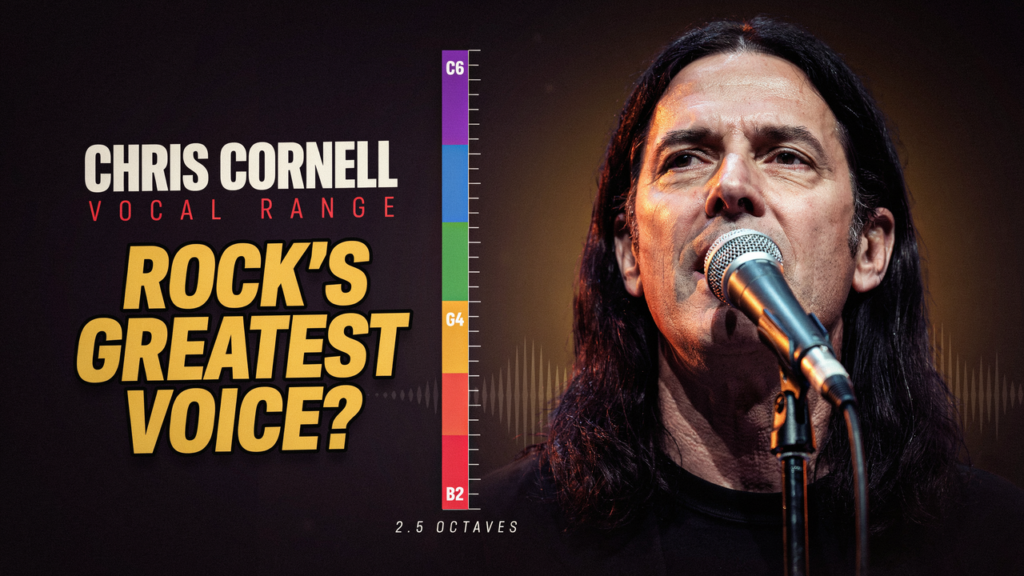
Chris Cornell’s Vocal Range: The Most Useful Way to Understand It
Most public range estimates for Cornell vary, and that’s normal. Why? Because people measure different things:
- studio vs live
- clean voice vs grit
- falsetto vs full voice
- repeatable notes vs one-time extremes
Instead of chasing the “perfect number,” the smarter approach is to understand Cornell’s voice as two connected skills:
- a high working range (tenor-leaning)
- a heavy tone (baritone-colored)
If you want a clean baseline before comparing any singer, start with what vocal range means so you’re measuring the same thing consistently.
Clean Range vs Grit Range (Why Cornell Confuses Everyone)
Cornell is a perfect example of why rock vocal range gets misunderstood.
Clean range
This is where Cornell sang with:
- stable pitch
- clear vowel shape
- consistent tone
Even if it was intense, it still sounded like “singing.”
Grit/distorted range
This is where Cornell added:
- rasp
- distortion
- scream-like textures
These can make notes sound bigger, higher, and more extreme.
A simple analogy:
- Clean singing is like a clear photo.
- Distortion is like adding a dramatic filter.
The image feels more intense, but it’s not “more pixels.”
Use the vibrato analyzer to measure vibrato speed and consistency.
Was Chris Cornell a Tenor, Baritone, or Baritenor?
If you ask ten singers, you’ll get ten arguments. Let’s keep it practical.
Cornell is best described as a tenor-leaning voice with a dark timbre. Many coaches call this a “baritenor” in modern terms — not as a strict classical label, but as a useful description.
Why he sounded like a baritone
Cornell often used:
- a darker vowel shape
- heavier compression
- thick resonance
So his tone could feel baritone-like even when the pitch was high.
Why he functioned like a tenor
Cornell could sustain:
- high belts
- high mixed notes
- intense upper phrases
for long sections of songs.
That’s a tenor behavior.
If you want to compare the range expectations, it helps to know the typical tenor range and also the baritone vocal range reference so you’re not guessing.
The Part People Miss: Cornell’s Tessitura Was High
A singer’s tessitura is where their voice sits most comfortably and consistently.
Cornell didn’t just hit high notes once. He often lived in a high area for entire verses and choruses. That’s one reason his voice feels athletic.
If you’re not sure what tessitura means (and why it matters more than the “highest note”), read what tessitura is before you try to label your own voice type.
What Made Chris Cornell’s High Notes So Powerful?
Cornell’s high notes didn’t sound like thin “head voice.” They sounded like a full-bodied shout — but controlled.
Here are the key ingredients that made his upper range work:
- Strong upper mix (not pure falsetto)
- Twang/edge (helps the note cut without yelling)
- Efficient compression (closure without choking)
- Smart vowel narrowing (especially above the passaggio)
- Intensity from resonance, not breath pressure
This matters because most singers try to get Cornell’s sound by pushing more air. That’s the exact wrong direction.
A Simple Table: What Cornell’s Range “Feels Like” in Practice
This table helps singers understand the functional zones of a voice like Cornell’s.
| Range zone | What it feels like | What it usually sounds like |
|---|---|---|
| Low usable notes | grounded, speech-like | dark, steady tone |
| Midrange power zone | easy intensity | full, loud, clear |
| Upper mix/belt zone | focused, narrow | ringing, aggressive |
| Falsetto/head zone | lighter, floaty | airy or pure tone |
| Distortion overlay | gritty, compressed | rasp, growl, scream color |
This is the key coaching idea: Cornell’s voice wasn’t “high because of grit.” His voice was high because of coordination — grit was a layer.
Step-by-Step: How to Measure Your Range Like a Singer (Safely)
If you want to compare your voice to Cornell’s, you need a consistent method. Here’s the safest and most useful approach.
Step 1: Warm up first
Never test range cold. Cold range tests create fake “limits” and encourage strain.
A short routine from the vocal warm-up generator is enough to prepare the voice.
Step 2: Find your lowest usable note
Your lowest note counts only if it’s:
- stable
- not whispered
- not forced downward
If your throat feels like it’s pressing down, stop.
Step 3: Slide upward gently
Use lip trills, “ng,” or a soft “gee.” Your goal is smooth coordination, not volume.
Step 4: Mark your first strain note
The first strain note is where you feel:
- neck tightening
- jaw clenching
- breath pressure spiking
That note is a training boundary.
Step 5: Find your highest clean note
A note counts if you can:
- sing it 2–3 times
- keep pitch stable
- avoid pain
If it only happens once in panic mode, don’t log it.
Step 6: Label your notes accurately
If you don’t know your note names, use the pitch detector so you’re not guessing.
How to Train Toward Cornell-Style High Power (Without Destroying Your Voice)
This is the part most singers actually need.
Cornell’s sound is built on intensity without yelling. That means you need coordination first, then volume.
The most reliable training order (numbered list)
- Build stable pitch in your midrange
- Strengthen your mix without forcing volume
- Add twang to increase cut and brightness
- Practice vowel narrowing on higher notes
- Add intensity gradually, not all at once
- Only then experiment with grit (lightly)
If you want the safest starting point, the principles in how to sing high notes match Cornell-style rock singing better than most “just push harder” advice.
The Big Misconception: “Cornell Just Shouted”
Cornell sounded like he was shouting because the emotion was huge.
But shouting has a very specific feeling:
- throat tightens
- pitch gets unstable
- you get hoarse afterward
Cornell’s singing, at its best, was:
- focused
- pitched
- repeatable
A good analogy:
Shouting is like trying to break a door down.
Cornell’s singing is like using a key — still powerful, but efficient.
Common Mistakes When Trying to Sing Like Chris Cornell
1) Pushing breath to create power
More air does not equal more power. It often equals:
- strain
- flat pitch
- vocal fatigue
Power comes from resonance and closure, not breath blasting.
2) Adding grit before you can sing clean
Grit is not a substitute for technique.
If you can’t sing the phrase cleanly, adding distortion just hides problems until they get worse.
3) Keeping vowels too wide on high notes
Wide vowels (like “AH”) get harder as you go higher.
Cornell often narrowed vowels subtly. That keeps the voice focused.
4) Confusing dark tone with low voice type
A dark timbre can happen in any voice type.
Cornell sounded dark, but functionally his voice behaved higher than many male singers.
5) Practicing at full intensity every time
Cornell’s style is intense, but training shouldn’t be.
If your voice feels scratchy, hoarse, or swollen afterward, you practiced too hard.
Quick Self-Check (60 Seconds)
Use this to check whether your “high notes” are real or forced.
- Can you sing your highest note three times with the same quality?
- Does your neck stay relaxed while you do it?
- Can you sing one note below it with the same vowel and ease?
- Does your voice feel normal 10 minutes later?
If not, you found an absolute note — not a usable performance note.
If you want to track your real range over time, measure it consistently with the vocal range calculator.
What You Can Learn From Cornell (Even If Your Voice Is Totally Different)
You don’t need Cornell’s exact range to learn from his method.
His biggest lessons for singers are:
- intensity comes from coordination, not force
- high notes need focus, not volume
- grit is a layer, not the foundation
- dark tone doesn’t automatically mean baritone
And if you’re still unsure where your voice sits, a starting point like the voice type classifier can help you get direction — as long as you treat it as a guide, not a permanent label.
FAQs
1) What was Chris Cornell’s vocal range?
Cornell is widely described as having a wide rock range, combining strong lows with tenor-level high notes. Exact note-to-note numbers vary because different sources include different kinds of sounds (clean, falsetto, grit). The most important takeaway is his high tessitura and powerful upper mix.
2) Was Chris Cornell a tenor or baritone?
In practical singing terms, Cornell behaved like a tenor-leaning voice with a dark timbre. His tone could sound baritone-like, but his working range and tessitura sat higher than most baritones. Many modern coaches describe this as “baritenor” to capture both traits.
3) How many octaves did Chris Cornell have?
Octave claims differ depending on what counts (clean notes only vs falsetto and effects). Most rock range discussions get exaggerated because they count one-time extremes. For singers, the usable performance range matters more than the biggest number.
4) Did Chris Cornell use falsetto?
Yes, Cornell used lighter upper coordination at times, especially for color and contrast. But many of his famous high moments are not pure falsetto — they’re a strong mixed/belt coordination. That’s why they sound so full.
5) How did Cornell sing so high with a dark tone?
He combined upper mix with focused resonance and compression, while keeping vowels slightly narrowed. That allows a singer to keep weight in the sound without shouting. Dark tone is more about resonance strategy than voice type.
6) Is it safe to try Chris Cornell-style grit?
It can be safe, but only after you can sing the phrase cleanly with stability. Distortion should never feel painful or leave you hoarse the next day. If your voice gets scratchy, stop, rest, and reduce intensity.
7) What’s the best first step if I want Cornell’s high notes?
Start by stabilizing your midrange and building a reliable mix. Most high-note issues are actually midrange issues. Once your middle is steady, your upper range becomes much easier to develop without forcing.

John Mayer is a vocal analysis and music education writer specializing in vocal range testing, voice type analysis, pitch recognition, and singing improvement tools for singers, musicians, performers, and beginners. He creates practical content focused on vocal training, singing techniques, and voice analysis tools to help users better understand and improve their vocal abilities.