
Corey Taylor is one of the rare modern metal vocalists who can do all three at a high level: clean singing, gritty rock belts, and aggressive screams. That’s why people constantly search for his vocal range — and why so many singers try to copy his sound.
But here’s the coaching truth: Corey Taylor’s real advantage isn’t just how high he can go. It’s how well he manages power, stamina, and vocal effects without collapsing his technique.
A singer’s vocal range is the span from their lowest usable note to their highest usable note, usually written in scientific pitch notation (like A2–C5). With Corey Taylor, range should be measured in two parts: his clean (modal) singing range and his distorted/screamed range, because vocal effects can extend perceived pitch without reflecting true tessitura.
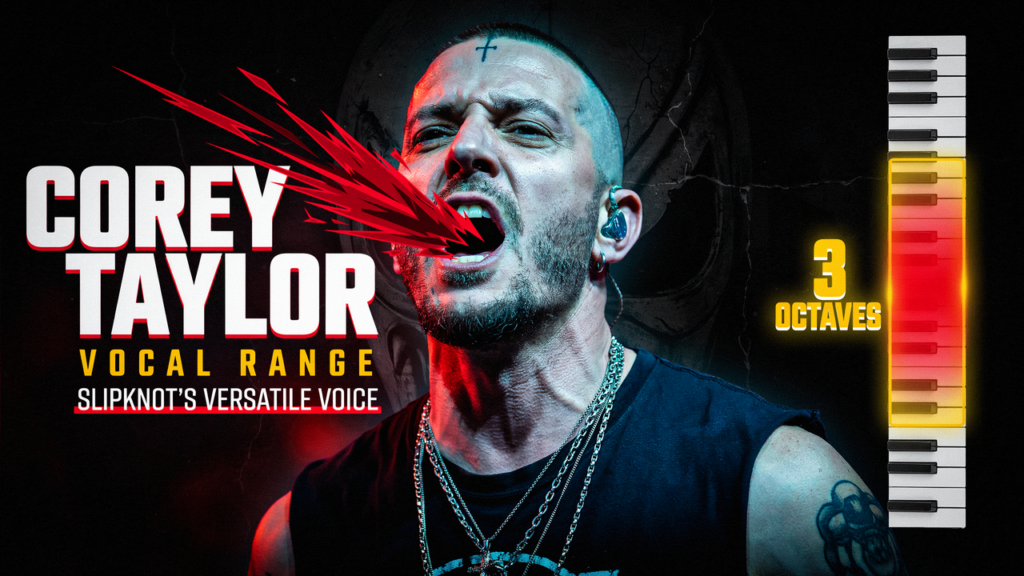
Corey Taylor’s Vocal Range: The Most Useful Way to Understand It
If you search for Corey Taylor’s vocal range, you’ll find wildly different answers. That’s normal in metal because people measure different things:
- clean vocals vs screams
- studio vs live
- falsetto vs full voice
- one-time extremes vs repeatable notes
The best way to understand Corey’s voice is to separate it into two “instruments”:
1) His clean singing range (what counts as true singing)
This is where pitch is stable and the tone is connected.
2) His effects range (distortion, grit, screams)
This is where the sound is aggressive and intense — but the pitch may not reflect normal singing coordination.
If you want a clear baseline, start with what vocal range means so you’re not mixing up range with style.
Clean Range vs Scream Range (The Most Important Distinction)
Metal singers often get misled by the idea that screaming “adds range.”
It doesn’t work that way.
Clean range
A clean note counts if it’s:
- repeatable
- stable in pitch
- not painful
- sustainable for a phrase
Scream/distortion range
A screamed note can feel higher or lower because the sound is dominated by:
- distortion noise
- resonance effects
- formant shifts
That’s why two people can argue about Corey’s “highest note” and both think they’re right.
A simple analogy:
Clean singing is a piano note.
Screaming is a guitar amp.
The guitar amp can sound huge — but it doesn’t mean the string is “higher.”
The soprano vs alto test can be helpful for beginners.
Is Corey Taylor a Baritone, Tenor, or Baritenor?
Corey Taylor is often described as a baritone because he has a heavy tone and strong low-mid presence. That’s a fair description of his color.
But functionally, he also sings higher than many typical baritones — especially in rock/metal choruses — which is why many coaches and singers call him a baritenor.
Why he sounds deep
Corey often uses:
- thicker vocal fold closure
- darker vowels
- strong low-mid resonance
Why he can still sing high
He also uses:
- mix voice coordination
- twang/edge
- compression for intensity
These allow him to sing high without turning it into a shout.
If you want clean comparison benchmarks, it helps to know both the baritone vocal range and the tenor vocal range so you’re not guessing based on tone alone.
The Real Story: Corey Taylor’s Tessitura Is Where the Power Lives
Tessitura is the part of the range where a singer spends most of their time.
Corey’s most famous clean vocals don’t live at the very top of his range. They live in a high, intense midrange — a place where many singers get tired quickly.
That’s why his singing is impressive: not because of a single high note, but because he can hold intensity for an entire chorus.
If you want to understand why this matters more than “highest note,” read what tessitura is.
A Table That Explains Corey Taylor’s Voice (Fast)
This table helps singers understand what they’re actually hearing.
| Vocal zone | What it sounds like in Corey’s style | What it requires from you |
|---|---|---|
| Low clean notes | grounded, heavy | relaxed throat + stable airflow |
| Midrange power | loud, clear, aggressive | mix coordination + resonance |
| High clean notes | focused, intense | twang + vowel shaping |
| Distortion layer | grit, rasp, bite | controlled closure + restraint |
| Full screams | extreme aggression | specialized technique + stamina |
The key takeaway: distortion is a layer. The clean coordination underneath is the foundation.
Step-by-Step: How to Measure Your Range Like a Metal Singer (Safely)
If you want to compare your voice to Corey Taylor, don’t start by screaming. Start by measuring your clean range.
Step 1: Warm up first
Never test range cold. Cold testing leads to strain and fake limits.
Use a quick routine from the vocal warm-up generator before doing anything intense.
Step 2: Find your lowest clean note
A low note counts only if it’s:
- stable
- not breathy-whispered
- not forced down
If your throat feels like it’s pressing, stop.
Step 3: Slide upward gently
Use lip trills, “ng,” or a soft “gee.” Keep volume medium.
Step 4: Find your highest repeatable clean note
A note counts if you can:
- sing it 2–3 times
- keep pitch stable
- avoid neck tension
If you can only hit it once in panic mode, it’s not usable.
Step 5: Track your falsetto separately (optional)
Falsetto can be useful in rock, but it should not be mixed into your “full voice” range.
Step 6: Label your notes accurately
If you don’t know the note names, use the pitch detector so you’re not guessing.
Step 7: Calculate your octave span
If you want the octave number, use how many octaves so your counting stays consistent.
How Corey Taylor Creates Power Without Shouting
Most singers think Corey’s sound is “just yelling with grit.”
It isn’t.
Corey’s intensity is built on coordination — and the coordination is learnable.
1) Compression (closure without choking)
Compression means the vocal folds close efficiently so the sound is strong.
Shouting is the opposite: it’s breath pressure smashing into an unstable closure.
2) Twang (edge that cuts through guitars)
Twang is not nasal whining. It’s a resonance strategy that makes the voice:
- louder without more air
- brighter without strain
- clearer in a loud band mix
3) Vowel shaping (narrower as you go higher)
Metal singers often fail because they keep vowels too wide.
Corey’s high notes often work because the vowel becomes slightly narrower and more focused.
How to Train Toward Corey Taylor’s Style (Without Blowing Out Your Voice)
This is the part that matters if you’re actually trying to sing metal.
You don’t start with screams. You earn screams.
The correct training order (numbered list)
- Build stable pitch in your midrange
- Learn to sing loudly without throat tension
- Develop a reliable mix voice
- Add twang to increase cut and volume
- Practice gritty clean singing at low volume
- Increase intensity gradually over weeks
- Only then explore scream technique (carefully)
If you skip steps, you don’t become Corey Taylor — you become hoarse.
If you’re working on upper notes, the principles in how to sing high notes safely apply perfectly to metal singing too.
One Bullet List: Signs Your Distortion Practice Is Unsafe
If you’re practicing grit or screams and any of these happen, stop:
- your voice feels scratchy afterward
- you lose your high notes for the rest of the day
- you feel pain, burning, or sharpness
- your speaking voice becomes raspy
- you need to cough to “clear” your voice
Distortion should feel like a controlled texture — not like damage.
Common Mistakes When Copying Corey Taylor
1) Using distortion to “cheat” high notes
Distortion can mask pitch problems. It doesn’t solve them.
If you can’t sing the note cleanly, you can’t safely scream it either.
2) Pushing too much air
More air pressure usually makes metal vocals worse:
- pitch gets unstable
- throat tightens
- you fatigue faster
Power comes from resonance and closure, not breath blasting.
3) Shouting instead of mixing
A shout feels like a neck workout.
Corey’s high clean singing is mix-based — focused, not forced.
4) Practicing screams at full volume
This is the fastest way to injure yourself.
Scream training should start quiet and controlled, not “stage volume.”
5) Ignoring recovery
Metal singing is athletic.
If you never rest, your voice doesn’t adapt — it breaks down.
If you want a safe baseline, keep your recovery habits aligned with vocal health tips.
Quick Self-Check (60 Seconds)
Use this quick test to see if you’re training like a singer or like a gambler.
- Can you sing your highest clean note three times without strain?
- Can you repeat a chorus twice without losing pitch?
- Does your voice feel normal 10 minutes later?
- Is your speaking voice clear afterward?
If the answer is “no,” you’re pushing too hard.
If you want a clean measurement for progress, use the vocal range calculator and test the same way every time.
The Biggest Takeaway
Corey Taylor’s voice isn’t impressive because he screams.
It’s impressive because he can:
- sing clean with power
- stay intense in a high tessitura
- add grit as a controlled layer
- perform night after night
If you want that kind of voice, train the foundation first. Then add the effects.
That’s how you build a metal voice that lasts.
FAQs
1) What is Corey Taylor’s vocal range?
Corey Taylor is widely described as having a wide range for a metal vocalist, especially when you include both clean singing and vocal effects. Exact note-to-note numbers vary depending on what sources count as “range.” For singers, the most useful measurement is his repeatable clean range plus a separate effects range.
2) Is Corey Taylor a baritone or tenor?
He’s often described as baritone because of his heavy tone and strong low-mid presence. Functionally, he also sings high enough that many singers consider him baritenor in rock terms. The best way to think of it is: baritone color, tenor-leaning behavior.
3) Does screaming count as vocal range?
Screaming can create the illusion of higher or lower notes, but it’s not the same as clean singing range. Distortion changes resonance and adds noise, which affects perceived pitch. For accurate tracking, measure clean range and effects range separately.
4) How does Corey Taylor scream without ruining his voice?
He relies on controlled closure, compression, and technique rather than pure breath pressure. Safe screaming should not feel painful and should not leave you hoarse the next day. If your voice gets scratchy, you’re doing too much.
5) What’s the safest way to learn grit like Corey Taylor?
Start with clean singing first, then add light distortion at low volume. Build control before intensity, and keep sessions short. If your speaking voice changes afterward, stop and rest.
6) Why does Corey Taylor sound so powerful even when he’s not screaming?
Because his clean singing uses strong resonance, twang, and efficient vocal fold closure. He creates “cut” without shouting, which is why his voice stays present over loud guitars. That coordination is the real engine behind his power.
7) Can beginners learn Corey Taylor songs safely?
Yes, but you should start with clean versions and avoid screaming early on. Transpose songs if needed and focus on pitch stability and mix voice. Once your clean technique is solid, you can explore distortion gradually and carefully.

John Mayer is a vocal analysis and music education writer specializing in vocal range testing, voice type analysis, pitch recognition, and singing improvement tools for singers, musicians, performers, and beginners. He creates practical content focused on vocal training, singing techniques, and voice analysis tools to help users better understand and improve their vocal abilities.