
To test your singing range accurately: warm up, use a piano or pitch app, sing downward to your lowest comfortable note, then upward to your highest clear note. Record both notes and avoid strained or breathy sounds for precise results.
Online vocal range test can work — but only when you understand what they measure, what they don’t, and how to use the results correctly. Most confusion comes not from the tool itself, but from poor testing habits and unrealistic expectations.
To analyze your vocal range, visit this site.
How Do I Find My Vocal Range Online?
To find your vocal range online, use a digital piano or pitch tuner and sing from your lowest comfortable note to your highest clear note without strain. Record both notes to calculate your full range and identify your voice type accurately.
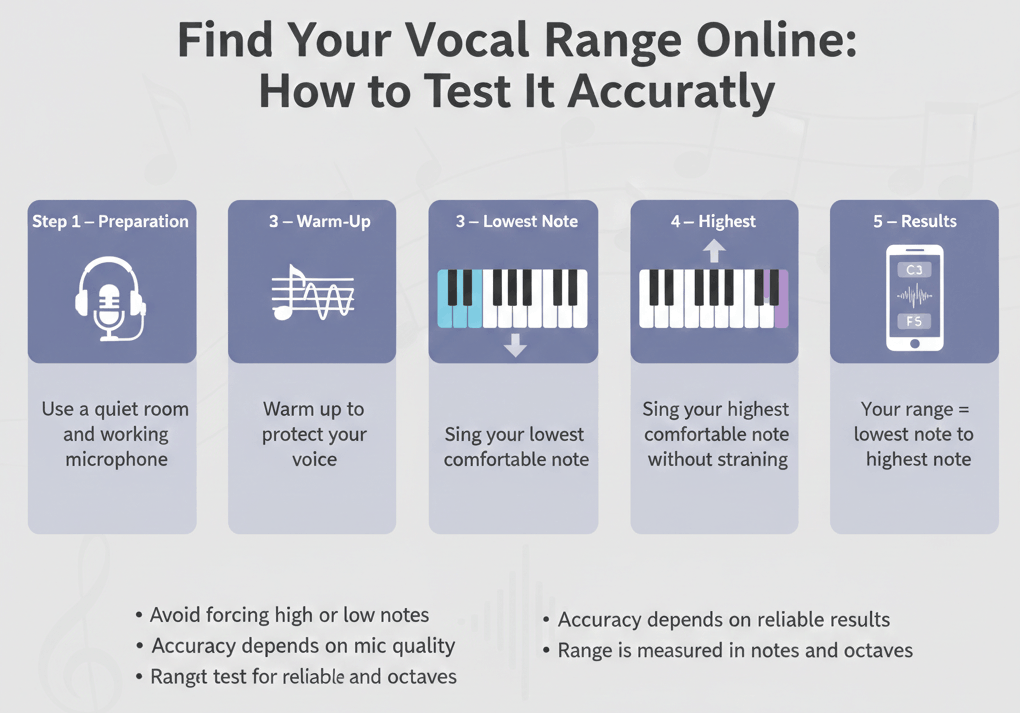
An online vocal range test measures pitch frequency — not singing skill.
Specifically, it detects:
- Your lowest repeatable note
- Your highest repeatable note
- The distance between them (range span)
The result is displayed as notes and octaves, similar to what you see in a vocal range chart.
What online tests do not measure:
- Tone quality
- Vocal health
- Tessitura (where your voice works best)
- Musical control
This distinction is essential. Many people mislabel their voice because they treat range numbers as identity.
Step-by-Step: How to Find Your Vocal Range Online Accurately
1. Warm Up Briefly
Testing a cold voice almost always produces inaccurate results. Even light humming or gentle scales improve reliability (see vocal warm-up exercises).
2. Choose a Quiet Space
Background noise interferes with pitch detection and creates false readings.
3. Start From a Comfortable Low Note
Do not use vocal fry or forced lows. If you can’t repeat the note comfortably, it doesn’t count.
4. Move Up Gradually
Slide upward in pitch without pushing. Stop when the note becomes unstable or strained.
5. Repeat Once
True range is consistent range. One-time extremes are not meaningful.
For automated tracking, a vocal range calculator simplifies this process and records results cleanly.
Why Online Vocal Range Tests Sometimes Feel “Wrong”
When users say online tests are inaccurate, it’s usually due to one of these issues:
- No warm-up
- Over-singing extremes
- Poor mic placement
- Breath instability
- Fatigue or tension
Online tools measure exactly what you produce — not what you intend to sing. That’s why consistency matters more than hitting impressive notes.
How Accurate Are Online Vocal Range Tests?
Online tests are accurate for pitch measurement, but limited in interpretation.
They work well for:
- Finding note boundaries
- Tracking progress over time
- Comparing results to averages
They are not reliable for:
- Definitive voice type classification
- Diagnosing vocal problems
- Determining repertoire suitability
This is why results should be interpreted alongside context, such as the average vocal range, rather than celebrity claims or extremes.
How to Interpret Your Online Vocal Range Result Correctly
After testing, you’ll see:
- Lowest note
- Highest note
- Total octave span
Important reminders:
- Range ≠ singing ability
- More octaves ≠ better singer
- Usable notes matter more than extremes
If you want to understand how your range fits into broader categories, tools like a voice type classifier offer structured interpretation instead of guesswork.
Can an Online Test Tell Me My Voice Type?
Not by itself.
Voice type depends on:
- Tessitura
- Tone quality
- Endurance
- Comfort across the range
Online tests provide data, not conclusions. Misusing that data is the most common mistake singers make.
How Often Should You Test Your Vocal Range Online?
Reasonable testing frequency:
- Every few weeks
- After consistent practice blocks
- When technique changes
Daily testing often leads to forcing, tension, and misleading results.
Can Finding My Vocal Range Online Help Me Improve?
Yes — if used correctly.
Online testing helps you:
- Track consistency
- Notice range shifts
- Avoid over-singing
- Set realistic goals
Improvement comes from technique, not testing itself. Testing simply provides feedback.
- Online vocal range tests can be accurate when used properly
- Preparation matters more than the tool
- Tests measure pitch, not singing quality
- Interpretation is more important than numbers
- Consistency beats extremes
Frequently Asked Questions
1. How can I find my vocal range online for free?
Use a browser-based vocal range tester with microphone access in a quiet room.
2. Are online vocal range tests trustworthy?
They are trustworthy for pitch measurement, but not full voice classification.
3. Do I need professional equipment?
No. A phone or laptop mic is sufficient in a quiet environment.
4. Should I warm up before testing?
Yes. Cold voices produce unreliable results.
5. Why does my range change between tests?
Fatigue, tension, breath control, and time of day all affect results.
6. How many octaves do most people have?
Most people fall between 1.5 and 2.5 octaves.
7. Can an online test tell me if I’m a tenor or alto?
Not definitively. Voice type depends on more than range alone.
8. Should I count vocal fry or strained notes?
No. Only comfortable, repeatable notes count.
9. Can online tests help me protect my voice?
Yes, by preventing over-singing and tracking fatigue patterns.
10. What’s the biggest mistake people make with online tests?
Treating the result as a label instead of a data point.
Related Articles:
- Before testing online, it helps to understand how vocal range is measured to avoid inaccurate results.
- Many singers gain context by comparing outcomes with a standard vocal range chart after testing.
- If your results seem unusual, reviewing the human vocal range limits can clarify what’s realistic.
- Consistency improves accuracy, which is why proper vocal warm-ups matter before any test.
- Understanding note placement becomes easier when referencing a detailed note breakdown alongside your test.
- For singers unsure where they fit, this voice type overview helps interpret range results correctly.
- Turning raw data into insight is simpler when you use an AI voice analysis tool after finding your range.