
Luciano Pavarotti’s vocal range refers to the lowest and highest pitches he could sing, usually measured in note names (like C3 to C5). But in opera, the more important factor is tessitura: the range where a singer can perform repeatedly with power, clarity, and ease—without strain.
If you’re here for the “numbers,” we’ll cover them. But if you want the real lesson—what made Pavarotti sound so effortless and huge—this article will give you something you can actually use in your own singing.
The Quick Answer (Without the Myths)
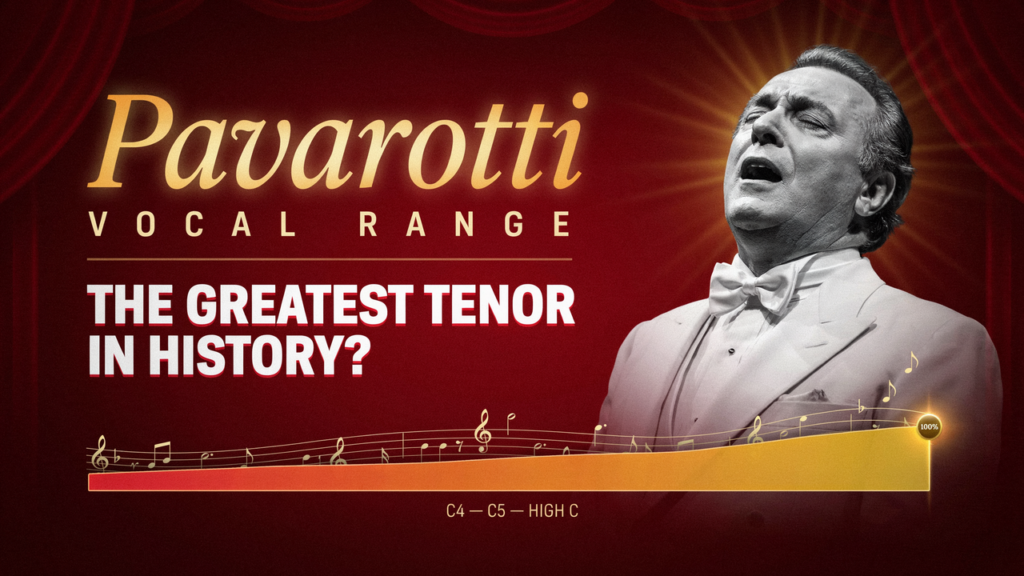
Pavarotti was a tenor, and his reputation is strongly tied to one note: the tenor high C (C5).
Most serious discussions of his voice agree on this:
- His voice lived in a high tenor tessitura
- He could deliver top notes with clarity and ring
- He didn’t need an extreme multi-octave range to sound legendary
A lot of online claims inflate opera singers’ ranges by counting non-performance sounds, rare studio moments, or notes that aren’t sustained and musical.
If you want a baseline for your own context, check your current notes using a tool like the vocal range calculator and compare that to the typical tenor landscape.
What Type of Tenor Was Pavarotti?
Pavarotti is most often described as a lyric tenor with exceptional brilliance, and later in his career he took on heavier repertoire that can overlap with spinto territory.
Lyric vs Spinto (in plain English)
Lyric tenor doesn’t mean “lightweight.” It means the voice is built for:
- Clean, clear tone
- Easy top range
- Flexibility
- Bright resonance
A spinto tenor keeps some lyric qualities but has more:
- Density
- Weight
- Dramatic thrust
Pavarotti’s sound had something special: a bright, ringing core that carried like a laser, even when the orchestra was big.
If you want a quick reference for how opera voice categories relate to range, your tenor vocal range guide is the best supporting page to link from.
Why Range Is the Wrong “Main Metric” in Opera
Pop culture treats vocal range like a high score. Opera doesn’t.
In opera, you don’t win by touching a note once. You win by singing in a demanding range for long periods, with:
- Stable intonation
- Consistent tone
- No strain
- Clear vowels
- Enough volume to project
That’s tessitura.
If you’ve never fully understood tessitura, it’s worth reading your own explanation of what tessitura is because it changes how you evaluate every singer—yourself included.
The live pitch tracking tool helps you see whether you’re sharp or flat.
What Made Pavarotti Sound “So Big”?
Pavarotti’s magic wasn’t “more notes.” It was how he tuned his sound.
The “Ring” (Squillo) Effect
Opera singers talk about squillo—often described as a “ring” or “ping” in the tone.
Think of it like this:
- A normal flashlight spreads light everywhere.
- A laser concentrates light into a focused beam.
Squillo is the laser. It’s the part of the tone that cuts through an orchestra.
Pavarotti’s voice had an unusually clean, bright core that stayed present even on high notes.
Clean Vowels = Easy High Notes
One of the biggest reasons tenors struggle above the passaggio is that vowels get distorted.
When vowels spread or flatten, the voice feels like it’s hitting a ceiling.
Pavarotti’s vowels stayed:
- Focused
- Tall
- Consistent
This is why he could sing high notes with a feeling of “release,” not brute force.
A Practical Way to Think About His “Usable Range”
Most singers obsess over their top note. But for training, you should focus on your usable range.
Range vs Usable Range vs Tessitura
Here’s a simple table you can apply to any singer—including yourself.
| Term | What it means | Why it matters |
|---|---|---|
| Vocal range | Lowest to highest pitch you can produce | Fun fact, not a full picture |
| Usable range | Notes you can sing clearly and repeatedly | This is your real singing toolkit |
| Tessitura | Where you can sing for long stretches with ease | Determines roles and voice type |
To understand your own voice type more accurately, your voice types page is a strong internal support link for readers who are trying to label themselves.
Step-by-Step: How to Learn From Pavarotti Without Copying Him
You can’t “become Pavarotti.” But you can train the same principles that made his singing work.
Step 1 — Stop Chasing the Highest Note
If your goal is “hit C5,” you’ll likely:
- Push volume
- Tighten the throat
- Spread vowels
- Lose resonance
Instead, aim for repeatable, clean notes.
If you’re currently working on range expansion, pair this article with your guide on how to increase vocal range so your readers have a safe training path.
Step 2 — Train the “Ring” Without Forcing
Here’s the key: ring is not yelling.
Ring is resonance + efficient breath + stable vowels.
A simple starting exercise:
- Hum gently on “mm”
- Slide upward slowly
- Keep the buzz forward (lips/face)
- Don’t increase volume as you go higher
If the buzz disappears, you’re likely spreading the vowel or tensing.
H3: Step 3 — Keep the Vowel Tall as You Go Up
High notes feel easier when vowels stay “tall.”
Try this:
- Sing a comfortable note on “ah”
- Now sing the same note but slightly more “uh” shaped
- Notice how the throat feels calmer
That’s not “changing the word.” It’s shaping resonance so the note stays stable.
Step 4 — Build Consistency (Opera’s Real Superpower)
Pavarotti wasn’t legendary because he hit high notes once.
He was legendary because he could do it:
- Night after night
- With clarity
- With musical phrasing
So your training goal should be consistency.
Here’s a numbered routine you can use 4–5 days per week:
- 3 minutes of gentle humming slides
- 5 minutes of lip trills through mid-range
- 5 minutes of “ng” sirens into upper range
- 5 minutes of vowel tuning (ah → uh) on scales
- 3 minutes of light high notes at medium volume only
If you want to tighten accuracy while doing this, your readers will benefit from your pitch accuracy test as a simple way to track improvement.
A Quick Self-Check (So You Don’t Train the Wrong Thing)
Use this as a 60-second check after upper-range work:
- Does your throat feel normal after singing?
- Can you repeat the top notes 3 times without tightening?
- Does the sound stay clear, or does it turn shouty?
- Are you getting louder as you go higher?
- Do you feel neck/jaw engagement?
If your neck or jaw is working hard, you’re not building Pavarotti-style efficiency—you’re building compensation.
For a more objective check, use the pitch accuracy analyzer to see whether your high notes stay stable or drift sharp/flat under pressure.
Common Mistakes People Make When Studying Pavarotti
Mistake 1 — Treating High C Like the Whole Story
High C is famous, but it’s not the full picture.
Many tenors can “touch” C5. Far fewer can sing it:
- With stable vowels
- With consistent tone
- With full resonance
Mistake 2 — Thinking Range = Voice Type
A baritone can sometimes sing a high note. A tenor can sometimes sing a low note.
That doesn’t define the voice.
Voice type is about:
- Tessitura
- Timbre
- Passaggio behavior
- Long-term comfort
If your readers are confused about this, link them to your voice type test as a gentle next step (with the reminder that tools can’t replace a real coach).
Mistake 3 — Trying to “Muscle” Opera Sound
Opera sound is not brute force.
A good operatic tone feels more like:
- Spinning
- Floating
- Ringing
If it feels like pushing a heavy object uphill, you’re doing the opposite of what made Pavarotti great.
Mistake 4 — Ignoring Breath Efficiency
This is the quiet truth:
Most “high note problems” are breath management problems.
Not more air—better control.
If you’re training breath support, your readers will naturally benefit from breathing techniques for vocal range as a supporting internal resource.
Realistic Expectations (and Safe Vocal Health Notes)
Pavarotti’s voice was a rare combination of:
- Anatomy
- Training
- Musical instinct
- Career-long technique discipline
You can absolutely improve your range and your resonance, but don’t set the goal as “sound like him.”
Set the goal as:
- Sing higher with less strain
- Maintain clarity through the passaggio
- Build consistent usable range
When to Stop (Important)
Stop and reset if you feel:
- Burning or sharp pain
- Persistent hoarseness after practice
- Tightness that lasts more than an hour
- A “stuck” feeling in the throat
Training should feel challenging, not damaging.
The Biggest Takeaway: Why Pavarotti Is Still the Model Tenor
Pavarotti’s legacy isn’t just about high notes.
It’s about repeatable brilliance:
- Clear vowels
- Strong resonance
- High tessitura comfort
- A sound that carried effortlessly
If you learn anything from his voice, learn this:
A great tenor isn’t defined by a top note.
A great tenor is defined by how easy and consistent the high range becomes.
FAQs
1) What was Pavarotti’s vocal range in notes?
Most discussions place him firmly in the tenor range, with reliable top notes reaching the tenor high C (C5). Exact lowest and highest endpoints vary depending on how strictly you measure “sung musically” versus “produced briefly.” In opera, his tessitura matters more than the extremes.
2) Did Pavarotti sing high C (C5) consistently?
Yes—high C is one of his most famous strengths. The key point is that he didn’t just hit it; he delivered it with clarity, ring, and repeatability. That consistency is what separates elite tenors from everyone else.
3) What type of tenor was Pavarotti?
He’s most commonly described as a lyric tenor with exceptional brilliance, and he later performed repertoire that overlaps with spinto territory. He was not a dramatic tenor in the traditional sense. His sound carried through resonance and squillo more than sheer vocal weight.
4) How many octaves could Pavarotti sing?
People often ask for an octave number, but opera performance isn’t judged that way. His practical range was what you’d expect from a top-tier tenor, with extraordinary strength in the upper tessitura. Counting octaves can be misleading because it ignores consistency and musical use.
5) Why do different websites list different vocal ranges for Pavarotti?
Because they use different standards. Some count only musically sustained notes in performance, while others include rare studio moments, brief noises, or unverified claims. A reliable approach separates “verified, repeatable notes” from “possible but not consistent.”
6) If I can sing high C, does that mean I’m a tenor like Pavarotti?
Not automatically. One top note doesn’t define voice type—tessitura, comfort, timbre, and passaggio behavior matter more. If your high notes require pushing and you can’t repeat them comfortably, your voice may not be living in a true tenor tessitura.
7) What’s the most useful lesson singers can take from Pavarotti?
Train for consistency, not extremes. His greatness came from clean vowels, efficient breath use, and a resonant ring that carried without forcing. If your high notes feel easier and more repeatable over time, you’re learning the right lesson.

John Mayer is a vocal analysis and music education writer specializing in vocal range testing, voice type analysis, pitch recognition, and singing improvement tools for singers, musicians, performers, and beginners. He creates practical content focused on vocal training, singing techniques, and voice analysis tools to help users better understand and improve their vocal abilities.