
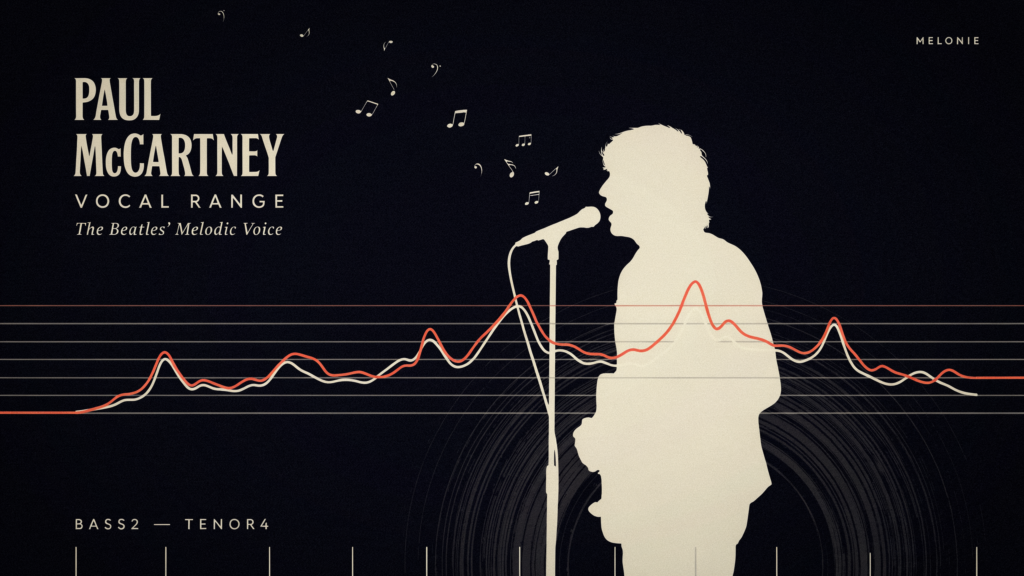
Paul McCartney’s vocal range is the span between the lowest and highest notes he sings across his recordings and live performances. Because he uses multiple vocal registers (full voice and falsetto), the most accurate way to describe his range is to separate “full voice notes” from “lighter/falsetto notes” and focus on his usable range.
McCartney is a perfect case study because his voice is famously flexible: he can sound warm and low in one song, then bright and high in another, often without sounding like he’s “trying.”
The Quick Answer (Without the Confusing Myths)
Most people search this keyword because they want a clean number: lowest note to highest note.
Here’s the coaching truth: there isn’t one single “correct” range number for Paul McCartney that every expert will agree on, because it depends on what you count.
What changes the range number?
- Whether you count falsetto as equal to full voice
- Whether you count very low notes that may be vocal fry or spoken
- Which era you measure (1960s vs modern live)
So instead of giving you a misleading one-liner, I’ll show you the method that produces the clearest answer—and helps you learn from his singing style.
If you want to compare your own voice to his in a practical way, start by checking your notes using the vocal range calculator so you’re working with real data, not guesswork.
Why McCartney Sounds Like He Has a “Bigger Range” Than He Does
McCartney’s range is impressive, but what’s even more impressive is his range illusion.
He often sounds like he’s jumping across huge intervals because he changes:
- Tone color (bright vs warm)
- Vocal weight (light vs heavy)
- Placement (forward vs round)
The “Actor” effect
Think of his voice like an actor changing characters.
An actor doesn’t need a new body to play a new role. They change:
- posture
- facial expression
- voice color
McCartney does the same thing vocally. He can sound sweet, gritty, shouty, tender, nasal, or round—sometimes in the same song.
That’s why people overestimate his range. They’re hearing style changes, not just pitch.
Use the tone range test as a quick audio diagnostic.
Full Voice vs Falsetto: The Key to Understanding His Range
If you want to measure McCartney fairly, you have to separate registers.
Full voice (what most people mean)
Full voice is the register where the vocal folds close strongly enough to produce a clear, speech-like tone.
This is the range that matters most if you’re asking:
- “Can I sing his songs comfortably?”
- “What voice type is he?”
- “How high can he really sing without flipping?”
Falsetto (still real, but different)
Falsetto is a lighter coordination where the vocal folds don’t close as firmly.
Falsetto notes still count as part of a singer’s range, but they don’t tell you the same things about:
- stamina
- power
- voice type
- tessitura
If you’re new to note names and want to understand what “C4” or “A4” even means, your vocal range notes guide is the best companion resource.
McCartney’s Voice Type: Tenor or Baritone?
People argue about this constantly because McCartney:
- sings high often
- sings low comfortably
- has a warm tone
- can brighten his sound dramatically
The simplest coaching answer
McCartney behaves like a high baritone / baritenor in many songs.
That means:
- he has baritone warmth and weight in the middle
- but he can access a tenor-like top with a lighter coordination
This is common in rock and pop. Pop voice types don’t fit neatly into classical categories.
If you want a clear breakdown of how voice types work in general, point readers to voice types so you don’t have to re-teach it inside this article.
The “tessitura clue”
The best clue isn’t his highest note.
The clue is where he sings comfortably most of the time: mid-range with frequent climbs upward, not constant living in the very low register.
A Practical Range Breakdown (What to Pay Attention To)
Instead of obsessing over the absolute lowest and highest notes, focus on what’s musically repeatable.
Here’s a simple table you can use for McCartney and for yourself.
| Category | What it means | Why it matters |
|---|---|---|
| Lowest note | The bottom pitch he can produce | Often exaggerated by fry/spoken notes |
| Highest full voice note | Highest strong, clear note | Most relevant for song difficulty |
| Highest falsetto note | Highest light note | Useful, but not equal to full voice |
| Usable range | Notes he can sing consistently | Best predictor of what you can sing |
If you want to see how his voice sits compared to typical singers, the vocal range chart page gives the cleanest reference without overcomplicating it.
What You Can Learn From McCartney (That Actually Improves Your Singing)
McCartney is not a “perfect technique” singer in the classical sense. He’s a brilliant pop vocalist with excellent instincts.
And that’s why he’s so useful to study.
Lesson 1 — He changes vocal weight, not just pitch
When McCartney goes higher, he often gets:
- lighter
- brighter
- more forward
He doesn’t drag a heavy, chesty sound upward the whole time.
That’s one of the biggest reasons he can sing high without sounding like he’s straining.
Lesson 2 — He uses vowels like steering wheels
High notes are easier when vowels stay narrow enough to focus resonance.
A lot of singers blow their range by letting vowels spread.
McCartney’s high singing often has a slightly narrowed, speech-like vowel shape that stays controlled.
Lesson 3 — He commits to the sound
Even when he sings softly, he’s not timid.
His voice is clear because the sound is “placed,” not hesitant.
That kind of confidence creates better vocal fold closure and more consistent pitch.
Step-by-Step: How to Sing McCartney-Style High Notes Safely
This is where the article becomes practical.
You don’t need his genetics. You need the principles.
Step 1 — Find your real baseline range
Before you imitate anyone, you need to know your own starting point.
Use a clean process like the one in how to test your vocal range so you’re measuring notes you can sing clearly, not notes you can “touch.”
Step 2 — Build a light mix instead of yelling
Most singers try to go higher by pushing volume.
McCartney often goes higher by:
- thinning the sound
- focusing resonance
- staying conversational in the throat
Try this:
- Start on a comfortable mid note on “yeah”
- Slide upward 3–5 notes
- Keep it medium volume
- Let it get slightly brighter as you go up
If you feel pressure building, stop. Reset. Try again lighter.
Step 3 — Train falsetto as a tool, not a crutch
Falsetto helps you learn the pathway to high notes.
But if you rely on falsetto to avoid tension, you’ll never build a stable top in full voice.
A good balance is:
- practice falsetto gently
- then practice a light mix
- then return to falsetto to relax
Step 4 — Build stamina gradually (the unsexy secret)
McCartney’s real skill is not one high note.
It’s doing it across entire songs.
Use this simple weekly plan (3–4 days per week). This is your numbered list:
- 2 minutes of gentle humming slides
- 3 minutes of lip trills through mid-range
- 4 minutes of “gee” scales (light and bright)
- 4 minutes of “yeah” scales (speech-like, medium volume)
- 2 minutes of easy falsetto
- 2 minutes of soft singing in your top range
If you want a structured approach to building those notes over time, your how to sing high notes guide fits perfectly as the next internal step.
The One Bullet List You Should Remember
If you want McCartney’s flexibility, train these consistently:
- Lighten the sound as you go higher
- Keep vowels focused (don’t spread)
- Use medium volume instead of pushing
- Practice consistency, not just “hit the note”
- Separate full voice and falsetto in training
- Stop if you feel strain, burning, or tightness
Quick Self-Check: Can You Sing McCartney Songs Comfortably?
This is a fast reality check you can do after warmups.
The 30-second test
Pick a song you think you can sing.
Then ask:
- Can I sing the chorus 3 times without tightening?
- Does my pitch drift sharp as I go higher?
- Do I start shouting on the top notes?
- Does my throat feel tired after one run?
If the answer is yes, you’re forcing.
Use a pitch tool to verify
McCartney’s singing is often clean and centered.
If your pitch wobbles or goes sharp when you reach the top, that’s a coordination issue—not a “range” issue.
Use the pitch accuracy test as an objective check, especially for high choruses.
Common Mistakes People Make When Measuring McCartney’s Range
This is where most online range claims go wrong.
Mistake 1 — Counting falsetto as the same as full voice
Falsetto is part of range, but it shouldn’t be mixed into the same “highest note” claim.
If you want to be accurate, label it.
Mistake 2 — Counting vocal fry as a “real low note”
Some low notes in pop recordings are more like:
- vocal fry
- spoken pitch
- studio-enhanced lows
That doesn’t mean the singer can sustain those notes musically.
Mistake 3 — Ignoring the era
A singer’s voice changes across decades.
McCartney’s early Beatles voice is not identical to his later live voice.
So any “range number” should specify:
- what era
- what register
- what kind of performance (studio vs live)
Mistake 4 — Trying to copy his rasp or grit too early
McCartney sometimes uses grit.
If you try to imitate grit without good coordination, you’ll end up squeezing.
If your voice feels raspy after practice, stop and recover. Strain is not “rock style.”
If you’re actively working on range expansion, your how to increase your vocal range article is the safest internal path to recommend.
Realistic Expectations (and Vocal Health Notes)
McCartney’s voice is a mix of:
- natural musicality
- smart stylistic choices
- decades of singing experience
You can absolutely learn his flexibility, but you should not expect to:
- gain an extra octave quickly
- sing high choruses loudly overnight
- add grit safely without training
When to stop and rest
Stop if you feel:
- sharp pain
- burning sensation
- persistent hoarseness
- throat tightness that doesn’t go away
Range work should feel like coordination, not punishment.
The Takeaway: What McCartney’s Range Really Teaches You
Paul McCartney’s vocal range is impressive, but the real story is how he uses it.
He doesn’t win by extremes.
He wins by:
- switching tone colors
- managing vocal weight
- staying musical at higher pitches
- using falsetto as a tool, not a hiding place
If you train those skills, your voice will feel bigger—without needing mythical octave claims.
FAQs
1) What is Paul McCartney’s vocal range in notes?
Different sources give different note ranges because they count different registers and eras. The most accurate approach is to separate full voice from falsetto and focus on what he sang consistently. For singers, the usable range is more useful than the absolute extremes.
2) Is Paul McCartney a tenor or baritone?
He often behaves like a high baritone or baritenor in pop terms. He has warmth and strength in the middle but can access a bright upper range with lighter coordination. Pop voice types don’t fit perfectly into classical categories.
3) Did Paul McCartney sing falsetto?
Yes, and he used it musically rather than as a gimmick. Falsetto helped him access high melodic ideas with less vocal weight. It’s best treated as part of his range, but not the same as full voice.
4) Why does McCartney sound so high in some songs?
Because he changes tone color and placement as he goes up. A brighter, more forward sound can make a note feel “higher” even if it isn’t extremely high. This is one of the best skills to copy from him.
5) How can I sing McCartney songs without straining?
Use medium volume, lighten your vocal weight as you go higher, and keep vowels focused. If you feel pressure building, reset and try again with less push. Repetition with ease beats one forced high note every time.
6) Did Paul McCartney’s voice change with age?
Yes, like all singers. High notes often become harder to sustain with the same brightness, and tone can get slightly thinner or raspier. Smart singers adapt by adjusting keys, phrasing, and vocal weight.
7) What matters more than range in McCartney’s singing?
Consistency, tone control, and musical phrasing. McCartney’s greatest strength is how he makes high sections feel natural and expressive. If you build a stable usable range and learn to switch tone colors, you’ll get much closer to his style than by chasing a top note.

John Mayer is a vocal analysis and music education writer specializing in vocal range testing, voice type analysis, pitch recognition, and singing improvement tools for singers, musicians, performers, and beginners. He creates practical content focused on vocal training, singing techniques, and voice analysis tools to help users better understand and improve their vocal abilities.