
Jay Chou is one of the most influential Mandopop artists ever — and one of the most misunderstood vocally. People search his vocal range to find his “highest and lowest note,” but the real challenge with Jay Chou songs is rarely the top note. It’s his phrasing, breath timing, and soft, speech-like delivery.
Jay Chou’s vocal range is the span of notes he can sing from his lowest to highest pitches in performance. He’s often perceived as a tenor-leaning pop vocalist with a comfortable midrange and frequent use of soft, controlled phrasing. His range is best understood through tessitura and style, not only maximum notes.
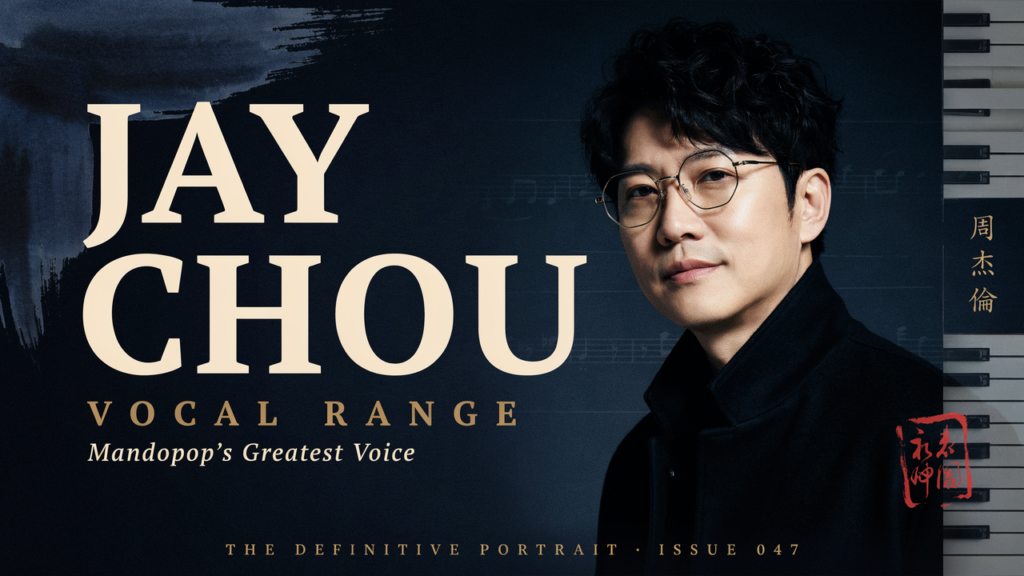
What Is Jay Chou’s Vocal Range?
Jay Chou’s voice generally sits in a male pop range that many singers can reach on paper. That’s why so many karaoke singers feel confident choosing his songs… and then struggle halfway through.
You’ll also see different range numbers online because “vocal range” can mean different things:
- studio notes vs live notes
- clean singing vs airy/falsetto moments
- one-time peak notes vs repeatable notes
The most singer-useful way to look at Jay Chou’s range is not “highest note.” It’s:
Where does he sing most of the time, and how does he stay in control?
If you want to compare accurately, first measure your own range with the vocal range calculator so you’re working with real notes.
Use the high frequency hearing test to test treble perception.
What Voice Type Is Jay Chou?
Jay Chou is often perceived as tenor-leaning, but he’s not a “big belting tenor” in the Western pop sense.
His voice tends to sound:
- relatively light compared to baritone voices
- comfortable in the midrange
- more speech-like than operatic
- controlled rather than explosive
Why people debate his voice type
Because Jay Chou doesn’t sing like a traditional vocal showpiece singer. He uses:
- restrained volume
- close-mic technique
- relaxed phrasing
- stylized diction
That can make his voice sound lower or smaller than it actually is.
If you want a clean framework for classification, voice types will help you understand why range and voice type are not the same thing.
Tessitura: The Real Key to Jay Chou’s Singing
Tessitura is the part of your range where you can sing repeatedly without fatigue.
Jay Chou’s tessitura is usually:
- midrange centered
- slightly higher than many casual male singers expect
- built around smooth phrasing instead of long held notes
This matters because many singers can hit the notes in isolation, but they can’t stay stable while singing softly with precise timing.
If you’ve never worked with this concept before, what is tessitura explains it in the most practical way.
Why Jay Chou Songs Are Hard to Sing (Even If They Aren’t Extremely High)
This is the part most people miss.
Jay Chou songs can feel difficult for four main reasons — and only one of them is pitch.
1) He sings softly, but still needs support
Soft singing is not “less technique.” It’s often more.
When you sing quietly, you can’t rely on volume to cover instability. Every small wobble becomes obvious.
A good analogy:
Soft singing is like balancing on a thin beam.
Loud singing is like walking on a wide sidewalk.
2) His phrasing is rhythmically tricky
Jay Chou often sings behind the beat, slides into notes, and uses conversational timing.
That’s a style skill, but it’s also a breath-control skill. If your breath timing is off, your pitch will drift.
If you want to build that stability, the exercises in how to improve pitch accuracy connect directly to this style.
3) Diction and vowels are not “open”
Many singers try to sing Jay Chou with big open vowels.
But his style is often:
- narrower vowels
- less jaw opening
- more internal articulation
That can make pitch harder to control if you don’t have stable resonance.
4) The melodies sit in an awkward “in-between” zone
A lot of his melodies sit in a zone where male singers either:
- want to sing too low and lose clarity
- or push too high and tighten
This is where a clean mix strategy matters, even if the notes aren’t extreme.
Does Jay Chou Use Falsetto or Head Voice?
Jay Chou does use lighter tones at times, but many of his “high” moments are not classic falsetto the way people expect.
The practical difference (for singers)
- Falsetto often feels airy and separate from chest voice
- Head voice (in male voices) can feel more connected and resonant
- Mix bridges the gap, keeping clarity without shouting
In Jay Chou’s style, the most important skill is usually:
connected light singing, not dramatic high belting.
If you want to identify what notes you’re actually singing, use the pitch detector while you practice short phrases.
A Singer-Friendly Range Map (So You Stop Guessing)
Instead of obsessing over a single range number, use this practical map. It shows why his songs feel hard even for singers with “enough range.”
| Vocal zone | What it feels like | What goes wrong for singers | What to train |
|---|---|---|---|
| Low-mid | comfortable speaking | gets too mumbly | clear consonants |
| Midrange | most common | goes flat when soft | breath stability |
| Upper-mid | frequent in choruses | tension or shouting | light mix coordination |
| Light high | occasional peaks | airy, weak falsetto | connected head tone |
This is exactly why singers feel surprised: the challenge is coordination, not a crazy top note.
Step-by-Step: How to Sing Jay Chou Songs Better (Without Strain)
If you want to sing Jay Chou well, don’t train like you’re preparing for a belting contest. Train like you’re building control and timing.
Step 1: Set your baseline range first
Before you choose a song, know your comfortable notes.
A lot of karaoke frustration comes from not knowing where your voice naturally sits. Use how to test your vocal range to get your baseline.
Step 2: Practice the chorus at 70% volume
Jay Chou’s style often falls apart when singers go too loud.
Train the chorus softly first.
If you can’t sing it quietly with stable pitch, you don’t truly have control of it yet.
Step 3: Fix breath timing (not breath amount)
Most singers think they need “more air.”
Usually they need better timing:
- inhale earlier
- release steadily
- avoid collapsing at the end of phrases
A steady breath is like cruise control. It keeps the voice from wobbling.
Step 4: Use narrower vowels in the upper-midrange
Jay Chou’s style often uses narrower vowels naturally.
If you open too wide, your pitch can spread and go flat.
If you narrow slightly, the note centers better.
Step 5: Train slides and note approaches deliberately
Jay Chou often approaches notes with a slide.
That’s stylistic, but it must be controlled.
If your slide is uncontrolled, it becomes pitch insecurity.
A Simple Practice Routine for Jay Chou Style (10 Minutes)
This routine builds the exact skills his singing requires: soft stability, timing, and connected tone.
1) Soft humming slides (2 minutes)
Hum from low-mid to midrange smoothly.
2) “NG” to vowel (3 minutes)
Hum “ng” (like the end of “sing”), then open into “neh.”
3) Quiet phrasing practice (3 minutes)
Speak the lyric rhythm first, then sing it on one note.
4) Light chorus run (2 minutes)
Sing the chorus at 70% volume with a relaxed jaw.
If you want warm-ups that match this style, the vocal warm-up generator can be used to build a routine focused on control rather than power.
The One Numbered Plan That Makes Karaoke Easier (14 Days)
If you want a realistic improvement plan, this works fast without overtraining.
- Pick one Jay Chou chorus and practice it slowly for 5 minutes per day.
- Record yourself and check pitch stability using the pitch accuracy analyzer.
- Fix one thing at a time: breath timing, vowel shape, or rhythm placement.
- Raise tempo only when the slow version is stable.
- After 14 days, sing the full song at 80% effort, not 100%.
This approach builds control and confidence — the two things Jay Chou songs demand.
Quick Self-Check (Are You Singing This Style Correctly?)
After practicing a Jay Chou song, check these:
- Your pitch stays steady when singing quietly
- Your throat feels neutral afterward
- Your jaw stays loose (no clenching)
- Your consonants stay clear without pushing volume
- Your voice doesn’t get breathy at the ends of phrases
If you fail more than one, reduce volume and rebuild slowly. Soft singing is a skill, not a shortcut.
Common Mistakes Singers Make with Jay Chou Songs
Mistake 1: Singing too loud
Jay Chou’s style is not meant to be shouted.
When you sing his songs too loud, you lose the smooth phrasing and start pushing the upper-midrange.
Mistake 2: Treating soft singing as “no support”
Soft singing still needs stable breath.
If you remove support, your pitch will drift and your tone will thin out.
Mistake 3: Over-opening vowels
Big open vowels can sound great in some styles.
But in Jay Chou’s phrasing, over-opening often causes:
- pitch spread
- flatness
- tension in the jaw
Mistake 4: Ignoring rhythm placement
His vocal timing is a huge part of the style.
If you sing too “on the beat,” it won’t feel right.
If you sing too far behind, you’ll run out of breath.
Mistake 5: Choosing the wrong key
A song can be “in your range” but still sit in your weak tessitura zone.
If the chorus lives right where you tighten, you’ll struggle every time.
This is why tessitura matters more than a single highest note.
Realistic Expectations (And Vocal Health Notes)
Jay Chou’s singing is deceptively controlled. If you’re new to singing, don’t expect to nail the style in one session.
You can realistically improve:
- pitch stability in soft singing
- breath timing
- phrasing confidence
- smooth upper-midrange connection
If you feel strain, hoarseness, or a scratchy throat afterward, back off. You should never need to force volume to sing Jay Chou well.
The Real Takeaway from Jay Chou’s Vocal Range
Jay Chou’s range is interesting, but it’s not the main reason he’s difficult to sing.
The real lesson is this:
Soft singing with good timing is harder than loud singing with sloppy control.
If you train breath stability, connected tone, and phrasing accuracy, Jay Chou songs become much easier — and your overall singing improves too.
FAQs
1) What is Jay Chou’s vocal range?
Jay Chou is often perceived as a tenor-leaning pop singer with a comfortable midrange and occasional lighter high notes. Exact note ranges vary depending on whether you count studio, live, or airy tones. For singers, his tessitura and phrasing style matter more than the maximum note.
2) Is Jay Chou a tenor or baritone?
Most listeners hear him as closer to tenor than baritone, but he doesn’t sing like a big belting tenor. His sound is more restrained and speech-like, which can make him seem lower. The best way to judge is where his voice sounds most relaxed and consistent.
3) Does Jay Chou sing in falsetto?
He uses lighter tones at times, but not always in an obvious, airy falsetto style. Many of his higher moments are more about a connected lighter production than dramatic falsetto flips. The key skill is keeping the tone stable and supported even when it’s soft.
4) Why are Jay Chou songs so hard to sing at karaoke?
Because the challenge is usually breath timing, phrasing, and soft pitch stability — not extreme high notes. Many singers go flat when they sing quietly. His rhythmic placement also makes the phrasing feel tricky if you don’t practice it slowly first.
5) Can an average male singer sing Jay Chou songs?
Yes, many can, but the songs often sit in an awkward upper-mid tessitura. Even if the notes are reachable, they may not be comfortable for long phrases. Choosing the right key and training soft control makes a huge difference.
6) What is Jay Chou’s tessitura?
His tessitura is generally centered in the midrange with frequent movement into the upper-mid area. That’s why singers feel like they’re constantly “almost too high,” especially in choruses. Training mix coordination and vowel control helps stabilize that zone.
7) How can I sing Jay Chou songs without going flat?
Start by practicing quietly at a slow tempo and focus on steady breath release. Keep vowels slightly narrower as you go higher and avoid letting the ends of phrases collapse. Recording and checking pitch stability is one of the fastest ways to fix this.

John Mayer is a vocal analysis and music education writer specializing in vocal range testing, voice type analysis, pitch recognition, and singing improvement tools for singers, musicians, performers, and beginners. He creates practical content focused on vocal training, singing techniques, and voice analysis tools to help users better understand and improve their vocal abilities.