
Stevie Wonder’s vocal range spans roughly three octaves in recorded material, extending from a warm lower register into high tenor territory, with additional notes accessed through head voice and falsetto. He is generally classified as a high tenor, known for agility, control, and expressive upper register singing.
That’s the technical summary. Now let’s break down what that really means — and what you can apply to your own voice.
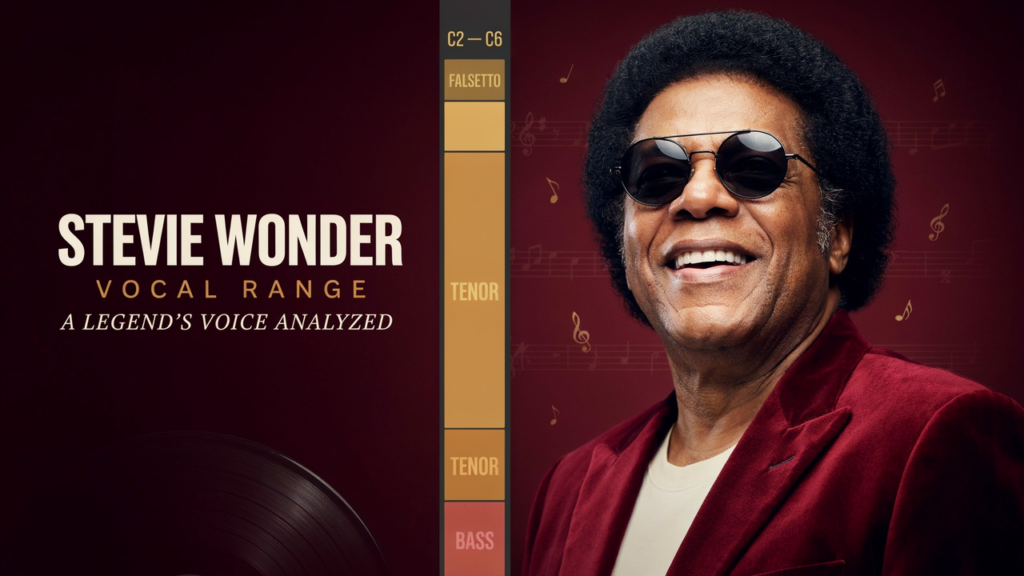
What Is Stevie Wonder’s Vocal Range?
Vocal range measures the lowest and highest notes a singer can produce with usable tone and control.
Stevie Wonder demonstrates:
- A stable lower register
- A flexible and expressive midrange
- Strong high tenor notes in modal voice
- Extended upper notes in head voice and falsetto
If you’re unsure how range is defined, reviewing what vocal range means will help you interpret these numbers correctly.
His range is impressive — but his coordination and agility are just as important as the octave span.
Use the vocal scale finder to generate scales you can practice immediately.
Is Stevie Wonder a Tenor or Baritone?
He is most commonly described as a high tenor.
Why High Tenor?
His tessitura — the range where he feels most comfortable — sits in the upper midrange. He sustains high notes with brightness and ease that align with the typical tenor vocal range.
Why Not Baritone?
Although he can access lower notes, his vocal weight and comfort zone are higher than a typical baritone. If you compare with the standard baritone vocal range, the difference in placement becomes clear.
Voice type is about comfort and tone center, not just the highest note you can reach.
Register Breakdown
Understanding his registers explains how he balances power and agility.
Chest Voice
His lower register has warmth and soul. It anchors the tone but doesn’t sound overly heavy.
Mixed Voice
His upper modal notes are coordinated through mix. This allows him to sing high with clarity rather than strain.
Head Voice and Falsetto
He uses head voice and falsetto for expressive effect and extension. These lighter mechanisms allow access to notes above his core modal range.
To visualize how these registers stack, reviewing a vocal range chart can make the transitions clearer.
Modal Range vs Falsetto Extension
One of the biggest misunderstandings in vocal discussions is counting falsetto without clarifying it.
Falsetto is a legitimate register — but it feels and functions differently from modal voice.
Here’s a simplified comparison:
| Element | Modal Voice | Falsetto |
|---|---|---|
| Cord Closure | Fuller | Lighter |
| Tone Quality | Rich and connected | Airier |
| Power | Stronger | Softer |
| Typical Use | Belted phrases | Stylistic extension |
Stevie Wonder uses both skillfully.
If you want to measure your own usable modal span, use a vocal range calculator before adding falsetto.
How His Range Compares to the Average Male Singer
Most untrained male singers have about two octaves of comfortable range.
Stevie Wonder’s usable span extends beyond that, especially when including head voice and falsetto.
For context, review benchmarks in average male vocal range.
But remember: range size does not equal musicality. Agility and control matter just as much.
How He Sings High Notes Without Strain
High notes require coordination, not force.
Stevie Wonder’s upper notes work because:
- Breath support remains steady
- The larynx stays relatively stable
- Resonance shifts forward
- Chest weight reduces naturally
Think of high notes like shifting gears in a car. You don’t stay in first gear while accelerating. You transition smoothly.
If you’re training upper extension, guidance from how to sing high notes can help prevent tension.
Step-by-Step: Strengthening Your Upper Register
Do not jump straight into loud high notes.
Build coordination first.
- Warm up gently with lip trills in midrange.
- Slide upward slowly on a bright “gee” vowel.
- Keep airflow steady and relaxed.
- Allow the tone to brighten as you ascend.
- Increase volume only after pitch feels stable.
If you struggle to stay centered on pitch, practicing with a pitch accuracy test can improve stability before increasing intensity.
High notes should feel energized, not squeezed.
Common Mistakes Singers Make
- Dragging heavy chest voice too high
- Confusing falsetto with full-voice belt
- Raising the chin while ascending
- Ignoring vocal fatigue
- Skipping warm-ups
High notes should feel lighter than you expect.
If your throat tightens or you feel sharp discomfort, stop. That’s a coordination issue — not a strength problem.
Self-Check: Do You Share Similar Traits?
Ask yourself:
- Does your voice brighten naturally as you ascend?
- Is your strongest singing zone above middle C?
- Can you transition into lighter head voice without cracking?
- Is your speaking voice moderately high?
If yes, you may have tenor tendencies.
If your comfort zone sits lower and darker, your voice type may differ — and that’s completely fine.
Voice type is about natural fit, not imitation.
Realistic Expectations for Range Development
Stevie Wonder’s upper control developed over years of singing and performing.
You cannot safely expand your range by an entire octave in a short period.
Healthy progress usually looks like:
- Smoother register transitions
- Less strain on high notes
- More consistent tone
- Increased endurance
Pain is not part of training. Mild fatigue can happen. Sharp discomfort means stop and reset.
Consistency builds range. Forcing volume does not.
The Bigger Lesson
Stevie Wonder’s voice isn’t just wide.
It’s flexible.
He balances mix, head voice, and falsetto with agility and control. That’s what creates expressive upper singing without constant strain.
The goal isn’t to chase extreme notes.
The goal is to coordinate your registers so high notes feel sustainable.
When your mix stabilizes, range expands naturally.
FAQs
1. How many octaves can Stevie Wonder sing?
He demonstrates roughly three octaves in recorded material, including modal voice and falsetto extension.
2. Is Stevie Wonder a tenor?
Yes, he is generally classified as a high tenor due to his upper tessitura and strong high register singing.
3. What is Stevie Wonder’s highest note?
His highest notes are typically accessed through head voice or falsetto rather than heavy chest voice.
4. Does falsetto count toward total vocal range?
Technically yes, but it should be separated from modal voice when analyzing vocal classification.
5. Is his vocal range considered rare?
His combination of range, agility, and control is exceptional, particularly in soul and R&B styles.
6. Can beginners develop falsetto like his?
With proper coordination and gentle training, singers can strengthen head voice and falsetto safely over time.
7. How can I safely expand my upper range?
Warm up consistently, reduce chest weight as you ascend, strengthen mix coordination, and stop immediately if you feel pain or persistent strain.

John Mayer is a vocal analysis and music education writer specializing in vocal range testing, voice type analysis, pitch recognition, and singing improvement tools for singers, musicians, performers, and beginners. He creates practical content focused on vocal training, singing techniques, and voice analysis tools to help users better understand and improve their vocal abilities.