
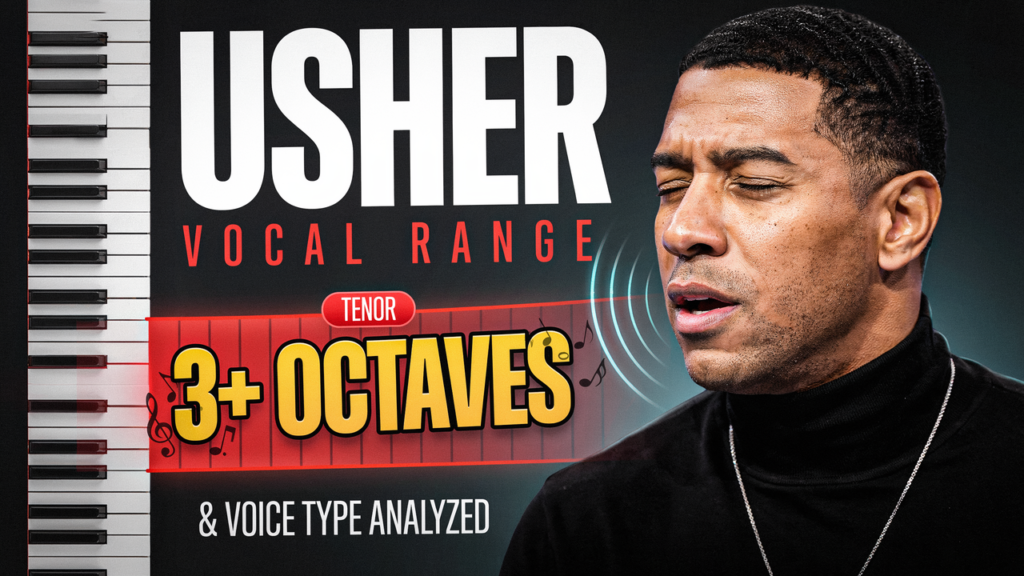
Usher’s vocal range spans roughly three octaves in documented performances, reaching from the lower second octave into the fifth octave at his highest peaks. He is commonly classified as a tenor, known for a smooth chest voice, flexible mix, and expressive falsetto that defines much of his R&B sound.
Range is only part of the story. The real power in his voice comes from control, phrasing, and how efficiently he transitions between registers.
Let’s break it down clearly and practically.
What Is Usher’s Lowest and Highest Note?
His lowest notes sit in the lower second octave, where his tone remains supported rather than hollow. He doesn’t artificially darken the sound to appear deeper.
His highest notes extend into the fifth octave, often achieved through mix or falsetto rather than full chest dominance.
If you’re not sure how these note spans are calculated, review this guide on what vocal range means so you understand the difference between isolated notes and usable singing range.
Take the pitch listening quiz before and after practice to measure improvement.
How Many Octaves Can He Sing?
Most documented evidence places his usable range around three octaves.
Some notes may extend slightly beyond that in brief moments, but sustained performance typically stays within a controlled span.
For perspective, compare that to the average male vocal range, which often sits closer to two octaves. That means his flexibility is above average, but not biologically extreme.
What Voice Type Is Usher?
Usher is widely considered a tenor.
A tenor voice typically features:
- Comfortable mid-to-upper register
- Strong mix coordination
- Easier access to higher pitches than baritones
If you explore the tenor vocal range breakdown, you’ll see that his tessitura fits well within that classification.
He is not a baritone. If you compare with the baritone vocal range, you’ll notice baritones generally sit lower and don’t naturally sustain upper fourth- and fifth-octave phrases with the same ease.
Range vs Tessitura: Why It Matters
Range tells you the outer limits of what someone can sing.
Tessitura tells you where they can sing comfortably for an entire performance.
Think of it like sprinting versus jogging. You might sprint briefly at full speed, but you can only maintain a steady pace for longer distances.
Usher’s tessitura sits in the mid-to-upper third and fourth octaves. That’s where his tone feels smooth, agile, and expressive.
If you want to measure your own comfortable span, try using a vocal range calculator rather than guessing.
Register Breakdown
Chest Voice
His chest voice is clear but not overly heavy.
He keeps the sound forward and supported rather than pressing downward for artificial depth.
Mix Voice
This is where his signature power lives.
The mix allows him to:
- Sustain high phrases
- Maintain clarity
- Avoid shouting
- Keep resonance balanced
Falsetto
His falsetto is smooth and controlled, not airy or disconnected.
Understanding the mechanics behind this requires knowing how the vocal cords work during singing. In falsetto, the cords thin and lengthen, reducing closure while maintaining airflow control.
How to Measure Your Range Like a Pro
If you want to compare your range accurately, follow this safe process:
- Warm up gently for 5–7 minutes with lip trills or light scales.
- Descend slowly until your tone becomes breathy or unstable.
- Record the lowest clean, supported note.
- Ascend gradually without pushing volume.
- Stop when you feel throat tension.
- Record the highest note that remains resonant and steady.
For detailed guidance, follow this tutorial on how to test your vocal range safely.
Never force high notes. If your throat tightens or you feel strain, pause.
Comparison: Usher vs Typical Male Singer
| Category | Usher | Typical Male Singer |
|---|---|---|
| Total Range | ~3 octaves | ~2 octaves |
| Voice Type | Tenor | Varies |
| Upper Extension | Strong mix & falsetto | Moderate |
| Lower Range | Light but supported | Varies |
His edge isn’t extreme depth. It’s upper flexibility and stylistic control.
What Makes His Voice Sound So Smooth?
Three main factors:
- Consistent breath support
- Controlled airflow during transitions
- Precise phrasing
Imagine pouring water steadily into a glass instead of splashing it. Controlled airflow keeps tone smooth and stable.
If you’re working on expanding your upper notes, explore structured exercises in this guide on how to increase vocal range.
Self-Check: Is Your Range Similar?
Ask yourself:
- Can you comfortably sing across nearly three octaves?
- Does your upper register feel connected, not strained?
- Can you shift into falsetto without a sudden crack?
- Is your mid-range strong and steady?
If most answers are “no,” that’s normal. Most singers develop gradually with training.
You can also take a structured voice type test to see where your tessitura naturally sits.
Common Mistakes When Comparing Yourself to Usher
1. Forcing Falsetto Too Loud
Falsetto is lighter coordination. Trying to make it overly powerful often creates tension.
2. Neglecting Breath Support
High notes require stable airflow. Without it, pitch wobbles or cracks.
3. Skipping Warm-Ups
Jumping straight into high songs increases injury risk.
4. Ignoring Rest
If your voice feels hoarse, stop. Muscles need recovery.
5. Confusing Range With Skill
Range is a measurement. Control, tone, and musicality are the real artistry.
Realistic Expectations
A three-octave range is achievable for many trained male singers, but it takes time.
Most beginners start closer to 1.5–2 octaves. Gradual expansion through consistent training can safely increase flexibility.
If you experience persistent throat pain, hoarseness, or loss of clarity, pause and allow recovery. Long-term vocal health matters more than hitting a higher note.
For broader perspective, review the human vocal range limits to understand what’s physiologically typical.
Final Coaching Takeaway
Usher’s vocal range is strong and flexible, sitting around three octaves with a tenor classification.
But what makes his voice stand out isn’t just high notes.
It’s control, smooth transitions, breath stability, and emotional phrasing.
Build those first. Range will follow.
FAQs
1. What is Usher’s vocal range in octaves?
His documented usable range spans about three octaves. Some brief notes may extend slightly beyond that, but sustained performance typically stays within that span.
2. Is Usher a tenor or baritone?
He is widely classified as a tenor. His tessitura and upper extension align more with tenor characteristics than baritone.
3. What is Usher’s highest note?
His highest notes reach into the fifth octave, often produced through mix or falsetto coordination.
4. What is his lowest note?
His lowest supported notes sit in the lower second octave. He maintains resonance rather than forcing depth.
5. Does Usher use falsetto often?
Yes. Falsetto is a major part of his R&B style, used for smooth upper phrases and emotional contrast.
6. Is his range considered wide for a male singer?
Yes, compared to the average male range of around two octaves, three octaves is above average.
7. Can beginners train to sing in his range?
With structured breath work and consistent practice, many singers can gradually expand toward a similar range. Progress should feel steady and tension-free.

John Mayer is a vocal analysis and music education writer specializing in vocal range testing, voice type analysis, pitch recognition, and singing improvement tools for singers, musicians, performers, and beginners. He creates practical content focused on vocal training, singing techniques, and voice analysis tools to help users better understand and improve their vocal abilities.