
Beyoncé’s documented vocal range spans A2 to Bb5 — approximately three octaves — with her voice type classified as a mezzo-soprano. What separates her from most three-octave singers is not the span of her range but the physical power, technical command, and musicality she brings to every note within it. She is widely regarded as one of the finest live vocalists of her generation.
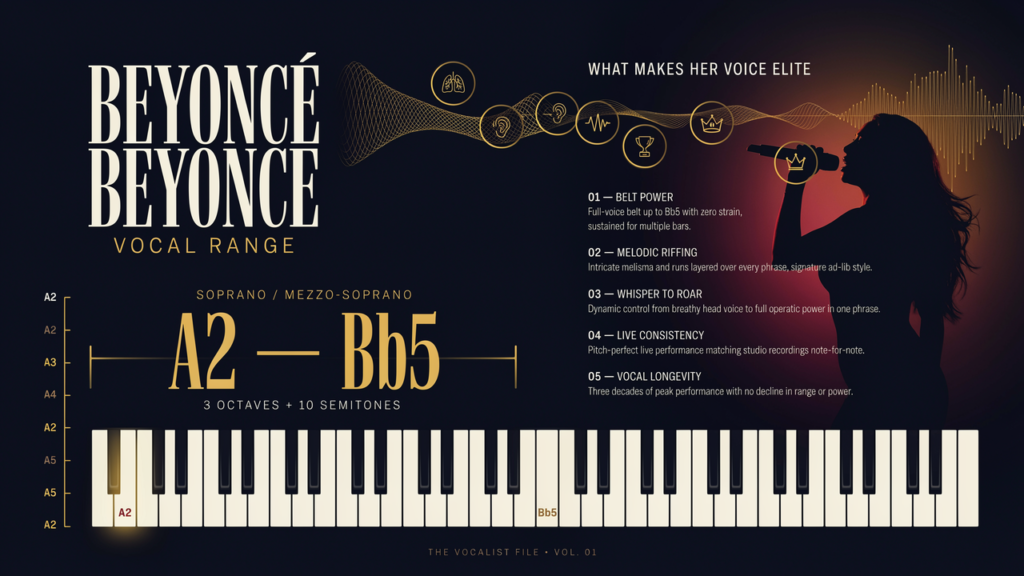
Beyoncé Vocal Range at a Glance
| Detail | Value |
|---|---|
| Full Documented Range | A2–Bb5 |
| Span | ~3 octaves |
| Voice Type | Mezzo-soprano (lyric to spinto) |
| Lowest Note | A2 (110 Hz) |
| Highest Note | Bb5 (932 Hz) |
| Tessitura | D4–G5 |
| Known For | Chest voice power, riff technique, live stamina, belting |
What Voice Type Is Beyoncé?
Beyoncé is a mezzo-soprano — the middle female voice type, sitting between soprano and contralto. Her natural tessitura (D4–G5) is characteristically mezzo, and her chest voice carries the heavier, richer quality associated with that voice category rather than the lighter, brighter tone of a lyric soprano.
Some analysts push her classification toward lyric soprano because she spends much of her performance time above F5, but the weight and character of her voice — particularly in the C4–E5 range — is unmistakably mezzo. Her voice shares characteristics with a spinto mezzo — a mezzo-soprano capable of sustaining power in the upper range. In the vocal fach system, this is the heaviest mezzo subcategory before crossing into contralto territory.
See the full mezzo-soprano vocal range guide for more on how her classification compares to other mezzo-sopranos.
What Makes Beyoncé’s Voice Distinctive
Chest voice power. Her chest voice extends higher than most mezzos, allowing her to belt up to G5 with full chest resonance and significant volume. Most singers of any voice type transition to a lighter head voice or mixed voice by E5. Beyoncé sustains chest voice through the upper passaggio — which is both physically demanding and carries significant risk of vocal strain over a long career.
Riff and run technique. Her gospel-influenced melismatic ornaments are rhythmically precise and tonally accurate. Her runs tend to be shorter and punchier than Ariana Grande’s or Mariah Carey’s — more rhythmic than lyrical — reflecting her R&B and gospel training.
Live stamina. The ability to sustain vocal performance at high volume for two-hour stadium shows while performing intense choreography. Breath control at that level requires years of physical conditioning specific to singing.
Dynamic range. She moves between intimate, almost spoken phrases and full-volume belts within the same song — sometimes the same phrase. This dramatic dynamic range is a vocal acting skill as much as a technical one.
Songs That Showcase Her Range
“Love on Top” (2011) — The key modulations in the final section force Beyoncé to demonstrate her upper range in real time. By the final chorus, she is singing in what amounts to soprano territory.
“Listen” (2006, Dreamgirls) — Her most classically constructed vocal performance, showing her ability to build a dramatic arc with sustained notes up to Bb5.
“Crazy in Love” (2003) — Demonstrates the riff technique and mid-range power (D4–G5) that is her most natural vocal zone.
“Halo” (2009) — Her melodic head voice, relatively restrained dynamics, and legato phrasing — shows her vocal control at moderate volumes.
“Drunk in Love” (2013) — Uses her lower register (A2–C4) with a spoken-sung delivery that showcases the darker, earthier end of her mezzo range.
How Her Range Compares
A typical mezzo-soprano operates between G3 and B5. Beyoncé’s documented range (A2–Bb5) fits largely within that bracket, though her lower notes (A2–F3) are lower than most mezzos comfortably reach. Her power and technique within that range puts her at an elite professional level.
Compared to the average singer (roughly 1.5–2 octaves untrained), her three documented octaves place her in the professional tier. The singer comparison tool can map her range visually against any artist on the site.
Test Your Own Vocal Range
Find out where your voice sits compared to Beyoncé’s mezzo range. The free vocal range test takes one minute and identifies your full span. The voice type test determines whether you’re a mezzo-soprano, soprano, alto, or another voice type. If you belt and want to understand which register you’re using, the head voice test gives a clear answer.
Frequently Asked Questions
What is Beyoncé’s vocal range? Her documented range is A2 to Bb5 — approximately three octaves. Some live recordings capture notes slightly outside this range, but A2–Bb5 represents notes she produces consistently in commercial and performance contexts.
What voice type is Beyoncé? She is a mezzo-soprano, with characteristics of a spinto or dramatic mezzo due to the weight and power of her upper chest voice. Despite performing frequently in soprano range, her natural voice classification is mezzo.
Is Beyoncé a soprano or alto? Neither. She is a mezzo-soprano — the voice type between soprano and contralto. Her upper range overlaps with soprano territory when she belts, and her lower range touches the upper contralto zone, but her natural tessitura and vocal weight are mezzo-soprano.
Who has a similar voice type to Beyoncé? Adele and Jennifer Hudson share the mezzo-soprano designation with similar weight and power characteristics. Amy Winehouse is another mezzo-soprano with a comparable tessitura.
What is tessitura? Tessitura refers to the part of a singer’s range where their voice is most comfortable, resonant, and powerful — as opposed to the full documented range which includes notes at the extremes of capability. Beyoncé’s tessitura is D4–G5.

John Mayer is a vocal analysis and music education writer specializing in vocal range testing, voice type analysis, pitch recognition, and singing improvement tools for singers, musicians, performers, and beginners. He creates practical content focused on vocal training, singing techniques, and voice analysis tools to help users better understand and improve their vocal abilities.