
Dave Grohl’s documented vocal range spans B2 to F#5 — approximately 2.5 octaves — with a voice type classified as baritone. Known primarily as a drummer through his Nirvana years, Grohl’s transition to frontman and lead vocalist with Foo Fighters revealed a gruff, characterful baritone capable of both gentle acoustic delivery and full-volume rock belting.
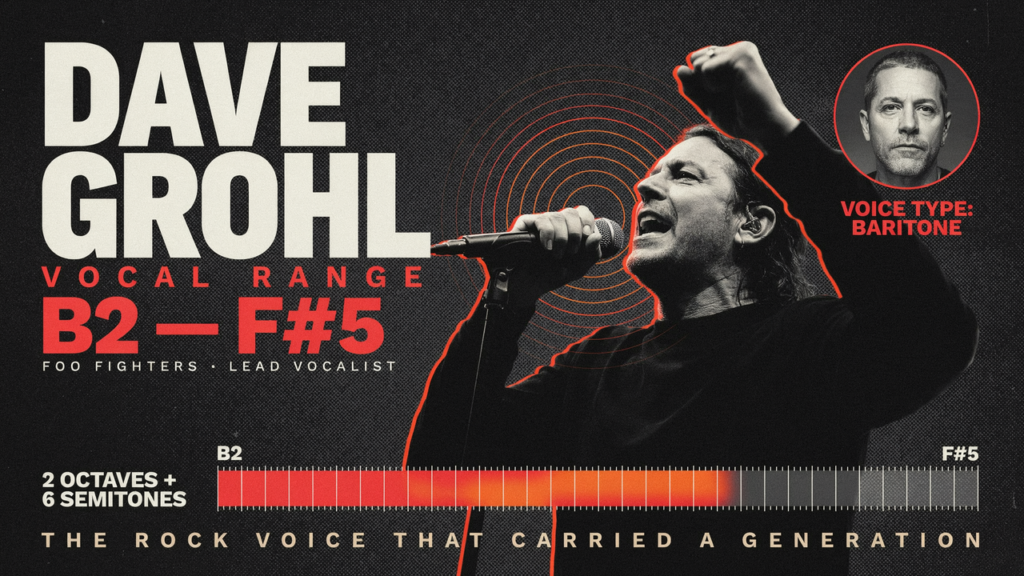
Dave Grohl Vocal Range at a Glance
| Detail | Value |
|---|---|
| Full Documented Range | B2–F#5 |
| Span | ~2.5 octaves |
| Voice Type | Baritone |
| Lowest Note | B2 (123.5 Hz) |
| Highest Note | F#5 (740 Hz) |
| Tessitura | D3–E4 |
| Known For | Gruff rock baritone, emotional directness, power belting |
What Voice Type Is Dave Grohl?
Dave Grohl is a baritone — mid-weight male voice with a naturally warm, gruff quality in his lower-to-mid range. His tessitura (D3–E4) is on the lower end of the baritone range, and his voice carries the kind of lived-in character associated with rock musicians who developed their instruments through intensive touring rather than formal training.
His upper range (D5–F#5) is reached through an aggressive chest voice extension — the rock belt — which produces significant volume and energy but is physiologically demanding to sustain. Compare baritone vs bass to understand where his voice sits in the deeper male voice spectrum.
What Makes Grohl’s Voice Distinctive
Natural authority. His voice sounds like someone who has something to say and is saying it. This is partly timbral (the natural warmth and slight roughness of his baritone) and partly phrasing — he delivers lyrics with the directness of a speaker rather than the aesthetic concern of a trained singer.
Whisper-to-scream range. Songs like “Best of You” demonstrate his ability to move from intimate verses to a screaming F#5 climax within a single song — a dynamic range that is as much emotional as technical.
Key Songs That Showcase His Range
“Best of You” (2005) — Full dynamic and range arc: B2 quiet verse to F#5 belt.
“Everlong” (1997) — Emotional mid-range performance in D3–D5.
“Times Like These” (2002) — Shows his acoustic vocal quality at lower dynamics.
“The Pretender” (2007) — Power performance using the full upper chest voice range.
Frequently Asked Questions
What is Dave Grohl’s vocal range? B2 to F#5 — approximately 2.5 octaves.
What voice type is Dave Grohl? Baritone, with a natural lower tessitura (D3–E4) and a significant upper extension through aggressive chest belting.
Did Dave Grohl take vocal lessons? He has acknowledged working with vocal coaches after experiencing voice fatigue from singing and drumming in the same period. His technique has visibly improved over Foo Fighters’ catalogue.

John Mayer is a vocal analysis and music education writer specializing in vocal range testing, voice type analysis, pitch recognition, and singing improvement tools for singers, musicians, performers, and beginners. He creates practical content focused on vocal training, singing techniques, and voice analysis tools to help users better understand and improve their vocal abilities.