
Frank Sinatra’s documented vocal range spans A2 to G4 — approximately two octaves — with a voice type classified as a lyric baritone. His range was not exceptional by any technical standard, and he knew it: Sinatra was famously dismissive of singers who relied on range over interpretation. What elevated him to his position in American music was an unmatched mastery of phrasing, dynamics, and the conversational intimacy of a song delivered directly to the listener.
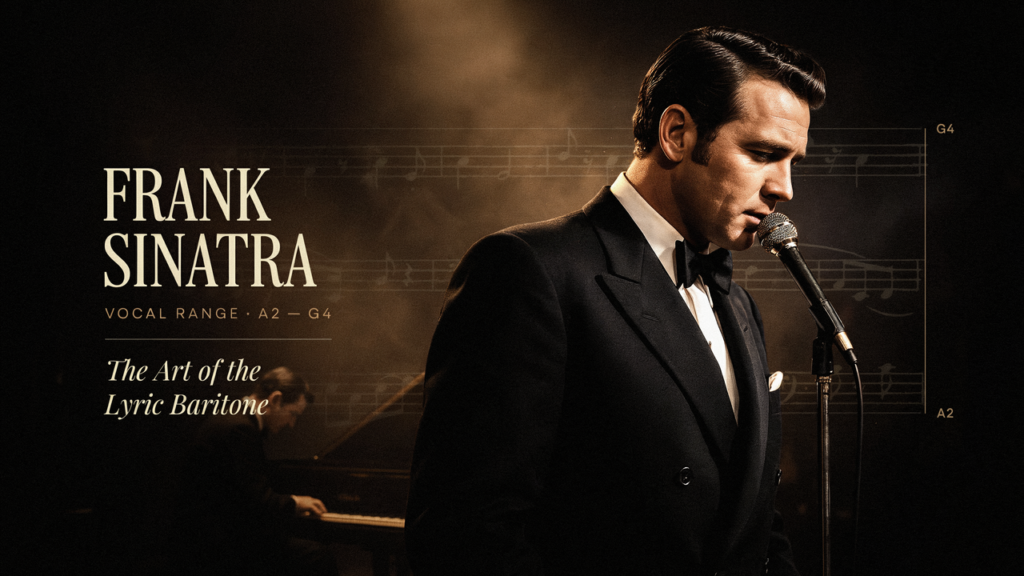
Frank Sinatra Vocal Range at a Glance
| Detail | Value |
|---|---|
| Full Documented Range | A2–G4 |
| Span | ~2 octaves |
| Voice Type | Lyric baritone |
| Lowest Note | A2 (110 Hz) |
| Highest Note | G4 (392 Hz) |
| Tessitura | D3–E4 |
| Known For | Phrasing, legato, emotional interpretation, swing timing |
What Voice Type Was Frank Sinatra?
Frank Sinatra was a lyric baritone — the lightest of the baritone subcategories, with a brighter, more agile quality than a dramatic baritone or bass-baritone. His voice sat naturally in the D3–E4 range, giving his lower notes a warm, intimate quality rather than the dark, heavy resonance of a true bass-baritone like Elvis Presley.
The lyric baritone is ideally suited to art song, cabaret, and the Great American Songbook repertoire — all of which Sinatra dominated. The voice type projects conversational speech patterns naturally, making it the ideal vehicle for the narrative phrasing he perfected. See the baritone vocal range guide for context on how lyric baritone compares to other baritone subcategories.
What Made Sinatra’s Voice Distinctive
Legato phrasing. His most distinctive technical feature: the ability to connect notes in a long, flowing line that mimics the most effortless form of speech. He studied clarinet player Tommy Dorsey’s ability to sustain notes without audible breath changes, and applied the same principle to singing.
Timing. His swing feel — the placement of notes slightly before or after the beat — created an improvisational quality that made even fully arranged standards sound spontaneous. This rhythmic freedom within a fixed structure is the defining quality of jazz-influenced phrasing.
Dynamic control. His ability to sing at true pianissimo (very soft) while maintaining tone quality and projection is rare. Most singers at low volume become breathy or lose resonance; Sinatra maintained a focused sound even in the quietest passages.
Breath control. He developed extraordinary breath control by swimming laps underwater — lengthening his phrase capacity to the point where he could sing longer melodic lines without audible breath than almost any contemporary.
Key Songs That Showcase His Range
“My Way” (1969) — A complete arc of his lyric baritone — from intimate verse to the dramatic climax at G4.
“The Lady Is a Tramp” (1957) — Shows his swing timing and mid-range ease in the D3–E4 zone.
“One for My Baby” (1958) — Late-night intimacy at its finest; primarily A2–D4, showcasing the low warmth of his natural register.
“New York, New York” (1980) — His most physically demanding popular performance, pushing G4 in the final section.
“Fly Me to the Moon” (1964) — Demonstrates his tessitura (D3–E4) at its most relaxed and confident.
How His Range Compares
Two octaves (A2–G4) is a modest range, below even the average trained singer. This is the strongest argument that range does not determine vocal greatness. For context, the is a 2-octave range good guide explains why this span can be more than sufficient for a professional career.
Compare his range against other artists with the singer comparison tool.
Test Your Voice
Discover if you’re a lyric baritone with the voice type test or deep voice test. The voice hz test shows your speaking frequency in real time.
Frequently Asked Questions
What was Frank Sinatra’s vocal range? A2 to G4 — approximately two octaves.
What voice type was Frank Sinatra? Lyric baritone — lighter and more agile than a dramatic baritone, with a naturally warm, conversational quality suited to jazz and the Great American Songbook.
Did Frank Sinatra read music? He was not a formal music reader and relied on his musical ear and emotional instinct rather than written notation in most recording contexts.
What made Sinatra’s phrasing so distinctive? He studied Tommy Dorsey’s legato technique on trombone and applied it to voice, developing an ability to sustain long melodic lines with minimal audible breath changes. Combined with his jazz-timing instinct, this gave his phrasing an effortless, conversational quality.
Is a 2-octave range enough for a professional singer? Yes. Sinatra is the definitive proof. What makes a vocal range “good” is quality within the range, not just how wide it is.

John Mayer is a vocal analysis and music education writer specializing in vocal range testing, voice type analysis, pitch recognition, and singing improvement tools for singers, musicians, performers, and beginners. He creates practical content focused on vocal training, singing techniques, and voice analysis tools to help users better understand and improve their vocal abilities.