
If you’re wondering how many octaves is normal, you’re likely comparing your voice to others—or worrying that your range is too small.
The truth is far more reassuring than most online claims. A “normal” vocal range is much smaller than celebrity examples, and having fewer octaves does not mean you’re a bad singer.
Most people can sing about 2 octaves, while trained singers typically reach 3 octaves or more. A range above 3 octaves is considered impressive, though tone quality, control, and comfort matter more than total range.
This article explains what a normal octave range really is, how many octaves most people have, why range is often overestimated, and what actually matters more than octave count.
You can check your singing pitch instantly online.
How Many Octaves Is Normal?
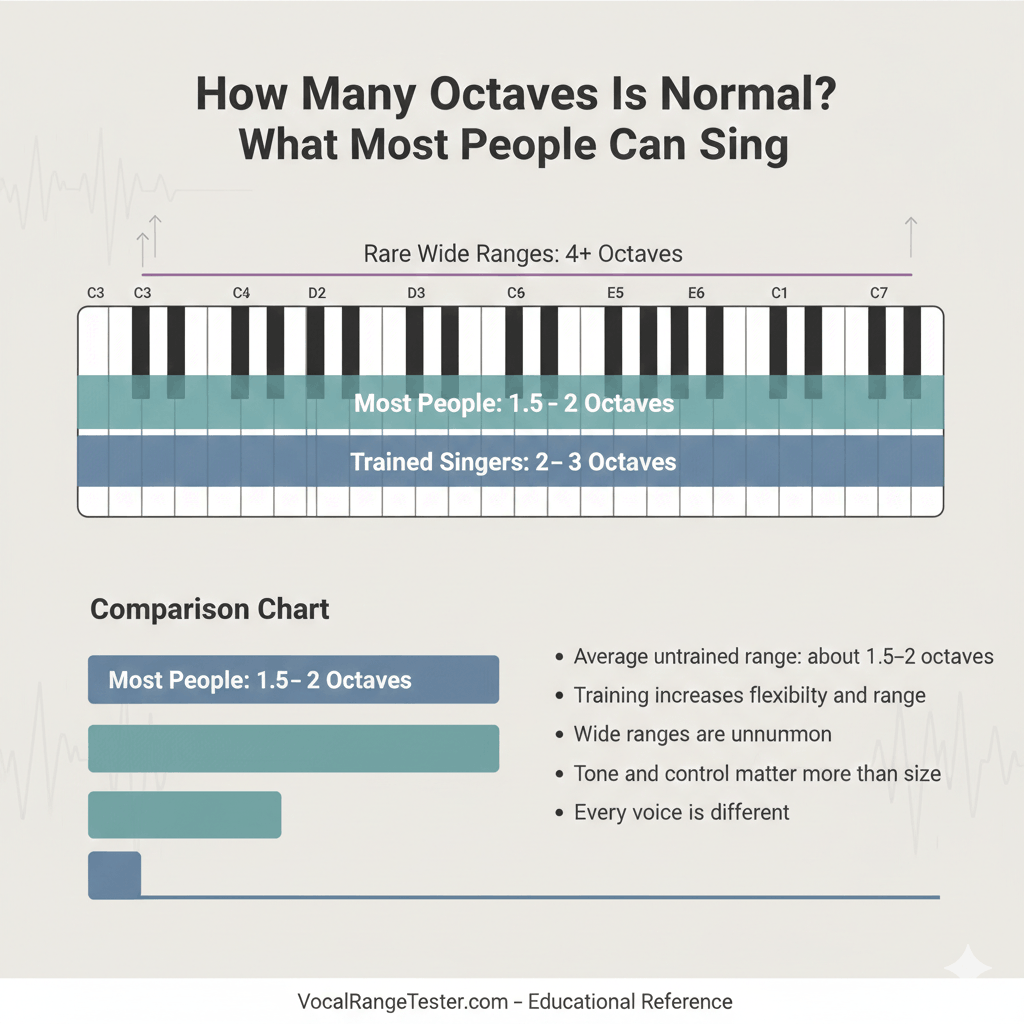
Most people can sing around 1.5–2 octaves, while trained singers commonly reach 2.5–3 octaves. Ranges above 3 octaves are rare, but vocal quality, control, and comfort are more important than hitting extreme high or low notes.
That number applies to real, usable singing, not one-time high or low sounds.
What Does “Normal” Mean in Singing?
In singing, normal does not mean:
- Professional
- Exceptional
- Celebrity-level
It means statistically common and functionally usable.
A normal range is the span of notes you can:
- Sing consistently
- Repeat on demand
- Sustain without strain
This aligns with how vocal range is actually defined in practical singing, not social media claims.
Average Vocal Range in Octaves (Realistic Benchmarks)
Most people fall into these ranges:
- Untrained voices: ~1.5 octaves
- Casual singers: ~2 octaves
- Well-trained singers: ~2.5–3 octaves
Anything beyond that is above average, not normal.
You can see how these ranges compare visually using a vocal range chart.
Is a 2-Octave Vocal Range Normal?
Yes — completely.
A 2-octave vocal range is solidly normal and more than enough for:
- Pop
- Rock
- Choir
- Musical theatre
- Most contemporary styles
Many successful singers work entirely within two octaves. Range alone does not determine musical ability.
For more context, see the full breakdown of the average vocal range.
Is 3 Octaves Normal or Above Average?
A 3-octave range is above average, especially when all notes are usable and controlled.
It is:
- Common among trained singers
- Uncommon in the general population
- Not required for great singing
Claims of 4–5 octaves often include strained or unusable notes, which inflates perception.
Why Most People Overestimate Their Vocal Range
From experience, people usually overestimate their range because they:
- Count strained high notes
- Include vocal fry lows
- Test without warming up
- Confuse one-time sounds with usable notes
A true range includes only notes you can sing reliably. That’s why objective testing—such as with a vocal range calculator—is far more accurate than guessing.
Range vs Tessitura: The Detail That Matters More
Your tessitura is where your voice feels strongest and most comfortable.
Two singers can both have a 2-octave range, but:
- One sounds relaxed
- The other sounds strained
Tessitura matters more for real singing than how many octaves you technically have. This is also why voice type depends on more than numbers alone (see voice types explained).
Does Training Change What’s “Normal”?
Training usually:
- Improves control
- Smooths register transitions
- Makes more of your range usable
It may expand range slightly, but it mostly improves how well you use the notes you already have. This is why many singers feel like their range “increased” even when their anatomy stayed the same.
What Matters More Than Octave Count
In real singing, these matter more than range size:
- Pitch accuracy
- Tone quality
- Endurance
- Musical expression
Many singers with average ranges sound far better than those with wider but uncontrolled voices.
- A normal vocal range is 1.5–2 octaves
- A 2-octave range is healthy and common
- 3 octaves is above average, not normal
- Extreme notes don’t define real range
- Control matters more than octave count
Frequently Asked Questions
1. How many octaves is normal for singing?
Most people sing comfortably within 1.5–2 octaves.
2. Is a 2-octave vocal range good?
Yes. It’s normal, healthy, and sufficient for most music.
3. How many octaves do professional singers have?
Often 2.5–3 octaves, with strong control.
4. Is a 3-octave range rare?
It’s uncommon in untrained voices but common among trained singers.
5. Can beginners have more than 2 octaves?
Some can, but consistency matters more than raw range.
6. Does vocal range equal singing skill?
No. Skill depends on control, accuracy, and expression.
7. Why do people think they have 4 or 5 octaves?
They often count strained or unusable notes.
8. Can training increase octave range?
Training usually improves usability more than total size.
9. Should I worry if my range is small?
No. Many excellent singers have average ranges.
10. How can I measure my octave range accurately?
Use structured pitch-based testing rather than guessing.
- To frame expectations, it helps to start with what vocal range actually means in practical singing terms.
- Many beginners discover their limits by following a simple testing method designed for accuracy.
- Seeing where most singers land is easier when you review the average vocal range as a baseline.
- Visual comparisons become clearer with a standard range chart that maps typical octaves.
- Voices that exceed the norm are often discussed alongside three-octave ranges for context.
- Proper preparation affects results, which is why structured warm-up exercises are recommended beforehand.
- For a fast, objective check, many singers rely on an online vocal range calculator after testing.