
Mick Jagger’s documented vocal range spans E2 to G5 — approximately three octaves — with a voice type classified as baritone. He does not have the technical vocal precision of a classically trained singer, but his voice — rough, rhythmically propulsive, endlessly characterful — has been one of the defining sounds of rock music for over sixty years. His longevity alone is a vocal achievement.
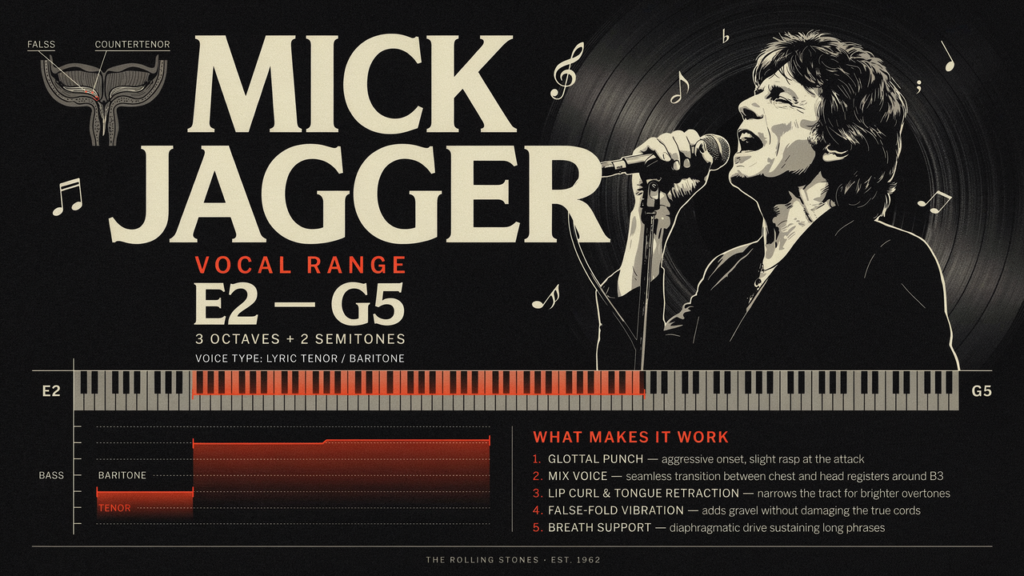
Mick Jagger Vocal Range at a Glance
| Detail | Value |
|---|---|
| Full Documented Range | E2–G5 |
| Span | ~3 octaves |
| Voice Type | Baritone |
| Lowest Note | E2 (82.4 Hz) |
| Highest Note | G5 (784 Hz) |
| Tessitura | A3–D5 |
| Known For | Raspy rock timbre, rhythmic aggression, stage presence |
What Voice Type Is Mick Jagger?
Mick Jagger is a baritone — a mid-weight male voice type sitting between tenor and bass-baritone. His natural tessitura (A3–D5) is characteristic of a standard dramatic baritone, though he frequently pushes into tenor territory for the rock songs that define the Rolling Stones’ catalogue. The tenor vs baritone comparison shows where his voice sits in the broader male voice spectrum.
His voice carries a natural rasp — partial hoarseness caused by minor tissue changes common in high-volume rock singers — that has become a defining timbral quality rather than a technical flaw. Many contemporary singers artificially produce a similar rasp; in Jagger’s case it is genuine.
What Makes Mick Jagger’s Voice Distinctive
Rhythmic aggression. His vocal style is as much rhythmic instrument as melodic voice. The placement of syllables, the clipping of word endings, and the way he “attacks” the beginning of phrases is more characteristic of percussion than of classical vocal technique.
Vocal stamina. Still performing stadium shows decades into his career, Jagger’s vocal longevity is remarkable. This reflects intelligent management of his instrument — he does not belt consistently at maximum volume, and his live voice has adjusted over decades to maintain sustainability.
Range versatility. The same voice that delivers the menacing low register of “Sympathy for the Devil” (E2–C4) also manages the upper rock belt of “Gimme Shelter” (up to G5) — a three-octave span maintained across a career of exceptional length.
Key Songs That Showcase His Range
“Sympathy for the Devil” (1968) — Classic lower-register performance in the E2–E4 zone.
“(I Can’t Get No) Satisfaction” (1965) — Mid-range A3–D4 aggression in its defining form.
“Gimme Shelter” (1969) — His highest documented range, pushing toward G5 in the climax.
“Wild Horses” (1971) — His lyric side: full mid-range warmth without the rhythmic aggression.
“Miss You” (1978) — Shows his falsetto capability and mid-range funk-influenced delivery.
How His Range Compares
Three octaves (E2–G5) is a strong professional range, well above the average singer. His upper range pushing to G5 is noteworthy for a natural baritone — compare to a standard baritone range ceiling of A4 and the extension is significant. Use the singer comparison tool to map his range against other rock legends.
Test Your Voice
Identify your baritone characteristics with the voice type test or check your low register with the deep voice test.
Frequently Asked Questions
What is Mick Jagger’s vocal range? E2 to G5 — approximately three octaves.
What voice type is Mick Jagger? Baritone — a mid-weight male voice, lower than a tenor and lighter than a bass-baritone.
How has Mick Jagger’s voice changed? His upper range has narrowed somewhat with age, which is natural. His lower register has deepened and gained character. His overall technique for managing the voice across a long performance has become more refined.
Is 3 octaves a good vocal range? Yes — three octaves is an excellent professional range. See is a 3-octave range good for a full breakdown.
What makes rock voices different from classical voices? Rock singing typically prioritises character, rhythmic expression, and emotional rawness over the technical precision and tonal purity of classical training. Voice type classifications apply to both, but the techniques and goals differ significantly.

John Mayer is a vocal analysis and music education writer specializing in vocal range testing, voice type analysis, pitch recognition, and singing improvement tools for singers, musicians, performers, and beginners. He creates practical content focused on vocal training, singing techniques, and voice analysis tools to help users better understand and improve their vocal abilities.