
Billie Eilish’s documented vocal range spans A2 to G5 — approximately 2.5 octaves — but her voice is defined far less by its range than by its extraordinary timbre, production philosophy, and the close-miked, breathy intimacy that made her a defining voice of the late 2010s and 2020s. Her voice type is a lower mezzo-soprano, with a chest voice that carries a dark, husky quality unusually low for her age.
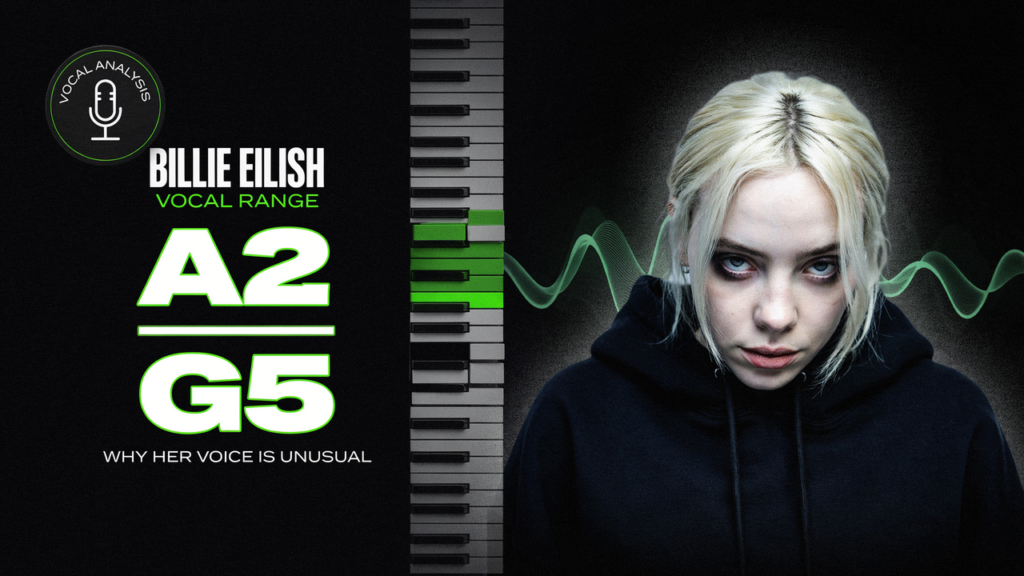
Billie Eilish Vocal Range at a Glance
| Detail | Value |
|---|---|
| Full Documented Range | A2–G5 |
| Span | ~2.5 octaves |
| Voice Type | Lower mezzo-soprano |
| Lowest Note | A2 (110 Hz) |
| Highest Note | G5 (784 Hz) |
| Tessitura | C4–D5 |
| Known For | Breathy timbre, whisper-singing, dark lower register |
What Voice Type Is Billie Eilish?
Billie Eilish is a lower mezzo-soprano — a mezzo-soprano whose natural tessitura sits toward the lower end of the mezzo range. Her most comfortable and characteristic vocal zone is C4 to D5, and her chest voice at A2–D4 carries a dark, heavy quality more associated with contralto voices.
She is not a contralto, despite the commonly held perception. True contraltos have a darker, heavier voice with significantly more chest resonance in the C3–F4 range. Eilish’s lower register is dark but primarily by timbral choice and microphone technique rather than the physiological weight of a true contralto.
Her vocal character was shaped as much by production decisions as by voice type: the ASMR-influenced, close-miked style developed with her brother Finneas O’Connell amplifies breathiness and removes the need for the volume and projection that classical voice type classification requires. In a classical singing context — at acoustic volume without amplification — she would likely read as a light-to-medium mezzo.
What Makes Billie Eilish’s Voice Distinctive
Breathy production. Her signature is a high air-to-sound ratio in the lower register — she pushes more breath through the vocal cords than most trained singers would, creating the intimate, almost whispered quality that defined her early recordings. Vocal coaches typically train students away from this quality, as it reduces projection and can cause strain over time. In Eilish’s case, it became her defining artistic choice.
Whisper-to-belt dynamic. Within a single song, she can move from a barely-audible whisper (D3) to a full-chest belt (G5). The dramatic contrast between these extremes creates tension and release that pure volume or range cannot replicate.
Dark lower register. Her A2–D4 range has a chest resonance that reads older and heavier than her age at the time of her debut. This unusual lower register quality, combined with her lyrical content, created an uncanny sonic persona.
Head voice control. Her upper register (E5–G5) is clean, light, and well-controlled — a contrast to the breathiness of her lower range. Check your own register with the head voice test.
Songs That Showcase Her Range
“Bad Guy” (2019) — The verses sit in her breathy lower register (B2–D4). The “duh” outro shows her lower tone at its most distinctive.
“When the Party’s Over” (2018) — Her most emotionally direct vocal performance, operating mostly in C4–D5 with notable restraint. The final phrases above E5 show her head voice quality.
“Happier Than Ever” (2021) — The second half shifts from a quiet, introspective verse into a belted rock-influenced section (E5–G5) that showcases the upper end of her range.
“Ocean Eyes” (2016) — Her debut and the clearest document of her natural head voice quality in the D4–E5 range.
“Lovely” (2018, with Khalid) — An A2–F5 span in a single performance; the building structure of the duet shows her range within a delicate delivery.
How Her Range Compares
At 2.5 octaves, Eilish’s range is on par with Adele and above the average professional singer. Her low note (A2) is the same as Adele’s, Beyoncé’s, and Whitney Houston’s — an interesting point that highlights how voice type is as much about where you live in your range as where it begins or ends.
Compare your range to hers with the singer comparison tool. Check your human vocal range position with the free range test.
Test Your Own Voice
The voice type test will identify if you share Eilish’s lower mezzo characteristics. The free vocal range test maps your full span. The voice quality test can give you a sense of your tonal character — breathy, clear, or mixed.
Frequently Asked Questions
What is Billie Eilish’s vocal range? Her documented range is A2 to G5 — approximately 2.5 octaves. Her most characteristic zone is C4 to D5.
What voice type is Billie Eilish? She is a lower mezzo-soprano — a mezzo-soprano with a naturally darker chest voice that sits toward the bottom of the mezzo range. She is not a contralto, despite the perceived darkness of her lower register.
Why does Billie Eilish’s voice sound so different? Several factors: a deliberately high air-to-sound ratio (breathiness) in her chest voice, close-miked production that amplifies intimacy, a naturally darker lower register, and a specific vocal personality shaped by her ASMR-influenced songwriting approach with her brother Finneas.
Is Billie Eilish a trained singer? She has not attended a formal conservatory or taken classical vocal training. She has worked with vocal coaches, and her technique — particularly her breath control and head voice quality — shows development over her career.
Can Billie Eilish belt? Yes. The second section of “Happier Than Ever” (2021) demonstrates her belting capability, reaching G5 with full chest-voice quality. It is a significant departure from her typical whisper-heavy style.

John Mayer is a vocal analysis and music education writer specializing in vocal range testing, voice type analysis, pitch recognition, and singing improvement tools for singers, musicians, performers, and beginners. He creates practical content focused on vocal training, singing techniques, and voice analysis tools to help users better understand and improve their vocal abilities.