
Celine Dion’s documented vocal range spans D3 to G6 — approximately 3.5 to 4 octaves — and her voice type is a dramatic soprano (lirico spinto), a classification that captures the combination of lyric warmth in her mid-range and the cutting power she sustains in her upper register. Few vocalists in pop history have combined the technical precision of a trained soprano with the emotional directness required for stadium-level commercial performance.
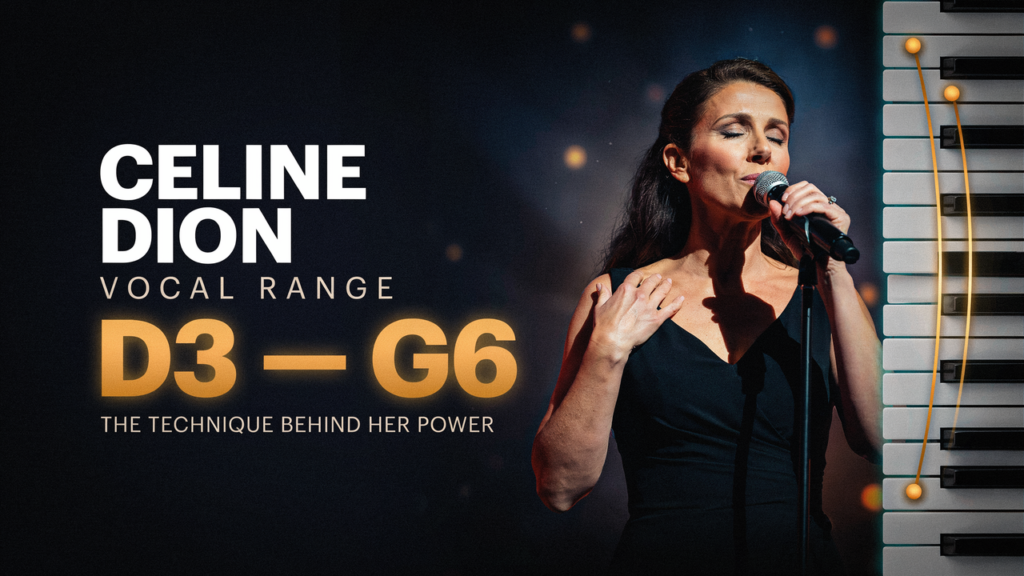
Celine Dion Vocal Range at a Glance
| Detail | Value |
|---|---|
| Full Documented Range | D3–G6 |
| Span | ~3.5–4 octaves |
| Voice Type | Dramatic soprano (lirico spinto) |
| Lowest Note | D3 (146.8 Hz) |
| Highest Note | G6 (1,568 Hz) |
| Tessitura | F4–C6 |
| Known For | Sustained power, precision, operatic technique in pop |
What Voice Type Is Celine Dion?
Celine Dion is a dramatic soprano — specifically a lirico spinto sopran in Italian operatic terminology — a soprano with the lyric warmth of a lighter soprano voice and the dramatic power and endurance of a heavier one. The spinto qualification means her voice can “push” (Italian: spingere) into demanding high passages without losing tone quality or sustaining ability.
This is a rare combination. Most lyric sopranos brighten and lose some body when pushed to high dynamics; most dramatic sopranos can push but sacrifice agility and lyric warmth. Dion’s voice maintains an unusual balance — her G6 in “The Power of Love” is bright and cutting, while her D3 carries warmth unusual for a soprano’s lower register.
Her classical vocal training began in Quebec when she was a teenager. She never pursued an operatic career, but the training is evident in her breath control, resonance placement, and the way she manages her passaggio. See the full vocal fach system for where lirico spinto sits in the classical hierarchy.
What Makes Celine Dion’s Voice Distinctive
Passaggio control. The break between chest and head voice is the technical challenge that separates professional singers from amateurs. Dion manages this transition with near-perfect smoothness, even at high dynamics — a skill that requires significant classical training.
Tonal consistency across dynamics. From a quiet D3 to a full-volume G6, her tone quality remains consistent. The bright, focused, forward-placed resonance does not shift significantly as she increases volume — a mark of correct breath support.
French Canadian vowel placement. Her French-language recordings reveal a different resonance placement from her English-language work — more nasal, more forward — and this occasionally bleeds into English recordings, giving her voice a characteristic brightness.
Lyric expressiveness. Unlike some powerful sopranos who sacrifice emotional nuance for sheer volume, Dion shapes phrases with dynamic variation, subtle vibrato control, and deliberate expressive choices. Analyse your own vibrato with the vibrato analyzer.
Songs That Showcase Her Range
“My Heart Will Go On” (1997) — Operates primarily in her E4–Bb5 tessitura, ending with a sustained Bb5 that demonstrates her soprano sustain.
“The Power of Love” (1993) — Contains the G6 that marks the upper documented limit of her range. One of the most technically demanding notes in mainstream pop.
“All By Myself” (1996) — Covers a wide dynamic range, from intimate verse passages in E4–G4 to the full-voiced climax pushing toward D6.
“To Love You More” (1995) — Shows her lyric soprano quality in a more restrained context, emphasising tone quality over raw power.
“I Drove All Night” (1992) — A full-range rock-influenced performance showing her belt and chest voice in a high-energy context.
How Her Range Compares
Compared to a standard soprano (C4–C6), her documented G6 extends two notes above that upper limit. Her D3 descends well below the typical soprano floor of C4, reflecting the lower extension of dramatic soprano voices.
The singer comparison tool maps her range against other artists. Find your own upper range with the high voice test.
Test Your Own Voice
If you suspect you’re a soprano or dramatic mezzo with strong upper range access, start with the high voice test to identify your upper limit. The voice type test will confirm your full classification. The free vocal range test gives you a complete picture in under two minutes.
Frequently Asked Questions
What is Celine Dion’s vocal range? Her documented range is D3 to G6 — approximately 3.5 to 4 octaves. Her most powerful and characteristic zone (tessitura) is F4 to C6.
What voice type is Celine Dion? She is a dramatic soprano (lirico spinto), combining lyric warmth in the mid-range with the power and endurance to sustain demanding high passages.
What is G6 in Hz? G6 is 1,568 Hz, well above the typical soprano ceiling of C6 (1,047 Hz). It requires a fully developed and well-placed head voice to produce with the volume and resonance Dion achieves on that note.
Has Celine Dion’s voice declined? She was diagnosed with Stiff Person Syndrome (SPS) in 2022, a rare neurological disorder that caused spasms affecting her ability to sing. She has been open about the impact on her voice and her career, with performances on hold while managing her health.
Who compares to Celine Dion vocally? Whitney Houston is the most frequent comparison — both dramatic sopranos with exceptional power and stamina. Barbra Streisand shares the lirico spinto soprano classification.

John Mayer is a vocal analysis and music education writer specializing in vocal range testing, voice type analysis, pitch recognition, and singing improvement tools for singers, musicians, performers, and beginners. He creates practical content focused on vocal training, singing techniques, and voice analysis tools to help users better understand and improve their vocal abilities.