
Elvis Presley’s documented vocal range spans G1 to Bb4 — approximately 2.5 octaves — with a voice type classified as bass-baritone. His lowest note, G1 (49 Hz), sits deep in the bass register rarely found in pop vocalists. His voice is one of the most recognisable in American music history — not because of its range, but because of the blend of gospel warmth, country twang, and rock energy that was genuinely new in the mid-1950s.
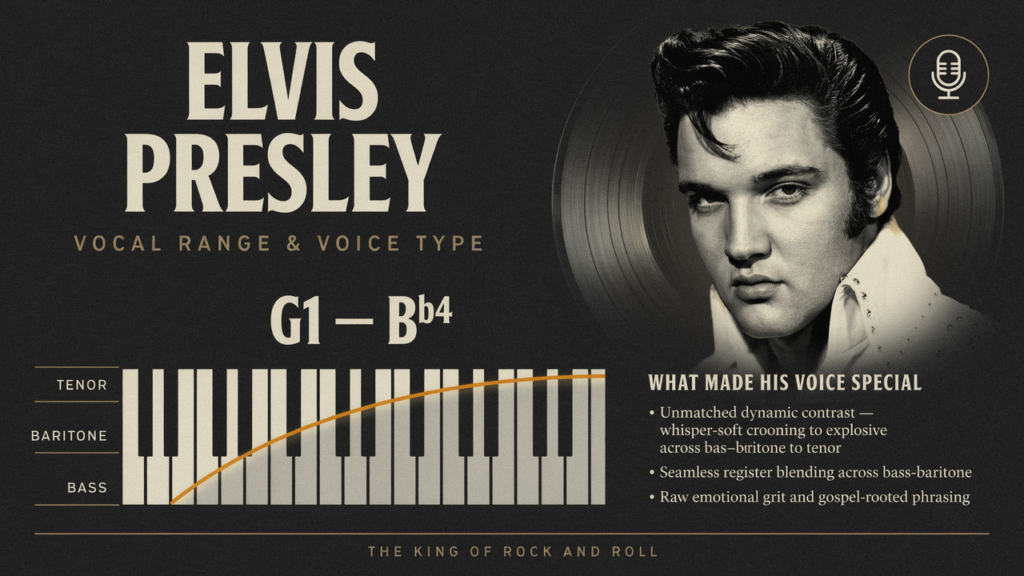
Elvis Presley Vocal Range at a Glance
| Detail | Value |
|---|---|
| Full Documented Range | G1–Bb4 |
| Span | ~2.5 octaves |
| Voice Type | Bass-baritone |
| Lowest Note | G1 (49 Hz) |
| Highest Note | Bb4 (466 Hz) |
| Tessitura | C3–G4 |
| Known For | Rich low register, gospel-country-rock blend, vibrato |
What Voice Type Was Elvis Presley?
Elvis Presley was a bass-baritone — a voice type positioned between the bass and baritone, with access to both the deep low notes of a bass and the warmer, more agile mid-range of a baritone. His natural tessitura (C3–G4) is characteristic of this voice type, sitting lower than a standard baritone but higher than a true bass.
His lowest documented note, G1 at 49 Hz, is extraordinary. Most bass singers operate down to E2 (82.4 Hz). G1 is below the lowest note on most piano keyboards and produces a vibration more felt than heard in conventional recording. The deep voice test regularly identifies voices this low as outliers — they represent fewer than 1% of male singers.
In the vocal fach system, he is most comparable to what German operatic tradition calls a Heldenbariton (heroic baritone) — a voice with the darkness and power of a bass-baritone but the upper extension and lyric quality of a dramatic baritone. See the bass-baritone vocal range guide for more context.
What Made Elvis Presley’s Voice Distinctive
Low register depth. His chest voice below E3 had a resonance and weight that most rock and pop singers simply do not possess. This anchored his sound physically — you felt his voice as much as heard it in recordings, even before the production technologies that later exaggerated low-frequency content.
Gospel-trained vibrato. His vibrato was wide, natural, and emotionally charged — developed in the gospel tradition through the Assembly of God church in Tupelo, Mississippi. Gospel vibrato tends to be more expressive and variable than classical-trained vibrato, reflecting the emotional priority of the tradition.
Stylistic synthesis. What made Elvis historically significant was not any single vocal quality but the synthesis of traditions his voice embodied simultaneously: the deep bass resonance of African-American gospel, the nasal twang of Appalachian country, and the rhythmic energy of R&B. No voice had combined these convincingly for a mainstream white American audience before 1954.
Upper register grit. His Bb4 upper limit is not a clean, bright soprano equivalent note but a powerful, slightly strained, emotionally raw sound — a characteristic of blues-influenced male singers who push the chest voice to its upper limit rather than transitioning to head voice.
Songs That Showcase His Range
“Old Shep” (1956) — An early recording that demonstrates his chest voice depth (down to around C2) before commercial production standards compressed his low end.
“It’s Now or Never” (1960) — Based on the Italian O Sole Mio, this recording shows his upper register (A4–Bb4) in an operatic-adjacent context, demonstrating how he adapted his naturally low voice to tenor-range material.
“Suspicious Minds” (1969) — Full-range performance covering C3–Bb4, showing the complete arc of his usable range in a late-career recording.
“If I Can Dream” (1968) — An emotionally charged performance that uses his mid-range power (F3–G4) to its fullest.
“American Trilogy” (1972) — The sustained low notes in the “Dixie” section document his bass depth, while the upper passages confirm his baritone agility.
How His Range Compares
A typical baritone spans A2 to A4. Elvis’s G1 lower note places him firmly in bass territory, while his Bb4 upper note matches a typical baritone ceiling. This confirms his bass-baritone classification — bridging both ranges rather than fitting neatly into one.
The singer comparison tool lets you map his range against other male artists on the site. To test your own low register, use the deep voice test.
Test Your Own Voice
If you’re drawn to the bass-baritone register, the deep voice test identifies how low your voice can go with a comparison to artists like Elvis. The voice hz test shows your exact speaking and singing frequency in Hz. The voice type test determines whether you’re baritone, bass, or bass-baritone.
Frequently Asked Questions
What was Elvis Presley’s vocal range? His documented range is G1 to Bb4 — approximately 2.5 octaves. His most characteristic performing zone was C3 to G4, where his voice had its characteristic warmth and resonance.
What voice type was Elvis Presley? He was a bass-baritone — a voice type between bass and baritone, with access to deep bass notes (G1) and the mid-range agility of a baritone.
How low could Elvis Presley sing? His documented lowest note is G1 (49 Hz), which sits below the lowest note on a standard guitar (E2 = 82.4 Hz) and at the extreme low end of human vocal capability. Most bass singers cannot reach below E2.
Was Elvis a classically trained singer? No. Elvis had no formal classical vocal training. His technique developed through gospel singing in church, listening to blues and country radio, and the intense practical training of live touring from his teenage years.
Who has a similar voice to Elvis Presley? Johnny Cash and Roy Orbison are the closest comparisons among classic American artists — both bass-baritones with roots in gospel and country. Josh Turner is a contemporary country bass-baritone with comparable low register depth.

John Mayer is a vocal analysis and music education writer specializing in vocal range testing, voice type analysis, pitch recognition, and singing improvement tools for singers, musicians, performers, and beginners. He creates practical content focused on vocal training, singing techniques, and voice analysis tools to help users better understand and improve their vocal abilities.