
Roger Daltrey’s documented vocal range spans Bb2 to B4 — approximately two octaves — with a voice type positioned at the baritone-tenor border. His voice sits in the baritone range naturally but regularly pushes into tenor territory — a characteristic shared by many classic rock frontmen. What defined his voice was not range but raw, unrestrained power: a voice built for arenas before arenas existed.
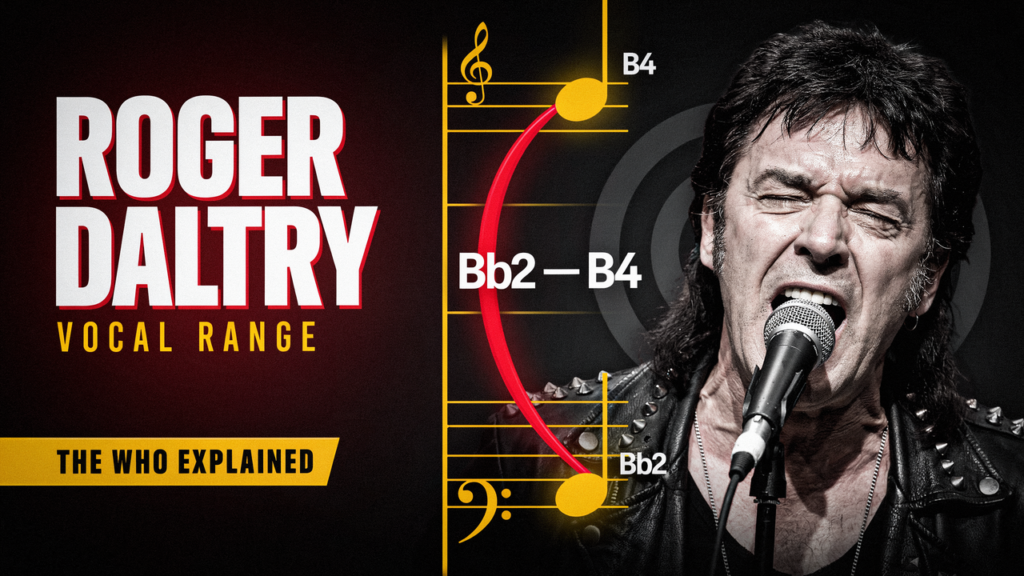
Roger Daltrey Vocal Range at a Glance
| Detail | Value |
|---|---|
| Full Documented Range | Bb2–B4 |
| Span | ~2 octaves |
| Voice Type | Baritone-tenor border |
| Lowest Note | Bb2 (116.5 Hz) |
| Highest Note | B4 (493.9 Hz) |
| Tessitura | D4–G4 |
| Known For | Raw power, aggressive delivery, rock stadium projection |
What Voice Type Is Roger Daltrey?
Roger Daltrey sits at the baritone-tenor border — his natural tessitura is baritone (D4–G4), but his performance style and the demands of The Who’s catalogue regularly take him into tenor territory above A4. This is a common position for classic rock tenors who have the physical capability to push their chest voice higher than a typical baritone would manage. The tenor vs baritone comparison is useful for understanding where his voice sits in the broader male voice spectrum.
What Makes Daltrey’s Voice Distinctive
Physical power. His voice has an aggressive, muscular quality that suggests significant chest resonance and abdominal breath support. In the pre-monitor era, rock singers developed their projection through pure acoustic effort, and Daltrey’s voice reflects that kind of physical vocal development.
Controlled aggression. Despite the raw sound, his performances show controlled shaping of phrases — the climax of “Won’t Get Fooled Again” is a structured vocal performance, not a scream.
Microphone technique. His famous “windmill” microphone swinging is theatrical but also practical — pulling the mic away on high-intensity moments keeps the dynamic in check during live recording.
Key Songs That Showcase His Range
“Won’t Get Fooled Again” (1971) — The scream at the 8:32 mark is one of rock’s most analysed vocal moments; estimated around A4–B4.
“Baba O’Riley” (1971) — Broad mid-range performance in E3–G4.
“Pinball Wizard” (1969) — Consistent energy across his full mid-range with powerful chest voice.
“Behind Blue Eyes” (1971) — His lyric side, showing controlled Bb2–E4 use with genuine emotional restraint.
Frequently Asked Questions
What is Roger Daltrey’s vocal range? Bb2 to B4 — approximately two octaves.
Is Roger Daltrey a tenor or baritone? He sits at the baritone-tenor border, with a baritone natural voice and tenor-range upper extension in rock performance contexts. See the tenor vs baritone guide for the full comparison.
What is Roger Daltrey known for vocally? His aggressive, high-volume power delivery, his physical stamina as a performer, and the raw, masculine quality of his upper chest voice in the G4–B4 range.

John Mayer is a vocal analysis and music education writer specializing in vocal range testing, voice type analysis, pitch recognition, and singing improvement tools for singers, musicians, performers, and beginners. He creates practical content focused on vocal training, singing techniques, and voice analysis tools to help users better understand and improve their vocal abilities.