
The lowest note ever sung in a verified public context is G-7 (0.189 Hz), achieved by American singer Tim Storms on March 30, 2012, verified by Guinness World Records. This frequency is approximately 8 octaves below the lowest note on a standard piano keyboard and produces a vibration so slow it is physically felt rather than heard — falling far below the 20 Hz threshold of human auditory perception. Tim Storms also holds the Guinness record for the widest vocal range ever documented.
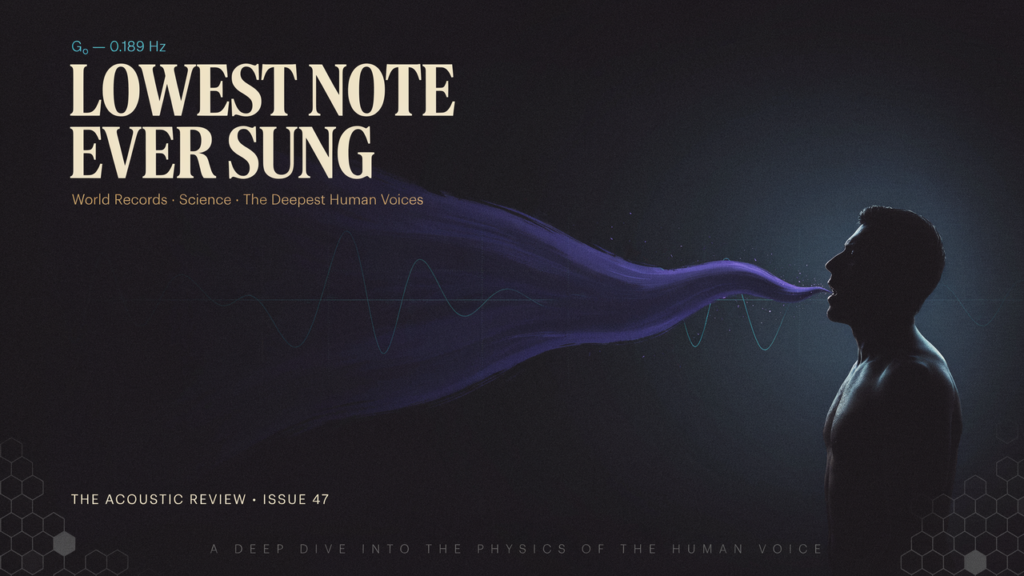
The Official Guinness World Record
| Detail | Information |
|---|---|
| Record Holder | Tim Storms (USA) |
| Note | G-7 (G negative 7) |
| Frequency | 0.189 Hz |
| Date Verified | March 30, 2012 |
| Record Type | Lowest note ever produced by a human voice |
| Register Used | Sub-bass chest voice / sub-modal |
| Verified By | Guinness World Records |
For context: the lowest note on a standard 88-key piano is A0 (27.5 Hz). Tim Storms’ G-7 at 0.189 Hz is approximately 145 times lower than the piano’s lowest key — a difference of more than seven octaves below the instrument floor.
At 0.189 Hz, the vibration occurs less than once per second. Human hearing begins at approximately 20 Hz. This note cannot be perceived as pitch by any human ear under any circumstances — it is detected by specialised acoustic measurement equipment, not by listening.
What Makes a Human Voice Capable of Extreme Low Notes?
The Physiology of Deep Voice
Low notes require the vocal cords to vibrate more slowly. Frequency and cord vibration are directly proportional — lower frequency = slower vibration rate. Factors that enable lower notes:
Vocal cord length and mass: Longer, heavier vocal cords vibrate more slowly. Adult male vocal cords average 17–25mm in length; adult female cords average 12.5–17.5mm. Tim Storms has unusually long vocal cords for a male singer, documented by acoustic researchers.
Cord thickness: Thicker cords vibrate more slowly. The thyroarytenoid (TA) muscles that control cord thickness can be developed to maintain greater mass at lower frequencies.
Laryngeal size: A larger larynx (the cartilaginous housing of the vocal cords) creates a larger vibrating chamber, contributing to deeper resonance. This is partly why taller, larger-bodied individuals tend toward lower voice types.
Subharmonic production: Some deep voice singers can produce subharmonic vibration — where the cords vibrate at a fraction of their standard rate (half, one-third, one-quarter speed), creating notes an octave or more below the fundamental. This is a rare physiological ability believed to be structural rather than purely trained.
The Human Hearing Threshold: What “Lowest Note” Actually Means
Human hearing operates between approximately 20 Hz and 20,000 Hz, though both limits vary by individual and change with age. Below 20 Hz — called the infrasound range — the human auditory system cannot perceive sound as pitch. Instead, very low frequencies (4–16 Hz) are felt as physical vibrations.
This creates an important distinction in “lowest note” records:
| Threshold | Hz | Significance |
|---|---|---|
| Lowest audible note (standard) | ~20 Hz | Human hearing floor |
| Lowest piano key (A0) | 27.5 Hz | Standard acoustic low reference |
| Typical bass voice floor | 82.4 Hz (E2) | Classical bass range floor |
| Tim Storms (audible) | ~20–30 Hz | Near the absolute hearing limit |
| Tim Storms (record) | 0.189 Hz | Far below human hearing — physically felt |
The more musically meaningful question is: what is the lowest note a singer has produced within the range of human hearing?
Lowest Audible Notes in Music
Tim Storms — Audible Low
Tim Storms has documented notes at or near the threshold of human hearing in live performance contexts. His verified audible low for musical purposes (notes that can be perceived as pitch by a human listener) is approximately E1 (41.2 Hz) — well below the classical bass floor of E2 (82.4 Hz) and comparable to the lowest notes on a bass guitar.
Tim Foust (Home Free)
American bass singer Tim Foust of the a cappella group Home Free regularly demonstrates notes approaching A0 (27.5 Hz) — the lowest piano key — in live performance. At these frequencies, the sound is perceived more as a rumble or physical pressure than a clear pitch.
Lowest Notes by Major Artists
| Artist | Lowest Documented Note | Hz | Context |
|---|---|---|---|
| Elvis Presley | G1 | 49 Hz | Studio recordings |
| Post Malone | B1 | 61.7 Hz | Commercial recordings |
| [Johnny Cash] | D2 | 73.4 Hz | Country recordings |
| Barry White | D2 | 73.4 Hz | R&B recordings |
| Josh Turner | B1 | 61.7 Hz | Country recordings |
| Marvin Gaye | A2 | 110 Hz | Soul recordings |
| Frank Sinatra | A2 | 110 Hz | Jazz/pop recordings |
Bass Voice Types and Their Low Note Ranges
The depth of a singer’s low range is the primary distinguishing factor between bass voice subcategories:
| Voice Type | Classical Low Limit | Hz | Context |
|---|---|---|---|
| Bass-Baritone | F2 | 87.3 Hz | Standard classical floor |
| Bass | E2 | 82.4 Hz | Standard classical floor |
| Basso profundo | C2 | 65.4 Hz | Deepest classical bass subcategory |
| Basso profundo (extreme) | A1 or below | 55 Hz or below | Extreme outliers |
The basso profundo (Italian: “deep bass”) is the deepest classical bass subcategory — a full operatic bass voice with an extended low register. Russian Orthodox choral music particularly values the basso profundo for its resonant depth in sacred choral writing.
Test your own low register with the deep voice test, which measures your lowest comfortable pitch in Hz. The voice hz test shows your speaking voice frequency in real time.
Tim Storms: The Voice Behind Both Records
Tim Storms holds two Guinness World Records simultaneously:
- Lowest note ever sung — G-7 (0.189 Hz), March 30, 2012
- Widest vocal range ever documented — G-7 to G5, spanning over 10 octaves
The second record is partially dependent on the first — the extraordinary width of his documented range reflects the extreme sub-bass notes rather than an equivalently extreme upper range. His G5 upper limit is a strong professional bass upper range but not particularly unusual. The remarkable achievement is the sub-infrasound lower register.
Voice scientists who have studied Storms believe he may produce subharmonic vibrations in his extreme low range — where the vocal cords vibrate at a fraction of their standard rate — rather than fundamental phonation in the traditional sense. This is a debated area of voice research.
How Deep Is the Average Male Voice?
For context against the world records:
| Voice Category | Average Speaking Pitch | Singing Low Note |
|---|---|---|
| Average adult male | 85–155 Hz | ~G2 (98 Hz) |
| Trained baritone | 100–130 Hz | ~A2 (110 Hz) |
| Trained bass | 80–100 Hz | ~E2 (82.4 Hz) |
| Trained basso profundo | 70–90 Hz | ~C2 (65.4 Hz) |
| Tim Storms (world record) | Below 50 Hz | 0.189 Hz (record) / ~20 Hz (audible) |
The average vocal range guide covers typical ranges for all voice types in detail.
Test Your Own Low Voice
The deep voice test measures your lowest comfortable pitch in Hz and compares it to documented bass and bass-baritone singers. The voice hz test shows your speaking voice frequency in real time. The voice type test determines whether you’re a bass, bass-baritone, or baritone based on your full range.
Frequently Asked Questions
Who holds the record for the lowest note ever sung? Tim Storms (USA) holds the Guinness World Record at G-7 (0.189 Hz), verified on March 30, 2012.
Can humans actually hear G-7 (0.189 Hz)? No. Human hearing begins at approximately 20 Hz. G-7 at 0.189 Hz is far below the auditory threshold — it cannot be perceived as sound or pitch by any human ear. It can be detected by acoustic measurement equipment and felt as physical vibration at close range.
What is the lowest note a singer can produce within human hearing? Tim Storms and Tim Foust have both demonstrated notes at or near A0 (27.5 Hz) in live contexts — at the very threshold of human hearing where pitch perception becomes difficult to distinguish from physical vibration. These are the most extreme audible notes documented in musical contexts.
What voice type has the lowest range? The basso profundo is the deepest classical bass subcategory, with exceptional singers reaching C2 (65.4 Hz) or below. In popular music, bass-baritone artists like Elvis Presley (G1 = 49 Hz) have documented some of the lowest commercial recordings.
How does the lowest note ever sung compare to the lowest piano key? The lowest piano key is A0 (27.5 Hz). Tim Storms’ world record G-7 at 0.189 Hz is approximately 145 times lower in frequency — more than 7 octaves below the piano floor.
What is the lowest note in the human hearing range? The lower threshold of human hearing is approximately 20 Hz, though this varies by individual. Below 20 Hz is the infrasound range — physically present vibration that the body can feel but the ears cannot process as pitch.

John Mayer is a vocal analysis and music education writer specializing in vocal range testing, voice type analysis, pitch recognition, and singing improvement tools for singers, musicians, performers, and beginners. He creates practical content focused on vocal training, singing techniques, and voice analysis tools to help users better understand and improve their vocal abilities.