
Layne Staley’s documented vocal range spans Bb2 to A5 — approximately three octaves — with a voice type most accurately described as a dramatic tenor. He is one of the most distinctive and emotionally devastating vocalists in rock history: a voice that combined a dark, almost subterranean chest resonance with a searingly powerful upper register, all delivered with an expressive vibrato that communicated anguish more directly than the words themselves.
As the lead vocalist of Alice in Chains from 1987 until his death in 2002, Staley created a body of work that permanently shaped how heavy rock vocals could be used.
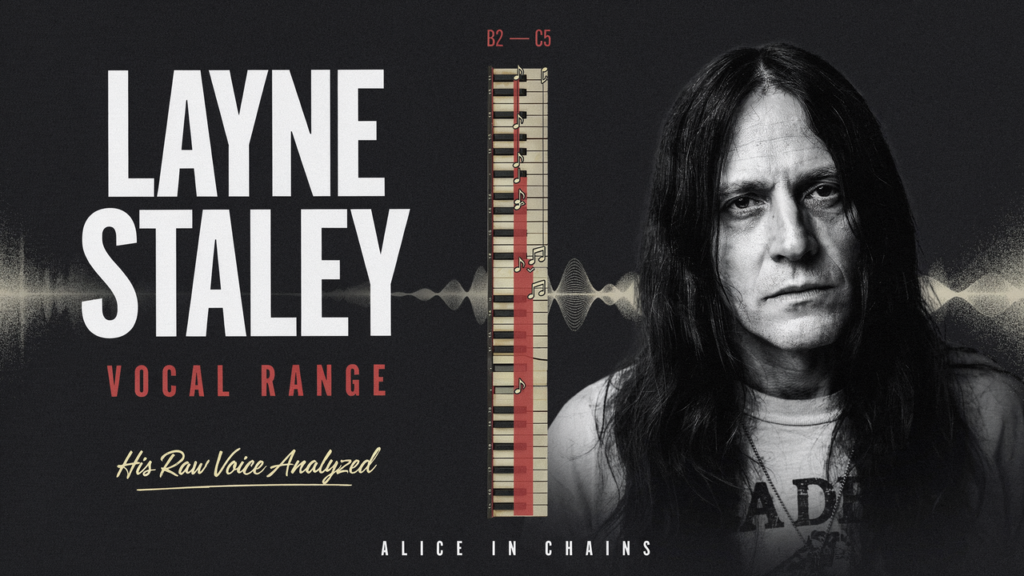
Layne Staley Vocal Range at a Glance
| Detail | Value |
|---|---|
| Full Documented Range | Bb2–A5 |
| Span | ~3 octaves |
| Voice Type | Dramatic tenor |
| Lowest Note | Bb2 (116.5 Hz) |
| Highest Note | A5 (880 Hz) |
| Tessitura | C#3–F5 |
| Known For | Dark chest resonance, expressive vibrato, harmonic dissonance with Cantrell |
What Voice Type Was Layne Staley?
Layne Staley is most accurately classified as a dramatic tenor — a tenor with more weight and darkness in the voice than a lyric tenor, capable of carrying over heavy instrumentation without losing tonal character. Some vocal analysts classify him as a baritone based on the dark quality of his lower register and speaking voice, but his sustained performance in the C#3–F5 zone and his upper chest voice capability above F4 point toward a dramatic tenor classification.
The comparison most often made is with Chris Cornell — another dramatic tenor from the Seattle grunge era — and Eddie Vedder, a true baritone whose lower tessitura clearly distinguishes him from Staley’s higher natural zone. Staley sits between them: darker and heavier than Cornell’s brighter spinto sound, higher and more piercing than Vedder’s baritone depth.
In the vocal fach system, Staley would be classified as a dramatischer Tenor — a dramatic tenor built for emotionally intense, heavy material rather than the lyric lightness of a Mozart or Handel tenor.
What Made Layne Staley’s Voice Distinctive
No other rock vocalist of his era or since has produced exactly Staley’s combination of qualities. Several features defined his voice:
Dark Chest Resonance
His chest voice — particularly in the C#3–D4 zone — carried an unusual darkness for a tenor. Where most dramatic tenors have a bright, forward-placed sound, Staley’s voice sat back in the throat more, creating a heavier, almost menacing quality even at moderate dynamics. This darkness was a physiological characteristic, not a stylistic choice — it is audible even in his quieter, more restrained performances (“Nutshell,” “Don’t Follow”).
The Vibrato
Staley’s vibrato is one of the most emotionally expressive in rock music. Wide in pitch deviation, moderate in speed (approximately 5–6 Hz), and appearing not just on held notes but within phrases — rising and falling in emotional intensity with the lyrical content. The vibrato had an almost trembling quality at its most intense, directly communicating the emotional states described in the lyrics. This is the musical parallel of a voice breaking under emotional weight.
Harmonic Identity With Jerry Cantrell
A distinctive element of Staley’s vocal presentation was how he harmonised with guitarist Jerry Cantrell. Alice in Chains routinely used dissonant parallel harmonies — intervals that create tension rather than resolution, particularly minor seconds and tritones — rather than the conventional major-third harmonies of most rock bands. Staley’s ability to locate and sustain these tension-heavy intervals precisely while maintaining his own tonal character was remarkable. The result was a sound that felt psychologically unsettling in a way that no other rock band of the era achieved.
Upper Register Intensity
His notes above D5 — while not used frequently — carried exceptional intensity. The A5 documented in recordings like “Angry Chair” is a chest-dominant push to the upper tenor range with a quality that communicates raw desperation. Unlike many rock vocalists who use falsetto for high notes, Staley drove his upper range with full voice, giving his high notes a strained, urgent quality that was clearly intentional rather than a technical limitation.
Control of Dynamics
Across the Alice in Chains catalogue, Staley demonstrated a wide dynamic range — from the near-whispered intimacy of “Down in a Hole” to the full-voiced rage of “Angry Chair.” The ability to maintain tonal character and pitch accuracy across this dynamic spectrum is a mark of a technically capable singer, even when the style does not signal classical training.
Songs That Showcase His Range
“Angry Chair” (1992) — His most documented upper range performance. The aggressive chest voice push above E5 documents his upper limit in a sustained, sustained musical context. The verse material in the D3–G4 zone shows his natural tessitura.
“Would?” (1992) — Full range display from C#3 to B4, showing the mid-range power that characterised his most forceful performances. The final chorus demonstrates his chest voice at full intensity.
“Down in a Hole” (1992) — Shows his lower register (Bb2–D4) in a restrained, emotionally controlled context. The contrast between the quiet verses and the soaring chorus is a demonstration of his dynamic range.
“Nutshell” (1994) — The most lyrical side of his voice: a B2–E5 performance in an acoustic context that strips away distortion and heavy production, revealing the pure quality of his instrument.
“Rooster” (1992) — A full-range performance showing both the dark lower register (B2–D3) and his most resonant mid-range power (E4–G4) in a single song arc.
“Man in the Box” (1990) — Iconic use of a nasal, half-falsetto quality in the verse contrasted against the full chest voice belt of the chorus — a deliberate sonic contrast that demonstrates his register control.
“Hate to Feel” (1992) — One of his most technically demanding recordings, showing his ability to sustain full-voice intensity across an extended performance without quality deterioration.
How His Range Compares
Staley’s Bb2–A5 span — approximately three octaves — places him comfortably in the professional tier. For a dramatic tenor, this range is standard: the low notes reflect the baritone-adjacent quality of the dramatic tenor voice, while the A5 upper limit is a strong upper extension for a non-operatic rock singer.
Among rock contemporaries:
- Chris Cornell had a wider documented range (approximately 4 octaves: A2–D6), including an exceptional falsetto extension — a lighter, brighter instrument than Staley’s
- Eddie Vedder has a lower tessitura and voice type (baritone), making direct range comparison less meaningful than tonal comparison
- Kurt Cobain had a comparable range but a higher tessitura and a rawer, less technically polished delivery
The singer comparison tool lets you visually map Staley’s range against other rock artists. To find your own range and see how it compares, use the free vocal range test.
Test Your Own Voice
If you’re drawn to the dark, chest-heavy sound of Layne Staley’s style, the voice type test will identify whether you’re a dramatic tenor, baritone, or other voice type. The voice quality test analyses your tonal characteristics — whether your voice carries the darker, heavier quality of a dramatic voice or a lighter, brighter quality. The deep voice test confirms how low your register descends.
Frequently Asked Questions
What was Layne Staley’s vocal range? His documented range is Bb2 to A5 — approximately three octaves. His most characteristic performing zone (tessitura) was C#3 to F5, where his voice carried its most distinctive dark power.
What voice type was Layne Staley? He is most accurately classified as a dramatic tenor — a heavier, darker tenor with more emotional weight than a lyric tenor, capable of sustaining power over heavy instrumentation. Some analysts classify him as a baritone due to the dark quality of his lower register, but his tessitura and upper range point toward dramatic tenor.
How does Layne Staley’s voice compare to Chris Cornell? Both are dramatic tenors from the Seattle grunge era, but Cornell’s voice was brighter, higher-sitting, and more classically oriented in its upper extension — he had a remarkable falsetto that Staley rarely employed. Staley’s voice was darker and heavier in the mid-range, with a more haunting emotional quality. Both are among the most studied voices in rock history.
Why did Layne Staley’s voice change in his later recordings? His vocal quality deteriorated in his final years, most audibly in the 1996 Alice in Chains (self-titled) album and the 1996 Unplugged performance. The changes — reduced power, some pitch instability, a more fragile quality — are consistent with the physical deterioration caused by his heroin addiction, which significantly impaired his overall health. Despite this, his Unplugged performance remains one of the most emotionally powerful vocal documents in rock music.
What made the Alice in Chains vocal harmonies so distinctive? Staley and Jerry Cantrell used dissonant parallel harmonies — particularly tritones (augmented fourths/diminished fifths) and minor seconds — rather than the conventional major and minor thirds of most rock harmony. These intervals create unresolved tension rather than consonance, giving the band’s vocal sound its characteristically unsettling, dark quality. Cantrell’s lower baritone voice against Staley’s darker tenor created a unique harmonic blend that defined the band’s sonic identity.
Who has a similar voice to Layne Staley? Chris Cornell is the most frequent comparison — same era, same city, similar voice weight. Mark Lanegan (Screaming Trees) had a comparable dark, heavy quality in a baritone register. Layne Staley’s son-in-law William DuVall, who became the lead vocalist of Alice in Chains after Staley’s death, has a lighter voice type that shows the difficulty of replacing Staley’s specific timbral combination.

John Mayer is a vocal analysis and music education writer specializing in vocal range testing, voice type analysis, pitch recognition, and singing improvement tools for singers, musicians, performers, and beginners. He creates practical content focused on vocal training, singing techniques, and voice analysis tools to help users better understand and improve their vocal abilities.