
Dolly Parton’s documented vocal range spans A3 to B5 — approximately two octaves — with a voice type classified as light soprano. Her bright, bell-like tone and effortless upper register place her firmly in soprano territory, though her country and Appalachian folk influences give her voice a character quite different from classical soprano training. She is one of the most gifted natural sopranos in popular music history.
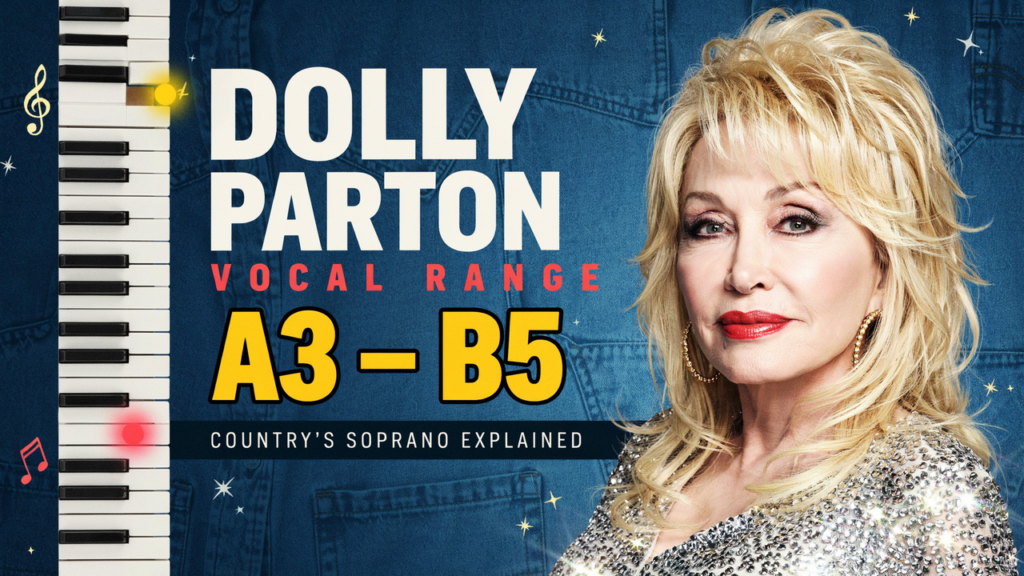
Dolly Parton Vocal Range at a Glance
| Detail | Value |
|---|---|
| Full Documented Range | A3–B5 |
| Span | ~2 octaves |
| Voice Type | Light soprano |
| Lowest Note | A3 (220 Hz) |
| Highest Note | B5 (987.8 Hz) |
| Tessitura | F4–G5 |
| Known For | Pure bright tone, natural upper register, Appalachian folk roots |
What Voice Type Is Dolly Parton?
Dolly Parton is a light soprano — the lightest soprano subcategory, characterised by a bright, pure tone and natural ease in the upper register. Her tessitura sits between F4 and G5, where her voice is at its clearest and most effortless.
Unlike heavier soprano voices that carry power through a wider resonating instrument, her voice is characterised by purity and focus — qualities developed through years of Appalachian folk singing tradition before she ever set foot in Nashville. Her mountain-region upbringing gave her a high, clear singing style that is physiologically natural rather than technically acquired. See the soprano vocal range guide for context on how light soprano fits within the broader soprano classification.
What Makes Her Voice Distinctive
Natural upper register brightness. Her notes above E5 carry a purity and ease that most trained sopranos spend years developing through technique. In her case, it appears to be physiologically natural.
Country-folk diction. Her vowel placement — influenced by Appalachian speech patterns — gives her voice a distinctive character that separates it from urban country or polished pop singing.
Yodelling technique. Her early recordings include elements of Appalachian yodelling — rapid alternation between chest and head voice — that reflects her roots and demonstrates excellent register transition control. This is essentially the same technique as the vocal break / passaggio used intentionally as a style element.
Key Songs That Showcase Her Range
“I Will Always Love You” (1973) — The original, in Parton’s soprano key. Compare to Whitney Houston’s version to hear the voice type difference between light soprano and dramatic soprano on the same song.
“Jolene” (1973) — A3 to Bb5 across the song; her most analysed and enduring performance.
“Coat of Many Colors” (1971) — Shows her natural, unadorned light soprano in its folk roots context.
“Here You Come Again” (1977) — Commercial pop production showcasing her C5–G5 upper zone.
How Her Range Compares
Two octaves (A3–B5) is a focused professional range. What makes it distinctive is that the entire span sits in the upper female register — her lowest note (A3 = 220 Hz) is higher than many female pop singers’ comfortable mid-range. Compare her range against other sopranos with the singer comparison tool.
Frequently Asked Questions
What is Dolly Parton’s vocal range? A3 to B5 — approximately two octaves.
What voice type is Dolly Parton? Light soprano — the purest and most agile soprano subcategory, with a natural upper register and Appalachian folk character.
How is Dolly’s version of “I Will Always Love You” different from Whitney Houston’s? Parton wrote and recorded the song first as a country ballad in a soprano key. Whitney Houston later recorded it as a dramatic soprano/spinto soprano performance in a lower key with significantly higher production values and dynamic range. Both are authentic to the singers’ respective voice types. See the soprano vocal range guide to understand both classifications.
What is a light soprano? A light soprano (also called lyric soprano or leggero soprano) is the lightest soprano subcategory — a voice with a bright, agile quality and a natural ease in the upper register. It differs from a dramatic soprano in weight, power, and the ability to sustain loud high notes for extended periods.

John Mayer is a vocal analysis and music education writer specializing in vocal range testing, voice type analysis, pitch recognition, and singing improvement tools for singers, musicians, performers, and beginners. He creates practical content focused on vocal training, singing techniques, and voice analysis tools to help users better understand and improve their vocal abilities.