
Post Malone’s documented vocal range spans B1 to Bb4 — approximately three octaves — with a voice type classified as bass-baritone. His B1 (61.7 Hz) is one of the lowest notes documented for a mainstream contemporary artist. Often underestimated as a vocalist due to his rapper-singer identity, Post Malone possesses genuine vocal depth that has grown more prominent as he has moved toward rock and country influences in recent years.
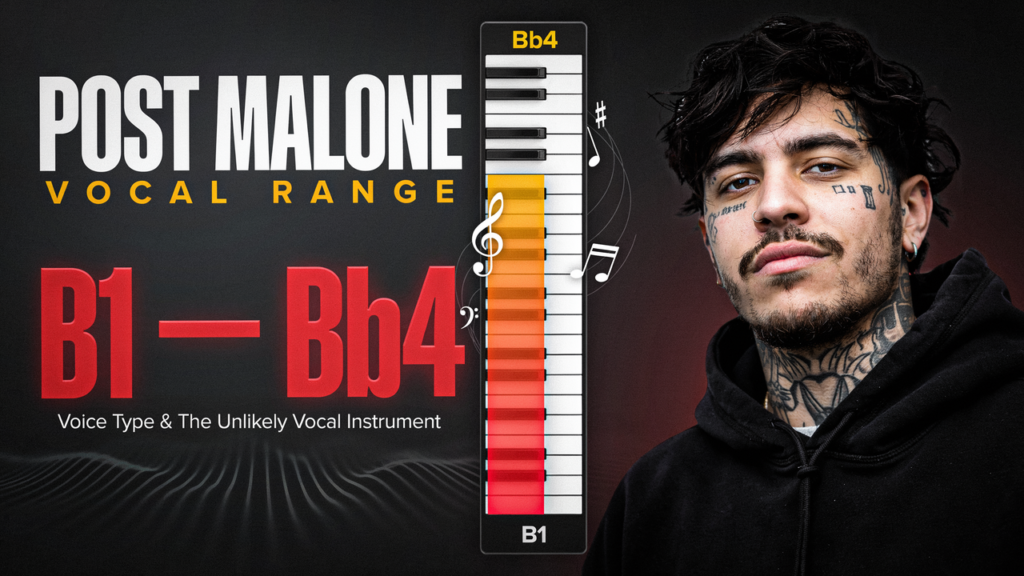
Post Malone Vocal Range at a Glance
| Detail | Value |
|---|---|
| Full Documented Range | B1–Bb4 |
| Span | ~3 octaves |
| Voice Type | Bass-baritone |
| Lowest Note | B1 (61.7 Hz) |
| Highest Note | Bb4 (466.2 Hz) |
| Tessitura | C3–F4 |
| Known For | Deep low register, melodic rap, crossover versatility |
What Voice Type Is Post Malone?
Post Malone is a bass-baritone — a voice type positioned between bass and baritone, with access to both the deep resonance of a bass and the mid-range agility of a baritone. His natural tessitura (C3–F4) sits in classic bass-baritone territory, and his B1 low note (61.7 Hz) is genuinely extraordinary — comparable to trained operatic basses.
His voice is often heavily processed in commercial recordings (reverb, autotune, vocal layering). In acoustic or minimal-production contexts, a more nuanced instrument is revealed: a warm, accurate bass-baritone with good pitch instincts and better technical control than his studio work might suggest.
See the bass-baritone vocal range guide for context on his voice type classification.
What Makes His Voice Distinctive
Extreme low register. His chest voice below E2 produces genuine bass resonance — physically present low-frequency vibration. This places him in a small group of contemporary artists with true bass vocal physiology. Check how low your own voice goes with the deep voice test.
Genre versatility. His voice has adapted convincingly to hip-hop, pop, country, and rock contexts — an unusual flexibility for a bass-baritone, a voice type often associated with formal classical repertoire.
Melodic instinct. His approach to melody in pop-rap contexts — particularly in songs like “Circles” — demonstrates genuine melodic phrasing ability that goes beyond the rhythmic pattern of conventional rap.
Key Songs That Showcase His Range
“Circles” (2019) — His most melodically developed work, showing the B2–E4 range of his natural tessitura.
“White Iverson” (2015) — Early career document of his bass depth and melodic rap style.
“I Fall Apart” (2016) — Demonstrates genuine vocal emotion in the E3–Bb4 range.
“Cold” (2017) — Acoustic-adjacent production that reveals his voice character without heavy processing.
“Go Flex” (2016) — Shows his lowest documented chest voice in a hip-hop context.
How His Range Compares
His B1 low note is comparable to Elvis Presley’s G1 — an extraordinarily rare low for a contemporary pop-rap artist. The deep voice test and voice hz test can confirm how your own low register compares. See where he ranks on the vocal range chart.
Frequently Asked Questions
What is Post Malone’s vocal range? B1 to Bb4 — approximately three octaves.
What voice type is Post Malone? Bass-baritone, with a documented low note (B1 = 61.7 Hz) that places him among the lowest-voiced mainstream contemporary artists.
Is Post Malone a trained singer? No formal classical training. His vocal development has been self-directed through studio work and performance, with increasingly refined melodic technique visible across his catalogue.
How does Post Malone’s voice compare to other deep-voiced artists? His B1 sits below Tim Storms (audible low E1), comparable to Elvis Presley (G1), and lower than most mainstream artists. The baritone vs bass comparison shows where his voice sits in the deep male voice spectrum.

John Mayer is a vocal analysis and music education writer specializing in vocal range testing, voice type analysis, pitch recognition, and singing improvement tools for singers, musicians, performers, and beginners. He creates practical content focused on vocal training, singing techniques, and voice analysis tools to help users better understand and improve their vocal abilities.