
Whitney Houston’s vocal range spans A2 to C6 — approximately 3.5 octaves — but range alone doesn’t explain her status as one of the greatest singers in recorded history. Her voice type is a dramatic soprano with a mezzo-soprano tessitura: a rare combination that gave her both the lower warmth of a mezzo and the soaring power of a true soprano. Her C6 in “I Will Always Love You” remains one of the most celebrated single notes in pop music.
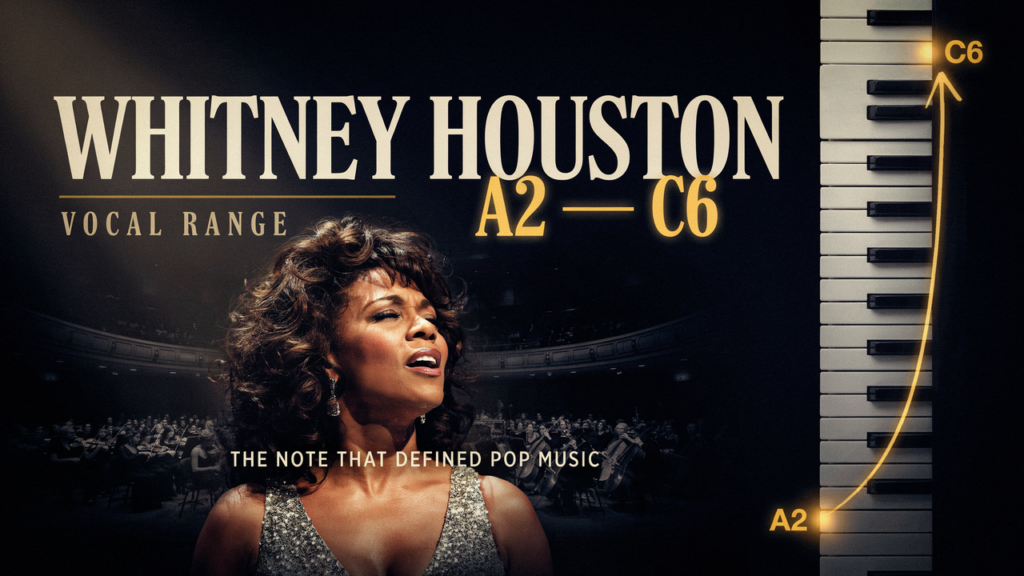
Whitney Houston Vocal Range at a Glance
| Detail | Value |
|---|---|
| Full Documented Range | A2–C6 |
| Span | ~3.5 octaves |
| Voice Type | Dramatic soprano (spinto) |
| Lowest Note | A2 (110 Hz) |
| Highest Note | C6 (1,047 Hz) |
| Tessitura | F4–A5 |
| Known For | Sustained power, emotional delivery, technical control |
What Voice Type Is Whitney Houston?
Whitney Houston is most accurately classified as a dramatic soprano — sometimes called a spinto soprano — a voice type known for combining power with emotional weight. Unlike the lighter lyric soprano, a spinto soprano can sustain high notes at full volume and carry over large orchestras without strain.
Her tessitura — the range where her voice was most comfortable and resonant — sat between F4 and A5, which is slightly lower than a typical soprano. This placed her naturally in the upper dramatic range, and she often chose keys that kept her voice in that powerful zone.
Some vocal analysts classify her as a mezzo-soprano based on her rich lower register (A2–E4), but her sustained C6 in live performances, her bright head voice above G5, and her classical vocal weight point firmly toward soprano. For context on where this sits in the full voice type system, a dramatic soprano is the heaviest of the soprano subcategories — closer to a mezzo in colour, but unmistakably soprano in range and register.
What Made Whitney Houston’s Voice Distinctive
Absolute power at the top. Most singers sacrifice tone quality for volume at high notes. Houston maintained a round, open, fully resonant sound up to and including C6 in live settings — a level of technical control that even trained opera singers rarely demonstrate.
Phrasing and breath control. Her breath control was extraordinary. She could sustain notes for extended durations while maintaining dynamic shape — getting louder at the end of a phrase rather than tapering off, which creates an effect of overwhelming emotional release.
Lower register warmth. Below D4, her voice carries a darker, almost contralto-like quality that gave her ballads emotional gravitas. This is the mezzo characteristic in her voice — and it meant she could build from a quiet, low phrase to a full belted climax across a song’s arc.
Vibrato. Her vibrato was natural, unhurried, and controlled. It appeared at the end of sustained notes rather than throughout, which is a sign of professional vocal discipline. Excessive vibrato throughout a phrase usually indicates tension; hers appeared only when the note was fully supported.
Songs That Showcase Her Range
“I Will Always Love You” (1992) — The climactic C6 in the final chorus is the most analysed note in modern pop. The key modulation before it (from Db to Eb major) creates maximum tension before the release.
“Greatest Love of All” (1985) — Demonstrates her mid-range control and legato phrasing. The emotional arc of this performance shows her interpretive mastery rather than raw range.
“I Have Nothing” (1992) — One of her most technically demanding recordings. The song covers her full tessitura from D4 to Bb5 within a single verse-chorus cycle.
“One Moment in Time” (1988) — Shows her ability to build a performance dynamically, ending with sustained high belts that demonstrate the spinto soprano’s characteristic stamina.
“Saving All My Love for You” (1985) — Showcases her lighter head voice and control at moderate dynamics, contrasting with the power performances she’s better known for.
How Whitney Houston’s Range Compares
With 3.5 octaves, Houston’s range is above the average professional singer (typically 2–2.5 octaves for untrained voices, 2.5–3 for trained performers). What set her apart was not the span itself — many singers have wider documented ranges — but the quality and power she maintained across every note.
Compare her to a typical soprano (C4–C6) and you can see that her documented range extends a fifth below the classical soprano floor. Compare to a mezzo-soprano (G3–B5) and you see she goes further above. She occupied a unique space between the two.
Use the singer comparison tool to map her range against other artists, or test your own voice type to see which category you fall into.
Test Your Own Vocal Range
If Whitney Houston’s voice inspires you to understand your own, start with the free vocal range test. The high voice test identifies your upper limit — whether that’s a modest E5 or something approaching soprano territory. The voice quality test can also give you a sense of your vocal weight and tone character.
Frequently Asked Questions
What was Whitney Houston’s highest note? Her documented highest note is C6 (1,047 Hz), heard most famously in the live and recorded versions of “I Will Always Love You.” Some sources cite Db6 in certain live recordings.
What voice type was Whitney Houston? She was a dramatic soprano, also described as a spinto soprano. While her lower register had mezzo-like warmth, her power and range above G5 firmly classify her as a soprano.
How did Whitney Houston’s vocal range compare to Mariah Carey’s? Mariah Carey has a wider documented range (E2–G#7, ~5 octaves) compared to Houston’s A2–C6 (~3.5 octaves). However, most vocal analysts consider Houston’s voice superior in terms of power, tone quality, and technical control within her range.
Did Whitney Houston have classical vocal training? She was primarily trained through the gospel tradition, singing from childhood at the New Hope Baptist Church in Newark, New Jersey. She later studied with vocal coaches but never received formal conservatory training. Her technique was largely natural and self-developed through gospel performance.
What note is C6? C6 (also called “soprano C”) is 1,047 Hz. It sits two octaves above middle C (C4 = 261.6 Hz) and is considered the upper limit of the female chest/belting voice. Notes above C6 typically require a head voice or whistle register transition.

John Mayer is a vocal analysis and music education writer specializing in vocal range testing, voice type analysis, pitch recognition, and singing improvement tools for singers, musicians, performers, and beginners. He creates practical content focused on vocal training, singing techniques, and voice analysis tools to help users better understand and improve their vocal abilities.