
Freddie Mercury’s documented vocal range spans Bb2 to F6 — approximately four octaves — according to a 2016 scientific study published in Logopedics Phoniatrics Vocology that analysed his archived recordings. His voice type is most accurately described as a baritone who sang as a tenor: a lower natural voice that he trained to operate consistently in tenor and countertenor territory. The same study found evidence of a rare vocal technique that may explain the unmistakable warmth and edge of his sound.
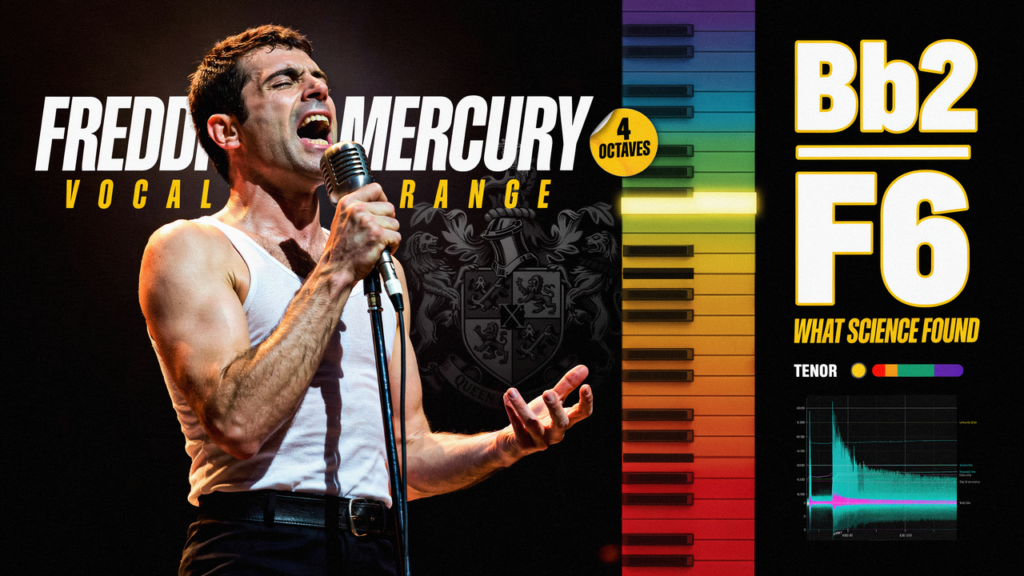
Freddie Mercury Vocal Range at a Glance
| Detail | Value |
|---|---|
| Full Documented Range | Bb2–F6 |
| Span | ~4 octaves |
| Voice Type | Lyric baritone (performed as dramatic tenor) |
| Lowest Note | Bb2 (116.5 Hz) |
| Highest Note | F6 (1,397 Hz) |
| Tessitura | B3–G5 |
| Known For | Vibrato, raw power, theatrical delivery, unique timbre |
What Voice Type Was Freddie Mercury?
This is one of the most debated questions in vocal analysis. Mercury is frequently labelled a tenor because of where he predominantly sang, but the scientific evidence points to a baritone as his natural voice type.
A 2016 study by researchers Herbst, Łukawska, Niemann, and Švec — published in Logopedics Phoniatrics Vocology — analysed Mercury’s recordings and speech samples. They concluded that his speaking voice sat in the baritone range, and that he had trained himself to sing consistently in the tenor register through a combination of technique and his distinctive vocal mechanism.
This is not unusual among male rock singers. Elvis Presley was a bass-baritone who sang as a baritone-tenor. Mick Jagger is a baritone who performs in the tenor range. Mercury’s case is notable because the gap between his speaking pitch and his performance tessitura was particularly wide.
In the vocal fach system, he would likely be classified as a dramatischer Bariton (dramatic baritone) with exceptional upward extension. His chest voice sat naturally in the baritone range (Bb2–E4), while his trained head voice and falsetto extended the range significantly higher.
What Made Freddie Mercury’s Voice Distinctive
The 2016 scientific study revealed two remarkable findings about his vocal technique:
Subharmonic vibrato. Mercury’s vibrato oscillated at approximately 5.4 Hz (cycles per second), compared to the typical trained singer’s 5.5 Hz. More unusually, the study found evidence of subharmonic components in his vibrato — meaning his vocal folds were producing frequencies below the fundamental note, creating a layered, complex sound that analysers struggle to fully model. This is exceptionally rare and may partly explain the “otherness” of his voice.
False vocal fold engagement. The research found evidence that Mercury engaged his false vocal folds (the ventricular folds above the true vocal cords) during singing. This technique, common in Mongolian throat singing and metal growl techniques, adds grit and harmonic complexity to the sound without straining the true vocal folds. It is the likely source of the rough, slightly raspy edge that distinguished his voice from polished pop tenors of the era.
Beyond the science: his theatrical delivery, dynamic range (from whispered intimacy to full stadium-filling power), and his instinct for vocal drama — building a phrase to a physical climax — were qualities that training cannot fully explain.
Songs That Showcase His Range
“Somebody to Love” (1976) — Possibly the best single document of his range and technique. The descending run from the opening phrase, the sustained G5s in the chorus, and the phrasing of the verse all show his complete vocal command.
“Bohemian Rhapsody” (1975) — Uses multiple voices across different registers, essentially building a vocal choir from his own overdubbed voice. The bass sections extend toward his lower register; the operatic passages push his upper range.
“Who Wants to Live Forever” (1986) — Shows his ability to carry an emotional arc with minimal vocal ornamentation. Pure tone, controlled vibrato, and phrasing that builds across the song’s structure.
“Don’t Stop Me Now” (1978) — Demonstrates speed and agility across his mid-range, with the playful personality that distinguished his live performances.
“The Show Must Go On” (1991) — Reportedly recorded while Mercury was severely ill with AIDS. The performance demonstrates his vocal control even at reduced physical capacity.
How His Range Compares
Mercury’s four-octave range places him well above the average professional singer. Compared to a typical baritone (A2–A4), his upper extension is extraordinary. Compared to a tenor (C3–C5), his lower extension is deeper.
Use the singer comparison tool to see how his range maps against other rock and pop legends. Check your own voice type with the voice type test or deep voice test.
Frequently Asked Questions
Was Freddie Mercury a tenor or baritone? Scientific analysis of his recordings suggests he was a baritone by natural voice type who trained himself to perform consistently in the tenor range. His speaking voice pitched in the baritone register, while his performance tessitura covered both baritone and tenor territory.
What was Freddie Mercury’s highest note? His highest documented note is F6 (1,397 Hz), based on analysis of archived recordings. This is in the soprano register and was produced using head voice technique.
What did the 2016 study find about Freddie Mercury’s voice? The 2016 study published in Logopedics Phoniatrics Vocology found evidence of: (1) a vibrato with subharmonic components, creating a uniquely layered sound; and (2) use of the false vocal folds during singing, adding grit and harmonic complexity. Both findings are rare in trained singers.
How many octaves could Freddie Mercury sing? Based on the 2016 scientific analysis, his documented range of Bb2–F6 spans approximately four octaves.
What is the vocal fach system? The vocal fach system is a classical German voice classification method that categorises singers by range, weight, timbre, and tessitura into precise subcategories. Mercury, in this system, would likely sit as a dramatic baritone or Heldenbariton.

John Mayer is a vocal analysis and music education writer specializing in vocal range testing, voice type analysis, pitch recognition, and singing improvement tools for singers, musicians, performers, and beginners. He creates practical content focused on vocal training, singing techniques, and voice analysis tools to help users better understand and improve their vocal abilities.