
Bruno Mars’s documented vocal range spans D3 to A5 — approximately three octaves — with a voice type classified as a lyric tenor. His natural tessitura (G4–E5) sits comfortably in classic soul-pop territory, and his voice quality — warm, bright, rhythmically agile — evokes the golden age of Motown and funk while delivering contemporary pop. What makes his range significant is not the span but the consistency and expressiveness he brings to every note within it.
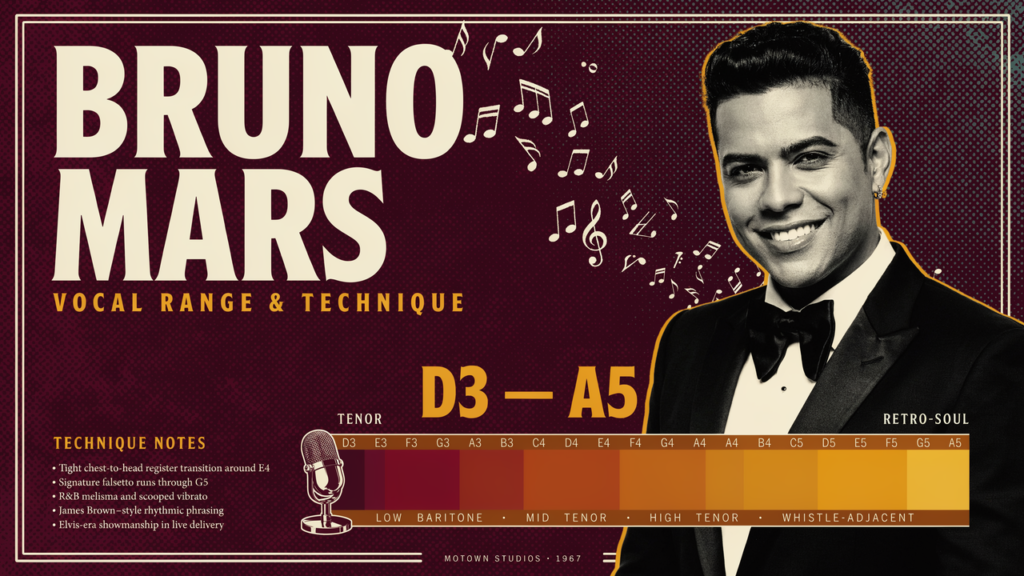
Bruno Mars Vocal Range at a Glance
| Detail | Value |
|---|---|
| Full Documented Range | D3–A5 |
| Span | ~3 octaves |
| Voice Type | Lyric tenor |
| Lowest Note | D3 (146.8 Hz) |
| Highest Note | A5 (880 Hz) |
| Tessitura | G4–E5 |
| Known For | Retro soul influence, falsetto, rhythmic precision |
What Voice Type Is Bruno Mars?
Bruno Mars is a lyric tenor — a lighter tenor with a naturally bright, agile quality and a higher tessitura than a dramatic tenor. His chest voice sits comfortably up to about E5, where it carries warmth and projection without strain, and his falsetto extends the range to A5 with a clean, integrated quality.
His lyric tenor sits in similar territory to Michael Jackson’s — both light tenors with expressive falsetto access. Mars’s chest voice is heavier and more grounded than Jackson’s, reflecting his gospel and soul influences, while his falsetto is similarly well-integrated into his performance style.
See the tenor vocal range guide for context on where lyric tenor sits within the male voice type system, and the vocal fach system for the full classical classification.
What Makes Bruno Mars’s Voice Distinctive
Soul vocabulary. His melismatic style draws directly from James Brown, Prince, and Stevie Wonder — short, rhythmically tight runs with emphasis on swing and groove rather than classical coloratura precision. The ornaments serve the rhythm, not just the melody.
Falsetto integration. His shift from chest to falsetto is seamless — evident in songs like “When I Was Your Man” where he moves between registers within a phrase. Use the falsetto test to check your own falsetto range.
Live consistency. His studio recordings and live performances are remarkably close in vocal quality — a mark of controlled, well-supported technique rather than heavy studio processing.
Key Songs That Showcase His Range
“Treasure” (2012) — Classic mid-range lyric tenor showcase in the G4–D5 zone with funk-influenced rhythmic delivery.
“When I Was Your Man” (2012) — Emotional ballad using his full range from D3 to E5, with falsetto appearing naturally at the top.
“24K Magic” (2016) — High-energy performance with consistent E4–G5 belting and tight rhythmic vocal placement.
“Versace on the Floor” (2016) — Slow soul ballad showing the warmth and control of his natural tessitura.
“Just the Way You Are” (2010) — Demonstrates his mid-range lyric quality in a restrained, melodic context.
How His Range Compares
A typical tenor spans C3–C5. Mars’s three octaves (D3–A5) extend well above that standard range, with his A5 falsetto placing him in mezzo-soprano territory. Compare his range against other artists with the singer comparison tool.
Test Your Voice
Check your lyric tenor potential with the voice type test or explore your upper register with the high voice test. The find my vocal range online tool maps your complete span in under 60 seconds.
Frequently Asked Questions
What is Bruno Mars’s vocal range? D3 to A5 — approximately three octaves.
What voice type is Bruno Mars? Lyric tenor — bright, agile, with a natural tessitura in the G4–E5 range.
Can Bruno Mars sing falsetto? Yes. His falsetto is well-developed and frequently deployed in both live and studio contexts, extending his range to A5.
Is 3 octaves a good vocal range? Yes — a three-octave range is excellent for a professional singer. See is a 3-octave range good for a full breakdown.
Who has a similar voice to Bruno Mars? Michael Jackson and Justin Timberlake share the lyric tenor classification with similar falsetto development. Stevie Wonder is a frequent stylistic comparison with a comparable voice type.

John Mayer is a vocal analysis and music education writer specializing in vocal range testing, voice type analysis, pitch recognition, and singing improvement tools for singers, musicians, performers, and beginners. He creates practical content focused on vocal training, singing techniques, and voice analysis tools to help users better understand and improve their vocal abilities.