
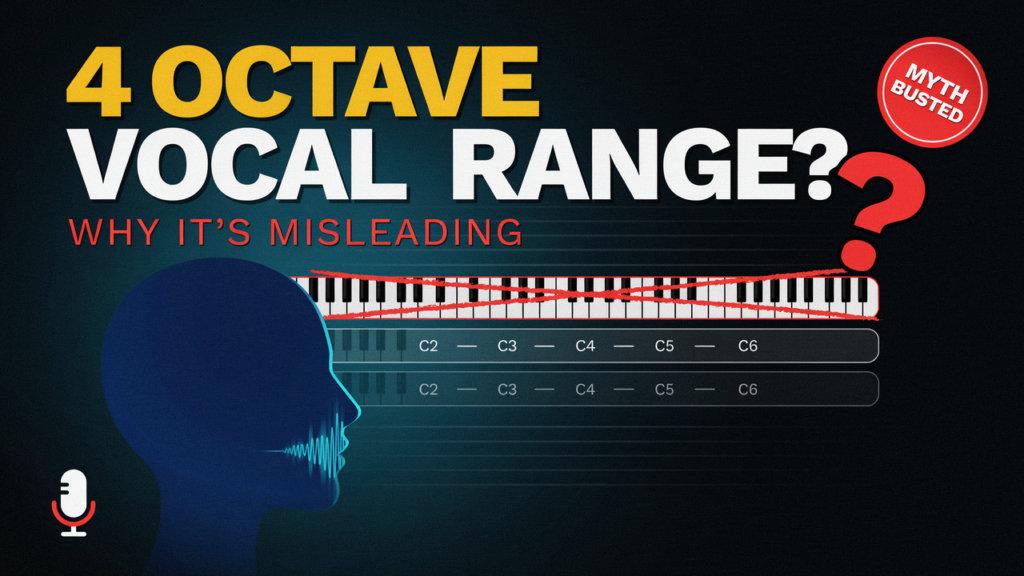
A 4 octave vocal range means a singer can produce notes spanning four full octaves (for example, C2–C6). While this is theoretically possible, it is extremely rare as a usable, healthy singing range. Most 4-octave claims rely on counting multiple vocal mechanisms (chest, head, falsetto, vocal fry) and non-sustained sounds. In practical singing, usable range and tessitura matter far more than octave count.
Why the idea of a 4 octave range is so popular
The number is impressive, simple, and easy to compare. Social media, talent shows, and celebrity marketing have turned octave counts into shorthand for “vocal greatness.” That creates three assumptions:
- Bigger range = better singer
- A 4 octave range is a realistic goal
- Anyone can train to get one
None of these assumptions hold up without context.
What a 4 octave vocal range actually means
An octave is the distance between two notes with the same name (C to C). A 4 octave range measures only the distance between the lowest and highest sounds a person can produce.
Examples:
- C2 to C6 = 4 octaves
- A1 to A5 = 4 octaves
That measurement says nothing about:
- Tone quality
- Control or consistency
- Endurance
- Musical usefulness
- Vocal health
It is a numerical span, not a performance standard.
Is a true 4 octave range possible?
Yes—but with major caveats.
Most singers who claim four octaves are counting:
- Chest voice at the bottom
- Mixed or head voice in the middle
- Falsetto above that
- Vocal fry or non-sustained sounds at the extreme low end
From a scientific standpoint, those sounds come from different vocal coordinations. From a musical standpoint, they are not equally usable.
A singer who can make noise across four octaves is not the same as a singer who can sing musically across four octaves.
Try this microphone-based vocal range tool to test your voice.
How rare is a usable 4 octave range?
Extremely rare.
- Many trained singers can touch 3 octaves at the extremes
- Fewer can sing 2.5 octaves with consistent tone and control
- A truly usable, sustainable 4 octave singing range is exceptional and uncommon even among professionals
Most music—across classical, pop, choir, and musical theatre—uses about 1.5 to 2 octaves per singer.
Range vs tessitura: the distinction most people miss
This is the most important concept in the entire discussion.
- Range = all the notes you can produce (including strained or special effects)
- Tessitura = where your voice works best most of the time
A singer with a smaller range but a well-centered tessitura will:
- Sound better
- Sing longer without fatigue
- Be cast more reliably
- Stay healthier over time
A large range outside your tessitura is impressive on paper—but costly in practice.
Why extreme octave counts are overrated
Chasing extreme range often leads to predictable problems:
- Pushing chest voice too high
- Forcing low notes past natural resonance
- Using fry or breathiness to “claim” notes
- Practicing extremes instead of fundamentals
This can cause:
- Chronic tension
- Loss of tone consistency
- Reduced endurance
- Increased injury risk
Professional singers optimize efficiency, not extremes.
Famous singers and 4 octave claims
You’ll often see lists of celebrities “with 4 or 5 octaves.” These claims typically:
- Count falsetto and fry as equal to modal singing
- Include notes never used in performance
- Ignore sustainability and tone
- Serve marketing, not pedagogy
This doesn’t mean those singers aren’t talented—it means octave counts are a poor metric for real singing ability.
Does a 4 octave range define voice type?
No. Absolutely not.
Voice type is determined by:
- Tessitura
- Timbre
- Passaggio placement
- Vocal weight
Not by how many octaves you can span.
Examples:
- A bass with a high falsetto is still a bass
- A soprano with strong low notes is still a soprano
- A baritone touching tenor notes doesn’t become a tenor
Range overlaps across all voice types.
Can you train to get a 4 octave range?
You can improve coordination—but you cannot override anatomy.
Training can:
- Smooth register transitions
- Improve breath efficiency
- Expand usable range slightly
- Reduce tension at the edges
Training cannot:
- Change vocal fold length or thickness
- Permanently relocate tessitura
- Turn extremes into effortless daily notes
If a wider range develops naturally with good technique, that’s fine. Training for the number is usually counterproductive.
What actually matters more than octave count
If your goal is to sing better, these matter far more:
- Consistent tone across your working range
- Reliable pitch and control
- Endurance over long rehearsals or performances
- Comfortable keys and repertoire choices
- Healthy technique over time
A singer who sounds excellent across two octaves will outperform a strained four-octave singer in every professional context.
A healthier way to think about your voice
Instead of asking:
“How many octaves do I have?”
Ask:
- Where does my voice feel strongest?
- Which notes can I sing repeatedly without fatigue?
- Where does my tone stay consistent?
- Which keys make music feel easy rather than forced?
Those answers describe your usable range—the range that actually matters.
Common myths (and the corrections)
Myth: “A 4 octave range means elite talent.”
→ Truth: Talent is defined by control and musicality, not span.
Myth: “Everyone should aim for 4 octaves.”
→ Truth: Most music doesn’t require anything close to that.
Myth: “If I don’t have 4 octaves, I’m limited.”
→ Truth: Many world-class singers work comfortably within two.
Final verdict
- A 4 octave vocal range measures distance, not quality
- Most claims rely on counting non-sustained sounds
- Usable range and tessitura matter far more
- Healthy singing prioritizes comfort, tone, and endurance
If your goal is strong, sustainable singing—not viral numbers—focus on how your voice functions, not how far it stretches.
- Many singers get a better baseline by comparing it with a three-octave range.
- Setting expectations becomes easier after checking a two-octave benchmark.
- Ambitious vocalists often wonder whether a three-octave goal already puts them ahead.
- Claims start to sound exaggerated when you look at six-octave examples.
- Technique matters more than numbers, which is why range-building methods are so valuable.
- Progress usually comes from consistent practice with targeted vocal drills.
- For wider context, this breakdown of a five-octave range shows how rare it really is.

John Mayer is a vocal analysis and music education writer specializing in vocal range testing, voice type analysis, pitch recognition, and singing improvement tools for singers, musicians, performers, and beginners. He creates practical content focused on vocal training, singing techniques, and voice analysis tools to help users better understand and improve their vocal abilities.