
Falsetto is a vocal register in which the vocal cords vibrate with minimal mutual contact — producing a lighter, breathier, higher-pitched sound than chest or head voice. The name comes from the Italian falso (false), historically reflecting the perception that it was an “artificial” extension of the natural male voice.
Today, falsetto is understood as a legitimate register used by both male and female singers across virtually every musical genre. It is the register that gives Marvin Gaye’s intimate soul ballads their vulnerability, Prince’s upper range its theatrical drama, and [Barry Gibb’s] disco vocals their soaring height.
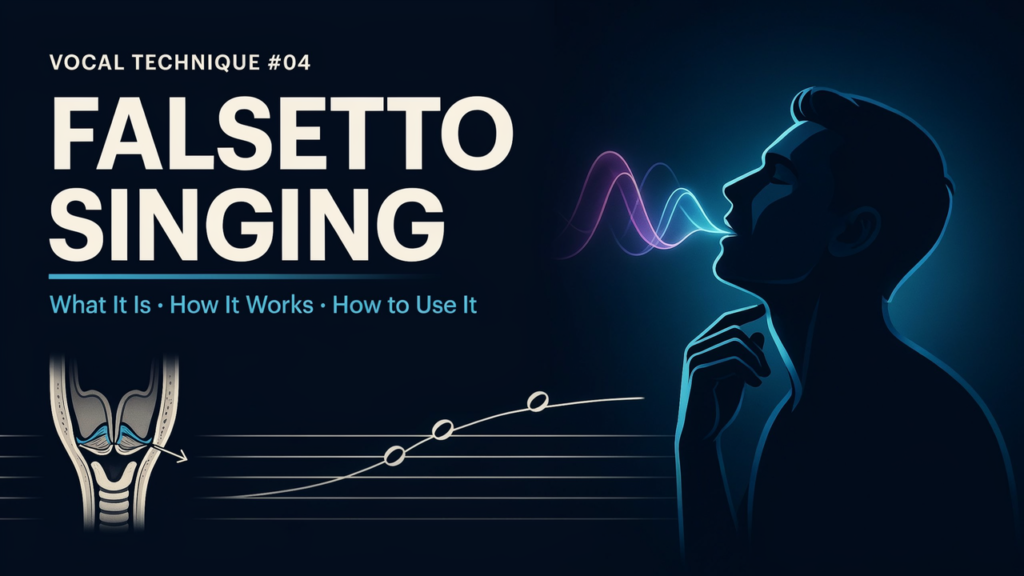
Falsetto at a Glance
| Feature | Detail |
|---|---|
| Register type | Light upper register — between head voice and whistle |
| Cord contact | Minimal or absent |
| Sound quality | Breathy, light, airy, ethereal |
| Volume | Lower than head voice at equivalent pitch |
| Projection | Limited — does not carry well acoustically |
| Used by | Male and female singers across all genres |
| Typical male range | Above D4 (293.7 Hz) |
| Typical female range | Above G5 (784 Hz) — often described as “light head voice” |
| Famous examples | Marvin Gaye, Prince, Michael Jackson, Barry Gibb, Sam Smith |
What Is Falsetto? The Physiology
What Happens in the Larynx
In normal chest voice, the vocal cords close completely during each vibration cycle, building up sub-glottal air pressure before releasing. In head voice, they close partially but consistently. In falsetto, the cords are stretched thin and barely make contact — or make no contact at all — producing what voice scientists call an incomplete glottal closure pattern.
Specifically:
- The thyroarytenoid (TA) muscles are largely inactive — not shortening and thickening the cords as in chest voice
- The cricothyroid (CT) muscles are dominant — stretching the cords lengthwise to their maximum
- The cords vibrate only along their edges rather than across their full width
- The incomplete closure allows air to leak through continuously, creating the characteristic breathiness
This mechanism allows the cords to vibrate at much higher frequencies than chest voice — but with significantly less amplitude, less resonance, and less power.
Why Falsetto Sounds Different From Head Voice
Both falsetto and head voice produce upper-range notes. The difference is in cord closure:
| Head Voice | Falsetto | |
|---|---|---|
| Cord closure | Partial but consistent contact | Minimal or no contact |
| Air leakage | Low | High (produces breathiness) |
| Sound quality | Resonant, full, projectible | Breathy, light, airy |
| Volume potential | High | Low |
| Vibrato | Natural, sustainable | Difficult to produce freely |
| Classical use | Primary upper register | Rarely used in formal classical singing |
| Pop/R&B use | Belted high notes | Intimate, expressive passages |
The clearest practical test: try to increase your volume dramatically on a high note. If you can get significantly louder while maintaining the same quality, you are in head voice. If the sound gets thinner or breaks under pressure, you are in falsetto. Use the falsetto test for an automated analysis, or the head voice test to identify your upper register.
Male vs Female Falsetto
Male Falsetto
In male singers, the distinction between chest voice and falsetto is pronounced and dramatic. The male chest voice typically ends around D4–F4 (293–349 Hz), and above this point the voice either cracks, transitions to mixed voice, or flips into falsetto. Male falsetto produces a distinctly different — noticeably lighter, more feminine-sounding — quality that is immediately audible.
This dramatic contrast has been used expressively in music for centuries:
- The sudden flip from chest to falsetto creates a vulnerability effect — the voice “breaks” in an emotionally expressive way
- Sustained male falsetto in the mezzo-soprano range creates an ethereal, otherworldly quality prized in soul and R&B
- The ability to control the chest-to-falsetto transition (rather than allowing it to happen involuntarily) is a mark of trained male vocal technique
Female Falsetto
Female singers have a smaller physiological gap between their chest voice and head voice, making the falsetto transition less dramatic and less easily identified. What female singers call “falsetto” is typically the very lightest portion of their upper range — above the main head voice ceiling — where breath flow increases and cord contact minimises.
In practice, most female “falsetto” references in contemporary music describe a deliberately breathy, soft upper register quality rather than a physiologically distinct register. The difference between a mezzo-soprano’s head voice and her “falsetto” is one of degree rather than mechanism.
Famous Falsetto Singers: How They Use It
Marvin Gaye — Falsetto as Emotional Language
Marvin Gaye’s falsetto is the most studied in soul music. He used it not as a high-note extension but as a primary expressive register — choosing falsetto for passages of vulnerability, intimacy, and emotional surrender even when chest voice was available. His G5 falsetto in “Let’s Get It On” is warm, breathy, and deliberately not projected — the sonic equivalent of a whisper into someone’s ear.
Voice type: Lyric tenor Falsetto range: Approximately D5–G5 (587–784 Hz) Characteristic quality: Warm, breathy, intimate
Prince — Falsetto as Theatre
Prince’s falsetto was theatrical and deliberately dramatic. He would shift into falsetto not for intimacy but for heightened emphasis — ascending into it at moments of maximum emotional intensity. His falsetto in “Kiss” (1986) is the defining example: dry, rhythmically precise, almost taunting.
Voice type: Lyric tenor Falsetto range: Approximately C5–A5 (523–880 Hz) Characteristic quality: Dry, precise, theatrical
Michael Jackson — Falsetto as Percussive Tool
Michael Jackson’s use of falsetto went beyond melody into rhythm. He deployed falsetto phonemes — “hee,” the glottal stops, the “woo” exclamations — as percussive rhythmic elements within songs. His falsetto was integrated so smoothly into his performance that transitions were often imperceptible.
Voice type: Lyric tenor Falsetto range: Approximately E5–F6 (659–1,397 Hz) Characteristic quality: Smooth, seamless, rhythmically integrated
Barry Gibb (Bee Gees) — Falsetto as Primary Voice
Barry Gibb took the approach of using falsetto as his main performing register in the Bee Gees’ disco era. Songs like “Stayin’ Alive” and “How Deep Is Your Love” have entire vocal melodies in falsetto. This is the closest a contemporary pop artist came to the countertenor tradition without being a trained classical singer.
Voice type: Baritone performing in falsetto Falsetto range: Approximately Bb4–G5 (466–784 Hz) Characteristic quality: Sustained, vocal, melody-focused
Sam Smith — Modern Soul Falsetto
Sam Smith’s vocal identity is built around a mezzo-range falsetto — sitting in the alto zone (A3–D5) with a warm, breathy quality drawn directly from the Marvin Gaye tradition. Their voice transitions fluidly between a chest voice and falsetto, often using the transition itself as a dynamic tool.
Voice type: Mezzo (non-binary identified) Falsetto range: Approximately B4–E5 (493–659 Hz) Characteristic quality: Emotional, warm, Gaye-influenced
Falsetto in Different Musical Genres
| Genre | Falsetto Role | Typical Use |
|---|---|---|
| Soul / R&B | Primary emotional register | Sustained passages, vulnerable moments |
| Disco | Primary melody register | Entire vocal lines in falsetto |
| Pop | Occasional effect or high note | Specific notes above chest range |
| Gospel | Rare — prefers chest voice power | Occasional decorative effect |
| Rock | Occasional dramatic effect | High sustained notes, theatrical moments |
| Baroque/Classical | Countertenor voice type | Entire performance register (trained) |
| Country | Rare | Occasional yodelling-related effect |
How to Develop and Improve Your Falsetto
Step 1: Access Your Falsetto
If you haven’t consciously used falsetto before:
- Say “who?” in a light, high-pitched voice — as if surprised
- Let your voice flip up naturally to a lighter register
- Sustain that lighter quality on a held “oo” vowel
- That is your falsetto — even if it feels thin or weak initially
Step 2: Strengthen the Cord Closure
Weak falsetto (very breathy, almost no tone) benefits from exercises that increase cord closure without adding tension:
- Try a light “hoo” with a slight staccato beginning — the brief onset encourages some cord contact
- Practice sustained notes with gentle dynamic swells — slightly louder, then softer — to develop control
- Descend from your upper falsetto into the passaggio zone to develop the lower end of the register
Step 3: Blend Falsetto with Head Voice
The most musically useful development: the ability to move between falsetto (breathy) and head voice (resonant) at will:
- Sing a sustained falsetto note
- Gradually add cord closure — imagine “focusing” the sound
- The note becomes less breathy and more resonant — this is the transition from falsetto toward head voice
- Practice moving back and forth along this spectrum on single notes
Step 4: Apply Falsetto Musically
Practice moving in and out of falsetto within melodic phrases. Choose songs known for falsetto use (Marvin Gaye’s “Let’s Get It On,” Prince’s “Kiss,” Bee Gees’ “Stayin’ Alive”) and study how the falsetto is deployed rhythmically and emotionally — not just technically.
The vocal warm-up generator includes falsetto development exercises. Test your current falsetto range with the falsetto test and compare it to your full range via find my vocal range online.
Falsetto and Vocal Health
Falsetto production, when done correctly, is gentle on the vocal cords — less demanding than heavy chest voice belting because the cord contact is minimal. This is why:
- Falsetto can be an excellent vocal recovery exercise after strain — the cords are working but with minimal collision force
- Voice teachers sometimes use falsetto exercises to release laryngeal tension before working on more demanding chest voice or mixed voice repertoire
- The vocal warm-up generator includes falsetto in warm-up sequences partly for this reason
Risks of improper falsetto:
- Straining to reach notes well above your comfortable falsetto ceiling — the same risk as pushing any register
- Using a very pressed, tense falsetto (rather than the relaxed, incomplete-closure quality it should have)
- Performing extended passages in falsetto with significant breath pressure — this can fatigue the cords despite the lighter contact
For complete vocal health guidance, see vocal health tips.
Frequently Asked Questions
What is falsetto in singing? Falsetto is a vocal register produced when the vocal cords are stretched thin and vibrate with minimal mutual contact. It creates a lighter, breathier, higher-pitched sound than chest or head voice and is used by both male and female singers for expressive and technical purposes.
Is falsetto the same as head voice? No. Head voice has more consistent cord contact, producing a more resonant, projectible sound. Falsetto has minimal cord contact, producing a breathy, lighter quality. The same pitch can be produced in either register with distinctly different results. See head voice vs chest voice for the full comparison.
Is falsetto bad for your voice? Healthy falsetto — produced with a relaxed larynx and light cord contact — is not harmful. The risk comes from straining to reach notes above your comfortable range or producing falsetto with excessive tension. Used correctly, falsetto is one of the gentler registers on the vocal cords.
Can females sing in falsetto? Yes, though the distinction is less dramatic than in male voices because females have a smaller gap between their chest and head registers. Female “falsetto” typically refers to the lightest, most breathy portion of the upper range above the main head voice.
How do I know if I’m singing in falsetto or head voice? Try to increase your volume significantly. If the note gets louder with full resonance, you are in head voice. If it gets thinner or breaks under pressure, you are in falsetto. Falsetto also feels more “effortless but thin”; head voice feels “supported and full.” The falsetto test and head voice test provide automated analysis.
Who has the most impressive falsetto in pop music? Marvin Gaye is most cited for musical sophistication of falsetto use. Prince for range and theatrical impact. Barry Gibb for sustained commercial use. Michael Jackson for integration and percussive creativity. Each represents a different approach to the same register.

John Mayer is a vocal analysis and music education writer specializing in vocal range testing, voice type analysis, pitch recognition, and singing improvement tools for singers, musicians, performers, and beginners. He creates practical content focused on vocal training, singing techniques, and voice analysis tools to help users better understand and improve their vocal abilities.