
A vocal register is a distinct mode of vocal production in which the vocal cords vibrate in a specific pattern, creating a characteristic sound quality across a defined pitch range.
Most singers have access to four registers: chest voice, mixed voice, head voice, and the whistle register (flageolet). Some voice scientists also recognise a fifth sub-modal register called vocal fry (creak). Understanding each register — where it begins, what it sounds like, and how to use it — is the foundation of complete vocal technique.
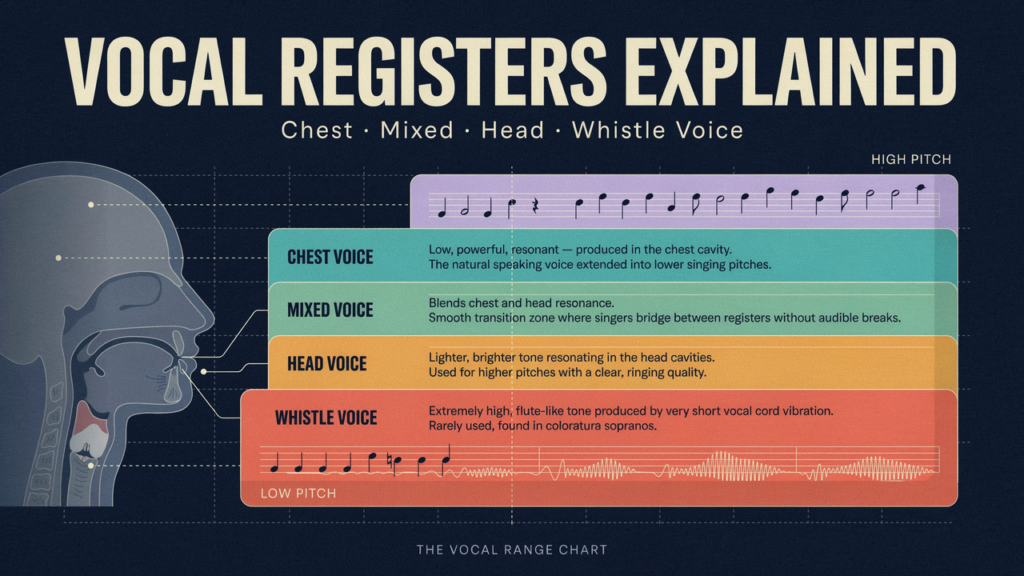
The Four Main Vocal Registers at a Glance
| Register | Also Called | Pitch Range (Female) | Pitch Range (Male) | Hz Range (Female) | Sound Quality |
|---|---|---|---|---|---|
| Chest voice | Modal register | Below F5 | Below D4 | Below 698 Hz | Warm, full, powerful, speech-like |
| Mixed voice | Middle voice, belt | E4–G5 | D3–G4 | 329–784 Hz | Blend of chest + head resonance |
| Head voice | Upper register | F5–E6 | E4–C5 | 698–1,319 Hz | Bright, clear, focused, classical |
| Whistle register | Flageolet register | Above E6 | Extremely rare | Above 1,319 Hz | Thin, pure, flute-like |
Register 1: Chest Voice (Modal Register)
What It Is
Chest voice is the primary register — the one you use for all speech and the lower portion of your singing range. It is called “chest voice” because vibrations can be physically felt in the chest cavity during production.
The Physiology
In chest voice, the thyroarytenoid (TA) muscles are dominant. These muscles shorten and thicken the vocal cords, creating a heavier vibrating mass. The cords close completely during each vibration cycle, building up air pressure and then releasing in a full-closure pattern that creates maximum resonance.
Sound and Feel
Rich, warm, full, physically present. The lowest notes in your chest voice feel grounded and effortless. As you ascend toward the passaggio, chest voice begins to feel increasingly heavy and eventually strained.
Range Context
- Lowest note: Your absolute lowest comfortable pitch — identified by the deep voice test
- Upper limit: The primo passaggio — where chest voice begins to strain. See the full head voice vs chest voice guide for passaggio positions by voice type
Famous Chest Voice Moments
- Whitney Houston — C6 in “I Will Always Love You”: chest-dominant spinto soprano
- Beyoncé — “Love on Top” final modulations: chest-dominant belt through G5
- Elvis Presley — G1 low notes: bass-baritone chest voice depth
Register 2: Mixed Voice
What It Is
Mixed voice is not a fully separate register but a coordination of both chest and head resonance simultaneously. As a singer ascends through the passaggio zone, a well-trained voice blends the two resonance sources proportionally — maintaining chest warmth and power while introducing head resonance to ease the higher pitch production.
The Physiology
In mixed voice, both the thyroarytenoid (TA) and cricothyroid (CT) muscles are active simultaneously. The TA muscles provide chest weight and closure; the CT muscles provide the lengthening stretch for higher pitches. The balance between them shifts continuously as pitch changes — more TA in chest-dominant mix, more CT in head-dominant mix.
Two Types of Mixed Voice
Chest-dominant mix (belt): More TA than CT activation. Sounds powerful, loud, and chest-resonant — but is NOT pure chest voice above the passaggio (which would cause strain). The “belt” sound heard from Broadway vocalists and pop singers is this chest-dominant mix. Adele and [Kelly Clarkson] produce this in their upper range.
Head-dominant mix: More CT than TA activation. Sounds round, warm, and resonant — but with more brightness than pure chest voice and more power than pure head voice. Classical mezzos and tenors in their passaggio zone use this. Celine Dion operates here extensively in the F4–C5 zone.
Range Context
Mixed voice typically spans the passaggio zone and extends above it — the range where neither pure chest nor pure head voice is optimal. See mixed voice singing for the complete development guide.
Register 3: Head Voice
What It Is
Head voice is the upper register, produced when the cricothyroid (CT) muscles are dominant. The vocal cords are stretched thin, vibrating with partial rather than full contact, and the primary resonance shifts upward into the skull, sinuses, and facial cavities.
The Physiology
In head voice, the vocal cords are elongated and thinned by CT muscle dominance. They vibrate with the edges touching but the bulk of the cord held apart — an incomplete closure pattern that creates the brighter, lighter quality of the head register. This is physiologically distinct from falsetto (where cords barely touch at all) — head voice maintains cord contact and therefore projects much better.
Head Voice vs Falsetto: The Critical Distinction
| Head Voice | Falsetto | |
|---|---|---|
| Cord contact | Partial, consistent | Minimal or absent |
| Sound quality | Resonant, projectible | Breathy, thin |
| Volume | Can be loud | Difficult to project |
| Feel | Full, supported | Effortless but airy |
| Classical context | Primary upper register | Rarely used |
See falsetto singing and the head voice test for detailed comparison and identification.
Famous Head Voice Moments
- Ariana Grande — G5 live belting: head-dominant mix into head voice
- Celine Dion — G6 in “The Power of Love”: soprano head voice
- [Josh Groban] — F5 in “You Raise Me Up”: tenor head voice with classical quality
Register 4: Whistle Register (Flageolet Register)
What It Is
The whistle register is the highest of the four registers, producing notes above approximately E6 (1,319 Hz) in female voices. It is named for the thin, pure, flute-like quality of the sound rather than any actual whistling mechanism.
The Physiology
In the whistle register, the vibration pattern of the vocal cords changes fundamentally. Rather than the full or partial closure of lower registers, only the posterior (back) edges of the cords vibrate — the anterior portions are held rigid. This creates a very high frequency with minimal overtone complexity, producing the thin, clear, almost pure-tone quality of whistle notes.
This mechanism is physiologically distinct from head voice and falsetto. It is also not accessible to all singers regardless of training — the specific laryngeal geometry required is physiologically determined.
Who Has the Whistle Register?
| Artist | Highest Documented Whistle Note | Hz |
|---|---|---|
| Mariah Carey | G#7 | 3,322 Hz |
| Ariana Grande | E7 | 2,637 Hz |
| Minnie Riperton | G7 | 3,136 Hz |
| Adam Lopez (world record) | C#8 | 14,640 Hz |
The whistle register guide covers the complete physiology, how to access it, and the famous singers who use it. The highest note ever sung documents the world records.
Register 5: Vocal Fry (Sub-Modal Register)
What It Is
Vocal fry — also called creak, glottal fry, or pulse register — is the lowest sub-modal register, producing a crackling, popping sound at the very bottom of the voice. It occurs below the normal chest voice range when the vocal cords are extremely slack and vibrate irregularly at very low frequency (20–70 Hz).
The Physiology
In vocal fry, the vocal cords are so relaxed and loosely approximated that they vibrate in an irregular, asymmetric pattern. Rather than the clean, periodic vibration of chest voice, fry produces a chaotic pattern of closures that creates the characteristic crackle.
Musical and Stylistic Use
- Deliberate stylistic effect in some contemporary pop and R&B (notably in female pop singers)
- Occasional low bass extension below the normal chest voice floor
- Used by some singers (including Elvis Presley on certain low notes) for character and colour
- Billie Eilish uses subtle vocal fry as part of her signature breathy style
The Complete Register Spectrum: From Fry to Whistle
The following shows how registers connect across the full human vocal range:
| Register | Female Pitch Zone | Male Pitch Zone | Hz (approx.) |
|---|---|---|---|
| Vocal fry | Below D3 | Below Bb1 | Below 147 Hz |
| Chest voice | D3–E5 | A1–D4 | 147–659 Hz |
| Mixed voice | E4–G5 | D3–G4 | 329–784 Hz |
| Head voice | F5–E6 | E4–C5 | 698–1,319 Hz |
| Whistle register | Above E6 | Extremely rare | Above 1,319 Hz |
Note: ranges overlap because the transitions (passaggi) are gradual, and different voice types enter each register at different pitches. See the vocal range Hz guide for the complete frequency reference.
Developing All Four Registers
Chest Voice Development
Sustained notes in the lower-to-mid range with strong breath support. Avoid straining upward — work the notes that feel comfortable and gradually push the upper limit through supported practice.
Mixed Voice Development
Lip trills and “ng” slides through the passaggio zone. Start in chest voice and ascend slowly, allowing the voice to blend naturally rather than forcing a flip. See the mixed voice singing guide.
Head Voice Development
Start at the top of your comfortable range in a light, easy quality and work downward — maintaining the lighter head resonance as you descend toward the passaggio. This builds strength in the head register without pushing from below.
Whistle Register Development (If Accessible)
Extremely gentle exploration above your head voice ceiling on “ee” or “wee” sounds. Do not push or strain — the whistle register either emerges or it does not. Forcing notes above your range ceiling risks vocal strain.
The vocal warm-up generator creates exercises targeted at each register based on your voice type and current range. The find my vocal range online tool maps your complete span across all accessible registers.
Frequently Asked Questions
How many vocal registers are there? Voice science most commonly recognises four primary registers: chest (modal), mixed (middle/belt), head, and whistle (flageolet). Some researchers also count vocal fry (creak) as a fifth, sub-modal register.
Is falsetto a register? Falsetto is sometimes listed as a separate register between mixed and head voice. In modern voice science, it is more accurately described as a production mode within the upper register — lighter and breathier than true head voice, with less cord contact. See falsetto singing.
Why do my registers sound disconnected? Register disconnection — the audible gap or crack between chest and head voice — is caused by an underdeveloped mixed voice (the bridge between them). Developing your mix through passaggio exercises will connect the registers. See vocal breaks explained.
Can everyone access all four registers? Chest voice, mixed voice, and head voice are accessible to virtually all singers with training. The whistle register requires specific physiological characteristics and is not accessible to the majority of singers regardless of training duration.
What register should I be singing in for pop music? Contemporary pop uses all registers depending on the section. Verses typically sit in chest voice or chest-dominant mix. Chorus hooks are often in chest-dominant mix (belt) or head-dominant mix. Specific high notes or emotional peaks may use head voice. Very few pop songs require the whistle register — it appears mainly as a stylistic effect.

John Mayer is a vocal analysis and music education writer specializing in vocal range testing, voice type analysis, pitch recognition, and singing improvement tools for singers, musicians, performers, and beginners. He creates practical content focused on vocal training, singing techniques, and voice analysis tools to help users better understand and improve their vocal abilities.